
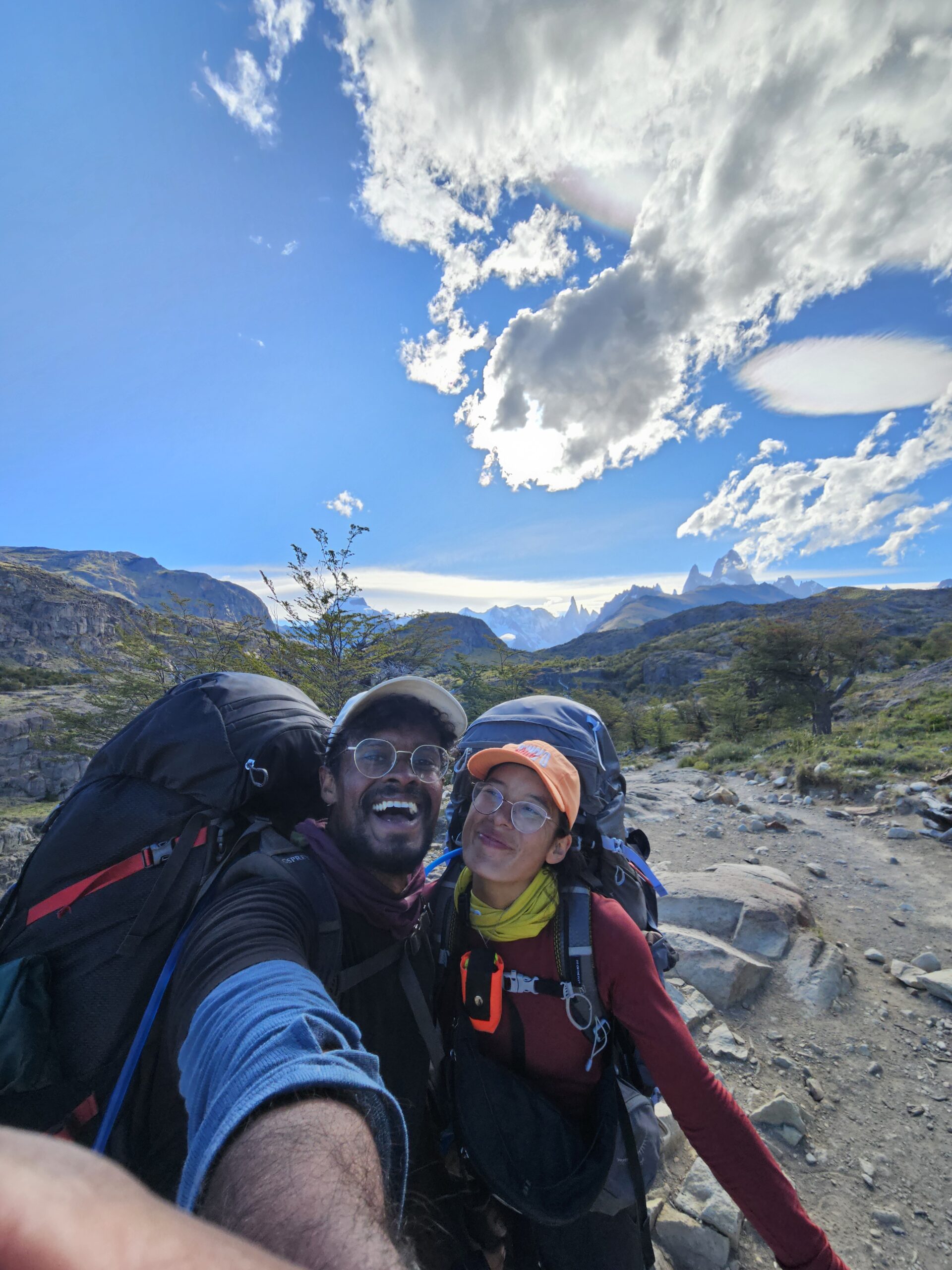
Logistically, this part of our journey was not well planned. As Worldwide Walkies, you can guess why we were in Chile in the first place – for Patagonia, and its wealth of trekking destinations. We wanted to do the whole honky – south as south goes, the big treks with big names, and anything we could fit in between. We knew it would be expensive – but just how expensive? We didn’t get to that level of detail, and we ended up with a number of shocks to our system (and the budget spreadsheet)!
You can definitely complete Patagonia on the cheap, don’t get us wrong. There are always options to cook in your hostel, to avoid the expensive tours, or to walk everywhere you conceivably can. However, there are three things which really contribute to a full ‘Patagonia Tour’ being very expensive, despite being in countries which are traditionally considered cheap.
Distances, Weather and Isolation
The Patagonia region is nearly 2 million km^2 of the world’s southernmost countries. Most of the places that offer the best hiking (and therefore receive all the tourism) are along the spine of the Andes, which are a substantial roadblock in any easy travel. The western side is peppered with fjords and mountains that are beautiful but basically uninhabitable. Most of the civilisation on the Chilean side lies along a single, dead-end road which traverses 1240km of Chilean Patagonia from Puerto Montt to Villa O’Higgins. This is the Carretera Austral. There are a few crossover points from the Carretera Austral into Argentina, but it is an extremely isolated route – and half of it isn’t even paved!
The eastern side of the Andes slowly flattens out into an arid plain that alpine grass and nothing else grows on. Roads (and ferries) do connect the southernmost point of Argentinian Patagonia to the northernmost, but the next consideration is the weather. Ruta 40 runs adjacent to the Andes and connects up the popular tourist towns of El Calafate and Bariloche, but the road is not passable in the winter, and can be questionable in the shoulder seasons. For the perspective of our kiwi readers: Stewart Island ends at about halfway down the Carretera Austral, and it’s another 900km South to Puerto Williams. That’s pretty far south.
So we have – towns that are connected by one road; roads that close in the wintertime; sub-Antarctic weather patterns all year around – which all in all, smells like true isolation. That’s part of the beauty of Patagonia – a real sense of being far, far away from anything else. Sure, there is still normal infrastructure in the towns, but just out of them, you can get a sense for how wild the countryside really is. That beauty just comes at a cost – and the costs are your groceries, which can be up to double the price that you’ll find in the northern regions of both Chile & Argentina.
National Park and Camping Fees
In Aotearoa, you pay for huts and the occasional campsite – and nothing else. Paying to enter a national park is a concept that was entirely foreign to us, although we have since heard it is common in many parts of the world. It seems like every National Park across Chile & Argentina have fees to enter, ranging from 10USD to 50USD – and it varies to pay by entry, and to pay by day. What really caught us out is that the fees in Argentina were introduced at the start of the 2024-2025 summer season and without warning – so just before we started travelling, but well after we’d done all of our research. For this very reason, we did not visit Tierra del Fuego National Park in Ushuaia.
Camping in Patagonia is also not always cheap. We paid, at maximum, 40USD per night per person in the O-Circuit in Chile – sure, this was in a campground with running water and hot showers, which was a pleasant surprise, but still a hell of a price to sleep in your own tent! In Los Glaciares in Argentina, campgrounds wanted to charge 15USD per night plus $45USD per day to enter, with the absolute bare minimum of facilities (long drop & no campers shelter). It seems crazy to us that we could be so self-sufficient and still be charged so much money!
The Cheap Countries are No Longer Cheap
Chile’s economy has been stable and strong for some time, so prices steadily increase over time as tourism and infrastructure develop. To be honest, the work of CONAF in a place like Torres del Paine felt genuine and really positive; despite the heinous amounts of tourists, we thought that the rangers were honest hard-workers who care about the diversity and conservation efforts in the park.
The major spanner in the works is Argentina. In 2022, people were travelling to Argentina and living like Kings and Queens. Argentina was renowned for its “Blue Dollar Rate” – an unofficial exchange rate (although, sanctioned by Western Union) of USD into ARG which could (at one point) double your pretty money. In 2024, inflation was 200% – the stability of the dollar compared to the chaos of the peso drove the blue dollar rate. However, the more recent political party has stabilised the inflating economy, which has resulted in the Blue Dollar Rate closing into the official rate – using Western Union still gives a better rate than the official, but only by about 10%. It also means that the cost of goods has increased dramatically, all over Argentina but felt even more strongly in Patagonia, where as above, distance and isolation further drives up the costs of goods. Talking to Argentinians living in Patagonia was rough – the wages of the local people haven’t increased with the record inflation, so the cost of living for the locals is sky-high.
Tell me everything:
What we did:
As per our previous blog posts, before descending into Patagonia we thought we would take a break and enjoy the north of Chile. This meant we’d been through Santiago de Chile, Pucon, Valdivia, visited Chiloe before flying out of Puerto Montt. If we hadn’t had the O-Circuit booked in our third week of travel, or maybe if we’d just thought a little harder, we would’ve decided to do a more efficient South > North route (or vice versa).
Our route, briefly, was as so – including the key trekking points:
Puerto Montt > Puerto Natales (plane) – Torres del Paine NP & the O-Circuit
Puerto Natales > Punta Arenas (bus)
Punta Arenas > Puerto Williams (plane) – the Dientes de Navarino
Puerto Williams > Ushuaia (ferry) – Tierra del Fuego NP & other hiking in the surrounds
Ushuaia > El Calafate (plane) – Perito Moreno Glacier in theory, but it was too expensive for us
El Calafate > El Chalten (bus, return) – Los Glaciares NP
El Chalten > Bariloche (plane) – Nahuel Huapei NP & other hiking in surrounds
Bariloche > Puerto Varas (bus) – to collect our gear!
That’s four flights, and a whole lot of doubling back and forth on ourselves. Looking at how to travel through Patagonia is confusing – there are buses, but some aren’t direct, or your sequence of stops is important to ensure you can bus from place to place. To top that off, some of the buses (looking @ El Calafate > Bariloche) can be far more expensive than flying – we booked our plane ticket 4 weeks in advance and saved around 100USD (with checked baggage!).
One thing that we do regret is flying from Punta Arenas to Puerto Williams. Apparently, the ferry is beautiful – 30 hours on a boat, but you’ll sail through the fjords of Patagonia, seeing wildlife and glaciers for the whole time. Apparently it is also very common to get all the seasons in one day 🙂 So if you’re travelling and you’ve got the time, we would definitely advise the ferry over the plane. For us, the decision was made because flight was slightly cheaper, but we definitely think that the ferry sounded worth it.
In hindsight, we have two routes we’d advise depending on whether you start in Argentina or Chile, minimising your time on the bus or the need to catch so many flights!
From Argentina:
Buenos Aires > Ushuaia (plane)
Ushuaia > Puerto Williams (ferry)
Puerto Williams > Punta Arenas (ferry)
Punta Arenas > Puerto Natales (bus)
Puerto Natales > El Calafate (bus)
El Calafate > El Chalten (bus, return)
El Calafate > Bariloche (bus)
From Chile:
Santiago > Punta Arenas (plane)
Punta Arenas > Puerto Williams (ferry)
Puerto Williams > Ushuaia (ferry)
Ushuaia > Punta Arenas (bus, which will get on a ferry!)
Punta Arenas > Puerto Natales (bus)
Puerto Natales > El Calafate (bus)
El Calafate > El Chalten (bus, return)
El Calafate > Bariloche (bus)
| Argentina | Chile |
| Buenos Aires > Ushuaia (plane) | Santiago > Punta Arenas (plane) |
| Ushuaia > Puerto Williams (ferry) | Punta Arenas > Puerto Williams (ferry) |
| Puerto Williams > Punta Arenas (ferry) | Puerto Williams > Ushuaia (ferry) |
| Punta Arenas > Puerto Natales (bus) | Ushuaia > Punta Arenas (bus, which will get on a ferry!) |
| Puerto Natales > El Calafate (bus) | Punta Arenas > Puerto Natales (bus) |
| El Calafate > El Chalten (bus, return) | Puerto Natales > El Calafate (bus) |
| El Calafate > Bariloche (bus) | El Calafate > El Chalten (bus, return) |
| El Calafate > Bariloche (bus) |
And if you want to do everything at once – instead of returning to El Calafate and continuing onto Bariloche, you can cross back into Chile from El Calafate and hitch-hike or bus up the Carretera Austral! Buses are available in some sections, but we’ve heard that in particular the southern section is very quiet, so you’ll need to be happy to chill out and spend some time waiting for a mate:
El Chalten > Villa O’Higgins (bus, ferry, hike/bike – this crossing sounds awesome, albeit a little complex. There are pletny of blogs out there with detailed descriptions, and we met lots of people who did it, it sounds amazing!)
Villa O’Higgins > Puerto Montt (hitch, bus)
Puerto Montt > Puerto Varas (bus)
We believe that both Puerto Varas and Bariloche are worthwhile destinations, of the lake districts of Chile and Argentina. There’s a lot to do in the Lakes Districts of both countries – we’ll cover the details (and the details of each of the different locations) in different posts!
Also just a random aside – the Andes are renowned for being high altitude – the highest capital, the highest lake, etc. However, the Andes in Patagonia are not high altitude. The maximum point above sea level would only be around 2000m. That doesn’t mean you don’t do lots of elevation when you’re hiking – just that your starting elevation won’t be adding in an extra factor of difficulty!