
From Humahuaca, we caught the night bus to La Quiaca, which is the border town in Argentina to Bolivia. The night bus arrived at about 7am in La Quiaca, which is when the border opens. We walked around 15 minutes through La Quiaca to the border, as there were two of us and it didn’t feel particularly unsafe (contrary to many things that we’d read online). What happened next… was the quickest border crossing we’ve ever done. There was nobody else approaching the border from the Argentinian side, so we were stamped into no-mans-land within a minute. Then we crossed the bridge toward the Bolivian side only to see a line of people waiting outside – as Bolivia is an hour behind Argentina, the office wasn’t open yet! But when we asked one of the security guards what to do, he encouraged us to just pop our heads in – when we did, a bored-looking officer took our passports and disappeared for another minute, came back with our Bolivian immigration slip (DO NOT LOSE) and waved us on our way to Villazon. The line waiting outside the Bolivian immigration office was to exit Bolivia.
Click here to take yourself to short and sweet where we summarize this blog post.
Tell Me Everything:
Overall the border crossing genuinely took about five minutes – and we ‘gained’ an hour of time, just crossing the border. We also found that the exchange houses at the border actually offered a reasonable rate – or, perhaps that with the Blue Dollar rate the difference was not going to bother us. However, we did get played for buying the first SIM card we found – 50 bolivianos for the SIM itself! When we bought a second in Tupiza, it was only 20BOB. But with our access to the internet restored, we walked to the bus terminal – again, the town felt safe and we were comfortable to walk rather than take a taxi, and it took about 30 minutes.
From the Villazon you have a few options for a direct bus, depending on what you want to do.
- Tupiza, 4 hours: we took the bus directly here, to settle into Bolivian travel and then start our tour of the Salt Flats. However, by heading immediately west, we missed out on…
- Tarija, 8 hours: we learned afterwards about this stunning town at moderate altitude in Bolivia. Tarija has plenty of swimming spots and beautiful architecture to occupy you inside and around the town. Besides, it is part of Bolivia’s wine region – a drawcard for many! This is a location of the beaten track but still with plenty to do. If you have the time to explore, we’d suggest this as a stop in your route.
- Uyuni, 8? Hours: Salt Flats tours are a day shorter from Uyuni, and with many more operators driving competition, your overall spend can drop decently. However, unless you’re really short on time we’d definitely recommend visiting one of the above options and potentially taking a tour from there!
- There are other options further afield – Potosí, or Sucre, though it’s most efficient to tour the Salt Flats before exploring the rest of Bolivia – unless you’re trying to wait for the mirror effects of the wet season (Jan – Mar).
Tupiza:
We didn’t really have many conversations in Villazon, so it wasn’t until we arrived in Tupiza that we began to get a feel for Bolivia. I’ve read quite a few blogs which comment on the reserved nature of Bolivianos – especially compared to the hospitality found across the rest of South America. We found that this was so far from the truth.
Fewer tourists in Tupiza mean that the locals are much more interested in your story – I had a lovely conversation with a couple of ladies selling tamales, who were confused (yet excited) as to what I was doing in their little town.
So what were we doing in Tupiza? Primarily, using it as the third (least popular) location to start a tour of the Uyuni Salt Flats & surrounds. The tours from Tupiza are a day longer than those starting in San Pedro (Chile) or Uyuni, so they’re a little pricier. However, we liked the extra day, although there is a lot of driving, it’s a nice way to meet people and it was fairly quiet, especially compared to the 3rd and 4th days where we were really in the same crowds as the normal tours. There is a lot of sitting and driving and chatting/listening to music/napping, so this lazier way of travelling may not be for you. We had a really fun group (luck of the draw) and the last day you take the salt flats tour, which is the really awesome part. We went with tupiza tours – who were fine, but we wouldn’t recommend them. Our guide was awesome and the food was tasty, but there wasn’t enough for any of the meals – your own snacks are absolutely required. We met others that were on other tours and they had no complaints about the amount of food served. So do some research before you book!
However, Tupiza absolutely has its own charm that is worth exploring. There’s a small mercado central to pick up produce, and the streets around it will be filled with vendors too, or head to the Mercado Campesino for more variety.
The surroundings of Tupiza are also worth your while. The town is famous for its similarity to the Hollywood depictions of the Wild West – think cactus filled desert, craggy rocks, reddened soils. Seriously! It’s some insane landscape. It’s lower altitude that a number of other spots in Bolivia, but still somewhat arid, so it’s stinking hot in the middle of the day with strong sun and lost of dust, but we still had some mozzies in our room at night.
To enjoy the desert landscapes, you can explore on foot – a real all-day excursion. GPS, water and sunblock are all essentials! Be aware of trail dogs, some of whom can be aggressive. Keep some rocks on hand to scare them off. Walking from town is viable, but you can also take a tuk-tuk to reduce the distance.
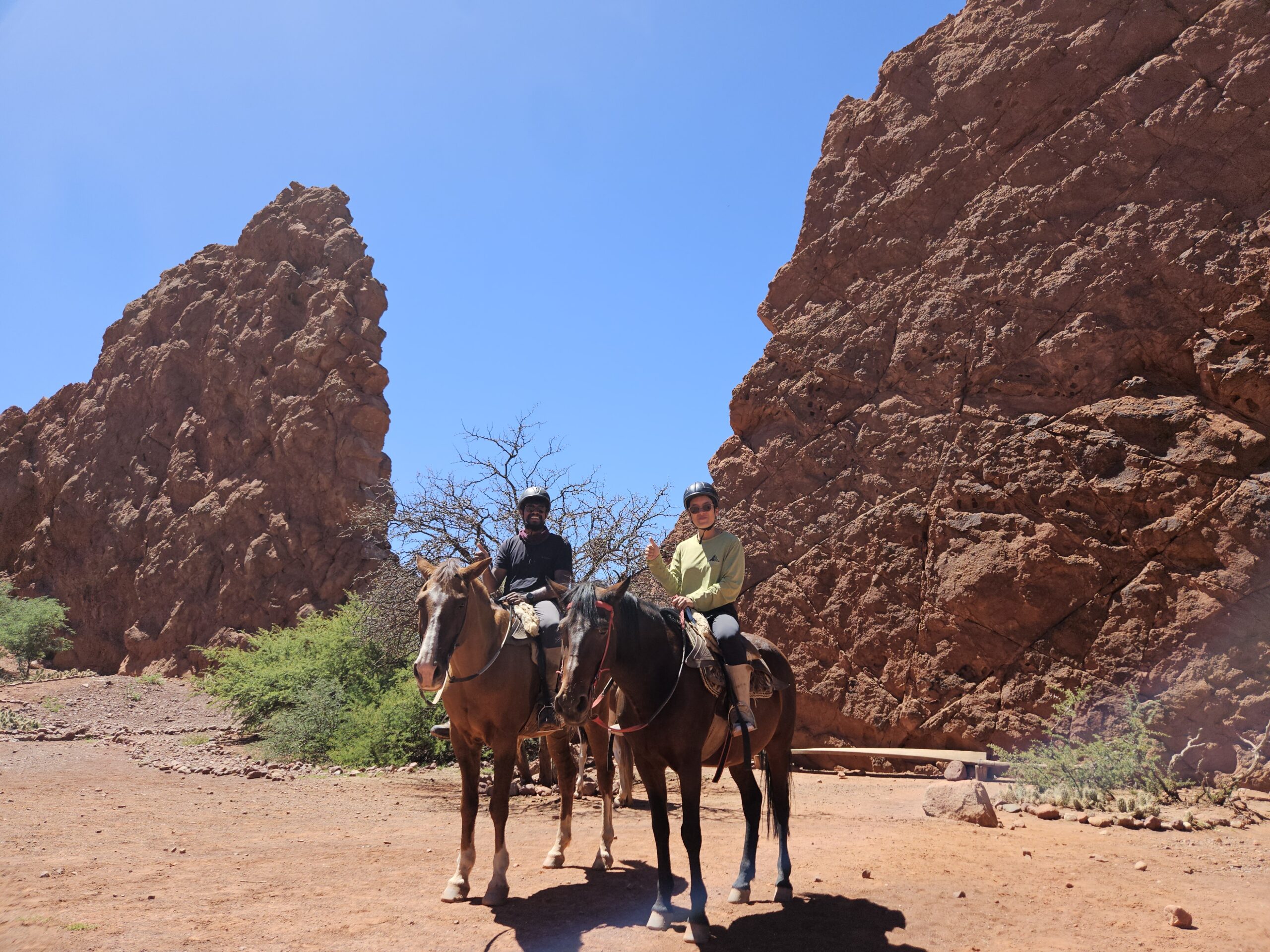
We chose to explore Tupiza in the most fitting way possible – on horseback! There were options for 3, 5 and 7 hour tours, depending on what features you wanted to visit – we went with 5, and could hardly walk the next day… but it was so worth it! Although we both have next to no experience on horseback, we felt super comfortable with our guide, the horses looked happy, and the whole stable group were so friendly. And we kind of felt like cowboys – we even got to ride the horses at a trot, which is HILARIOUS for uncoordinated first timers. We went with Club Ecuestre Amazonas – highly recommended. Get in touch with them on whatsapp to make a booking.
The main features to visit in the desert are:
- Canon del Duende – a narrow pass which opens up into a canyon with some spectacular rock formations. Best done on horseback as it is further away from town.
- Puerta del Diablo & Canon del Inca – easily combined on a walk. The first is a cool looking piece of rock, and you’ll have to pass it to visit the canyon. The canyon goes on quite a way, although it starts off with a small ‘climb’ up a little rock face – and it was our last visit on our horse tour and we were feeling a little heat-strokey, so we didn’t continue on.
This is a good thing to note though – we weren’t walking or exerting ourselves much on horseback, but by the end of the 5 hours and in the midday heat we were both feeling a little poorly – bring plenty, plenty plenty of water if you decide to go out into the desert!
We stayed in Hostal Butch Cassidy – there are not that many hostels in Tupiza, so we mention this one because the rooms were comfortable, the breakfast was good, and it had a tidy little kitchen. We spent two nights in Tupiza, which was perfect for us. After horse riding in the morning of our full day, we lunched and rested before checking out the sunset from the Mirador Corazón de Jesus. It was an early night and an early start for the Salt Flats tour the next day!
Keep it Short & Sweet:
- Crossing the border from Argentina (La Quiaca) into Bolivia (Villazon) is best done early in the morning, but can be so quick and easy – depending on your passport and the requirements for a visa.
- From Villazon, we’d suggest catching a direct bus to Tarija to explore Bolivia’s wine region and some beautiful-seeming swimming holes.
- We caught a direct bus to Tupiza – a great place for seeing some Bolivian life off the beaten track, wild-west horse riding and launching a tour of the Salar de Uyuni.
- Alternatively, there are direct buses to Uyuni, if you’re in a rush or aren’t interested (but we’d definitely recommend being interested!