
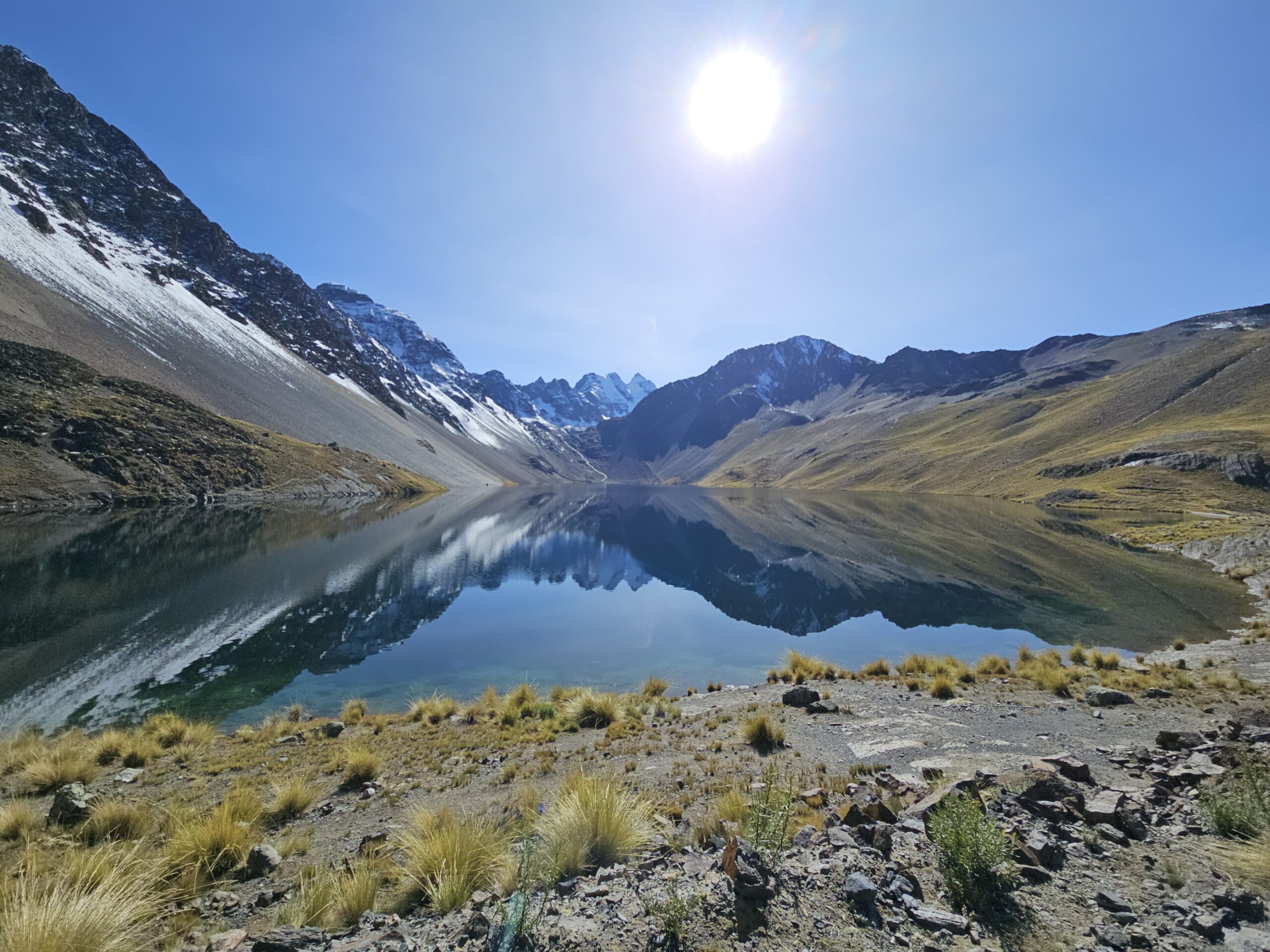
Hiking in Bolivia is… chaotic. It’s not an activity that’s popular amongst locals, and travel agents aren’t very forthcoming with information on how to navigate tracks unless you pay them for a guide. Trails aren’t marked, the paths that you may find are probably made by cattle, and will probably disappear after five minutes. People and their livestock live everywhere in the mountains, so you’ll likely be walking on someone’s land (even though they may not be nearby to care). It’s certainly not a hiking experience of isolation and peace, but there is still a lot to be enjoyed and incredible beauty to experience.
Since we’d arrived in Bolivia, we’d chickened out of multi-day hikes in both Sucre and Cochabamba, but La Paz is perched on the edge of the major heights of the Andes, and we were set on our first foray into high altitude hiking. We’ve had a taste of altitude sickness before, in Ecuador in 2022 where we took a tour up to Cotopaxi base camp (4900m). It was only a day, we didn’t even summit, but we’ve experienced the nausea and lack of focus that altitude can cause. We thought we knew what to look out for, but the Condoriri means five days of walking, eating and sleeping up high – the lowest point is right at the start at around 4400m, but you never sleep lower than 4600m, and the high point at Pico Austria is 5300m. It’s only 43km, but we’d read other blogs & AllTrails reviews saying to do it over 5 days – which seems ridiculous! But it is completely reasonable. We’d spent four days in La Paz acclimatizing, but nothing really prepares you for sleeping at 4600m four nights in a row. Every day was a struggle – sleeping was freezing – the trail was fairly non-existent on the first two days – and we both got mild altitude sickness.
For anyone else who’s trekking for the first time at altitude – or for the people who’ve done it and want to relive their first experiences – we think the key aspect to monitor at altitude is a lack of appetite. It’s easy to identify acute altitude sickness. If you’ve got serious nausea and certainly if you’re vomiting, get out of there. Dizziness, headaches, are normal for mild sickness – but the lack of appetite is the absolute kicker. The effect is twofold: not eating means you won’t have enough energy to tackle the remaining hiking. It also means you aren’t reducing your pack weight like you planned, so you’ll just lug around (already feeling drained) an extra few kgs until the end of the trek. To be fair, stuffing yourself doesn’t really work, because it brings on the nausea (worse). A shitty solution is having foods that are more bland – anything that’s easy to consume without thinking too hard.
Don’t let the warnings put you off. We seriously think hiking at altitude is some of the best. It’s an incredible challenge that is so satisfying to finish – hitting heights that you haven’t before, pushing through lower oxygen and steeper hills. And of course, being in the mountains – walking under snow-capped peaks, past massive mirrors that are glacial lakes, and amongst rocky outcrops and alpine grasses is all part of the beauty of the landscape.
Note: AllTrails does have reasonable trail descriptions in Bolivia, so you can use this alongside WikiLoc to gather more up to date information.
Keep it Short & Sweet:
Description: A high altitude three or five day hut-to-hut (with prior booking only) trek between glacial lakes and under the peaks of the Andes. The glaciers have mostly melted, so the lakes have been dammed for preservation. Unfortunately, this means there is a lot of debris from construction along the hike, and you’ll see many hamlets and sections which are connected by road. The trek is part of a greater trail that runs along the sub-range between Illampu and Illmani, and can be linked up with a summit of Huayna Potosi, if you have time to acclimatise.
Climate: Drier, clearer skies in winter (April – October), wetter and warmer in summer (November – March). Alpine walking (above 4000m), therefore very changeable weather. Cool during the day, fairly cold at night.
Total Distance: 43km
Elevation: Highest point 5300m at Pico Austria (slight detour), otherwise ~4400m – 5100m
Costs: On day 3, before ascending Pico Austria, you need to pay if the collector arrives before you leave (this is the starting point for many day hikes). May need to pay fees to camp on other nights if there are shepherds/land owners around (very variable, we didn’t encounter anyone on night 1 or 2). If using refugios, fees vary.
Track: Non-technical, except for some of the rock scrambling around Pico Austria. Unmarked and inconsistent track. GPS essential. Some places require very steep ascents to make up ground if you lose the track. Many animal tracks make the path confusing. Each ‘campsite’ is at a hamlet of some description, so you’ll always be around some evidence of humanity.
Facilities: Hand-pour flushing toilets at the refugios (the refugios & toilets may be locked – see below).High altitude makes ascending more difficult than usual.
Notes: Always carry small change on these types of treks. If anyone wants to charge you they will not (or, they will say they do not) have change. Be mindful of your body with the altitude at all times. While a guide is absolutely unnecessary on this track, get in touch with an agency to help you book the refugios (or at least open the toilets for you if you’re happy to camp).
Getting there: Taxi to the north side of the Cemeterio General; take the bus going towards Cochabamba (20BOL pp); disembark at Palcoco (~1 hour); take a taxi to the trailhead (150BOL to Condoriri (2N 3D), ~300BOL to Laguna Karakota (4N 5D) (~1 hour for either)
Day 1: Laguna Karakota – Laguna Ajwani (10km). After arriving (probably around mid-morning), at the end of Laguna Karakota, ascend with the ridgeline. The path is not clear – pick your own way. At some point a path should appear and will turn eastward after about 3km, around the curve of the hill. The path continues into a bowl between the mountains, before reaching a high point and descending into the neighbouring valley. There is a road and a small settlement. Cross the stream at an appropriate place and then ascend steeply up the opposite side until about 4500m, then follow the elevation. The trail should eventually turn to the right, alongside a small stream. You may need to pass across a fence to reach a few deserted buildings and a dam. There was a number on the outside of a dorm room here: 71268235, but it and the bathrooms were locked.
Day 2: Laguna Ajwani – Laguna Juri Khota (8.3km). This day is more marching through a combination of dry alpine grass, across gravelly tops, and also through boggy wetland. The elevation is similar – ascend to start, drop down into the neighbouring valley, cross the stream, and head up the opposite side to the next laguna and your dam and campsite. This one had an unlocked toilet, a big locked new dorm, and some old concrete dorms which were unlocked. There was no contact number, but someone came the next morning to charge us for the Pico Austria walk.
Day 3: Laguna Juri Khota – Laguna Chiar Khota (6.1km+1.3km to Pico Austria). While the distance is small, do not underestimate this day. The highpoint of the trail is 5100m, but Pico Austria is at 5300m, and walking gets quite hard at that altitude. The trail is well marked with cairns as you ascend into the rocky saddle of Pico Austria. There are a couple of sketchy bits of moving around rocky ledges, so take your time and possibly rethink it if it’s rainy and certainly if it’s icy. The descent on the other side to the refugio is a very easy trail. Because Pico Austria is a popular trek, this refugio appears to always be open, so you should be able to get a mattress inside if there is space (20bol per person). If doing the 3-day trek, you can start with this day, or start at Laguna Chiar Khota (possibly leaving bags at the refugio) and climb Pico Austria as an out-and-back trail. This one-day ascent of Pico Austria is quite popular.

Day 4: Laguna Chiar Khota – Unmarked Refugio (12km) There are a few options on this day for both camping and trail. We ascended via Paso Condoriri, then skirted around the next pass (trekking adjacent to Laguna Pouchinta, rather than upwards). There is a hamlet at Laguna Sura Khota, but no clear refugios which were open and no nice camping spots (a lot of rubbish). We continued up the hill, through a fence and along another road to find another refugio at a very small hamlet (halfway to Maria Lloko), where another group were staying – so we were able to use the facilities. Mario Lloko is at a higher altitude, and the campsite didn’t look amazing.
Day 5: Unmarked Refugio – Road End (6km). The advantage of continuing further the previous day is reducing the distance on your final day – and therefore how early you need to wake up. The trail follows the road for a few kilometres before starting up the hill and towards the final pass. At the other side of the pass is a road, and the end of your trek if you’ve arranged a ride. Otherwise, you’ll need to continue another 6km down the hill until you reach the main road between Huayna Potosi and La Paz.
Getting out: Pre-arrange a taxi from the closest road end, get lucky and meet a group trekking alongside you and jump in their car, or walk all the way to the main highway between Huayna Potosi basecamp and La Paz. For the last option: you must arrive before 11:30 to have a good chance of getting in a returning vehicle with one of the tour groups. After midday most of them will have departed.
Tell me everything:
As noted above, getting information about hiking in Bolivia is a bit of a nightmare. There are no hiking guilds, no government departments, and it’s not a super popular activity with the locals. There are plenty of agencies in La Paz who will offer you packages, but there is no need for a guide on this hike, unless you are interested in chatting to the guide while walking, and you’re in a big enough group to make the guide and cook fees worthwhile. It is worth noting that the hike will probably be more difficult than you expect – only because of the altitude. Keeping a light pack goes far in having a good time, so if you want to go unguided but are worried about gear, you should try to book refugios to save on tent and mattress weight. The travel agencies in La Paz can be a bit cagey, but if you ask directly and with confidence (there should be enough information here for you to know what to ask for! If not, leave a comment) for the refugio owners’ numbers, we assume they would be more forthcoming.
It’s also pretty cold at night at the altitudes you’ll be sleeping at, so having a refugio is a nice way to get another barrier between you and the frost. We actually slept inside 3 nights out of 4 – on the first night, none of the facilities were open, but on the second night, the doors on an old concrete dorm were only tied shut (rather than padlocked), and the toilet was open for use. We ‘pitched’ by setting our groundsheet down in one of the dorms, and our mattress on top – being in an enclosed space kept the warmth in much better. On nights 3 and 4 the refugios were open, and we paid a few bolivianos for our own room and a straw mattress each – and an extra blanket to throw on top of our sleeping bags. So cosy!
Getting to the start of the Condoriri requires a few different modes of transport, but the most annoying part is bartering with the taxi drivers once you arrive at Palcoco. Our hostel was very helpful in getting us this information – of course, you could take a private taxi to the start of the hike (as you’ll need to taxi at either end, anyway), but you can get a fair way via bus, which should cut your costs down. First taxi to the north side of the Cemeterio General; tell the driver you want to go to Cochabamba (also – take this bus if you want to go to Cochabamba, they’re cheaper than the ones from the main bus terminal). It should be about 20BOL per person. Tell the driver you want to go to Palcoco for the Condoriri trail. When you get off, you’ll be on a random bit of highway, but there should be a few taxi drivers waiting around. Now, these guys are used to taking people to ‘Condoriri’, which is the trail for Pico Austria, but if you are doing the 5 day hike you want to go to the far end of Laguna Karacota. It really is about the same distance from Palcoco, but because the latter is less popular (I guess from the Condoriri they can score a return ride) they tried to charge double to get to the Laguna. We spent a bit of time haggling but eventually settled on 220BOL. We arrived late morning, around 11am, to a construction site.
In this part of the Andes there used to be a great number of glaciers. Because of rapid global climate change, they are melting off, but the lakes that they form are essential to the lifestyle of the people in the valleys below. As part of maintaining the landscape, unfortunately, the government has had to build dams along the range. This means there’s a lot of really ugly concrete amongst what was once beautiful and untouched lagunas. However, it seems necessary for the lives of the local people. At any rate, the start of the hike was, for us, in the middle of a construction site, which also made us a little uncertain. We eventually found the trail, and although it didn’t appear for a while, the initial ascent provides increasingly incredible views of Laguna Karakota. We had incredible weather for this whole hike – very lucky with blue, blue skies and little wind. Once the trail appears, it’s reasonably easy to follow across the saddle and down into the next valley. Then it disappears again as you cross the base of the valley and begin ascending, just keep an eye on your GPS and it should reappear eventually. The last ascent takes you next to a small stream and into a property of some kind – we think it was an old dorm designed to house workers who built the dam (it was certainly abandoned), and a refugio. The number for the refugio was scrawled on the wall, and both the refugio and the bathrooms (down the hill) were locked up tightly. We slept in our tent outside the refugio – not the best place, but at least the ground was flat. We both had a bit of altitude sickness so had a really small dinner, and crawled into bed as soon as we could to ward off the bitter cold!
Day 2 is pretty similar to day one – up to the next saddle, down into the neighbouring valley, across a stream, and then back up the other side towards the next laguna and your campsite. However, for us it was a little less straightforward. As we climbed to the first saddle from the campsite, we had a little mishap with the reading of the map and getting our bearings, and ended up well to the right of the track. While we could’ve doubled back a little, we could see a track in the distance, and decided to go with it. Instead of skirting around the right of the main peak, we walked further to the north, walked up a different scree saddle, and ended up having to make a very sharp descent into the valley. We probably were on a random llama trail – a classic mistake, but thankfully we were still able to get down on the other side. It didn’t add too much time but it was a little stressful – better practice reading topo lines a bit more.
Another thing to note in the wet areas near the river – there are lots of hairy caterpillars! They’re weird little guys, but their crawling is a little creepy and they look like the type that would give you a rash if they touched your skin. Thankfully, they aren’t near the campsites, only in the low areas.
Once you’re out of caterpillar world and up the ridge, the next campsite awaits – this one is situated next to a stunning long lake and really gives you the idea of sitting at the foot of mountains – you’ll be able to see tomorrow’s challenge, Pico Austria. The campsite had a new big refugio (locked), and a small concrete dorm which was unlocked. There was a bathroom behind the main dorm which was only covered by a curtain, so I assume it’s always unlocked. We were a bit whacked by this point – having had the extra km or so with the detour, and generally being fatigued from the altitude and lack of food. However, we still arrived pretty early, set up in the open concrete area with our groundsheet, had a nap to stave off the altitude headache (it’s kind of like a hangover), enjoyed the sunshine, and tried to eat a decent meal before the sun set. The only problem with this campsite – was there was some asshole animal (rat or fox – who knows) who decided to scrape around in the discarded metal outside in the middle of the night, which woke us up a few times.
Day 3 started in a less-than-ideal way; Emma found that the zip holding her pack frame closed had burst, making the whole thing a lot less stable. While not a trip-ending event, it’s pretty annoying to have a 4-month-old 500NZD Osprey Pack break mid-hike, so we had a slow and unsuccessful morning while we tried to get it back together. This was also the first morning we saw anyone else interested in hiking – first of all, a fellow arrived on a motorbike, and once we were done with our pack disaster, came over to say hello and ask for payment for a ticket for the next part of the trail – we paid 20bol each. Once we got started, it turned out that he was probably there to get payment from a van of other hikers, so if we had’ve been a bit earlier in getting our shit together he probably would’ve missed us altogether!
This day really is a stunner, but it’s tough. At barely above 6km (7km, including the summit of Pico Austria), it’s short day in theory, but you’ll be hitting the highest altitude on the track today – so take it easy and take it slow. Eat and drink often. Today’s the only day it gets a little technical – it gets a little steep on the scree ascending to the upper lake (note, on the map it says you can camp next to this lake – but the campsites are tiny and it’s very rocky, so it might be a tough pitch. Past the lake, there is a little bit of rock climbing and scrambling – keep your cool and get your hands and feet set before you move too fast (especially with weighty packs!). Keep an eye out for cairns on this section of the track, as there’s no path to follow. It is, however, an incredible day. Once you get to the lake, you can see Condoriri and the snowy peaks to either side. The trail up to Pico Austria is tough but getting a true view of Condoriri (with the birdlike perspective!) is awesome. You’ll also get your first shot of Huayna Potosi, on a clear day.
This section is quite busy with day hikers, but the funniest thing (if you’ve got your big backpack on) is how interested and impressed all the guides are – every one asked us where our guide was, realised we were carrying all our own gear, and made a whole lot of impressed noises – hilarious, but also a great way to make a good impression (and some chatty friends!) fast.

The track down to the refugio from Pico Austria is easy, with a well worn track, but longer than you’d expect. The descent can be tough on the knees so if you weren’t convinced by poles we would say 100% yes right about now. The refugios here are busy – there are a few different buildings – and lots of overnighters or day trippers or people heading up to Condoriri (at the laguna above) in the high season pass through here. We were able to snag a room with a couple of mattresses, and have a cosy night cooking and eating inside. We were absolutely stuffed after this day, so we were in bed very early – and seriously considering taxiing back the next morning.
We started day 4 slowly, uncertainly, but once a tour group of four, who had been staying in the same refugio as us, started up the trail to Paso Condoriri, challenge mode was on. It was actually an excellent decision too – the track up to the pass was icy and filled with mischievous llamas, and the views over the mountains on the way up and at the pass were incredible. The descent on the other side got a bit muddled, as (again) there are plenty of animals tracks mixing and mingling. The trail will cross over the river at the bottom, and we scrambled up the ridge to meet up with the road (we aren’t sure, but we think you can skirt around it and still meet up with the right place – it’s probably easier). The trail continues along the road for a while, before turning off and passing by the small Laguna Puchinta. There’s an alternative route that continues upwards, runs up to another saddle, and meets up with a big descent on the other side. We were able to see the track from the laguna, but decided that was a biiiiig no. The lower track is reasonably well marked and follows the curve of the hill, sometimes on quite loose scree. It ascends a bit, before dipping back down towards the Lagunas Sura Khota and Wichu Khota. There’s a hamlet between these two lakes, and we’d read that there are refugios here too; however, nothing was open, even though one local pointed us in the right direction. There was flat ground, but the vibe was a bit weird, and there was no running water. We were pretty keen to continue on to somewhere nicer, but we weren’t convinced by anything the map was telling us now.
Yet we were in luck! We didn’t realise, but somehow we’d overtaken the group of 4 and their guide and cook. As we sat at the ‘refugio’, a bit desolately, we spotted them coming down the hill. Not that we were waiting (we were waiting), but instead of turning towards us they continued along the other side of the lake. In comes a bit of hope and the smell of a little opportunity. We picked up our weary bodies and followed – under the pretense of walking toward the next campsite on the map, Maria Lloco, but really with the hope that they might stop at another refugio with a spare room. We eventually caught up to them, and we just want to acknowledge – we have really got so lucky so many times on this trip. We had a friendly chat about the track, the refugios at the lagunas, the general scenery… and their guide (our new mate Vladdy), who recognised us from the day prior, said we’d be able to stay in their pre-booked refugio – and that they’d have space for us in their vehicle going back to La Paz the next morning. An absolute stroke of kindness and good timing – we have been so thankful for such people!
We again got our own room at the refugio, comfy straw beds and an extra blanket. This refugio was next to the road, halfway between the lagunas and Maria Lloco (see the image of the map for the marking). We don’t really know who to contact for this one, but there are a few houses around here so you might just be able to knock on a door and ask to stay. The refugio is in a gorgeous spot surrounded by snow capped mountains and right next to a burbling stream. The tour group actually caught some trout for their dinner with the help of the refugio owner, which was a hilarious scene.

The great thing about the stay at our random little refugio was the proximity to the road. We still had one more pass over 5000m to walk over (normal by this point – how did it end up like this?!), but it was only going to be 6km, and now we conveniently had a guide to follow. The track followed the road for the first few kms, before starting to ascend (a bit randomly) up the side of the mountain to the pass. Although the group had acclimatised a couple of days less than us, they also weren’t carrying anything, so we struggled a little to match their pace. However, it was totally worth it – where we were intending to walk all the way to the main road (another 6km) to wave down a taxi, the vehicle was waiting at the road right on the other side of the pass. The group of four were actually using the 3-day Condoriri to acclimatise for Huayna Potosi – so we first drove to basecamp, waited for the day’s hikers to return, then got back in the van back to La Paz. We ended up heading off at about midday; it’s really early, but we really recommend if you don’t have a pre-planned ride, try to get to the highway by midday at the latest – all the hikers get down at about the same time, and if you can’t get on one of those vans it’s really hard to find another shared ride.
We ended the hike still with half our food – a solid 4kgs or so of uneaten food, just weighing us down. Even though we’d worked through the appetite struggles by night 3, there’s only so much you can consume during the day. But what a learning experience it was – with stunning mountains and weather, friendly people and overwhelming kindness. While it’s not the most disconnected hike out there, it’s beautiful and it’s tough and it’s so very Bolivia.