
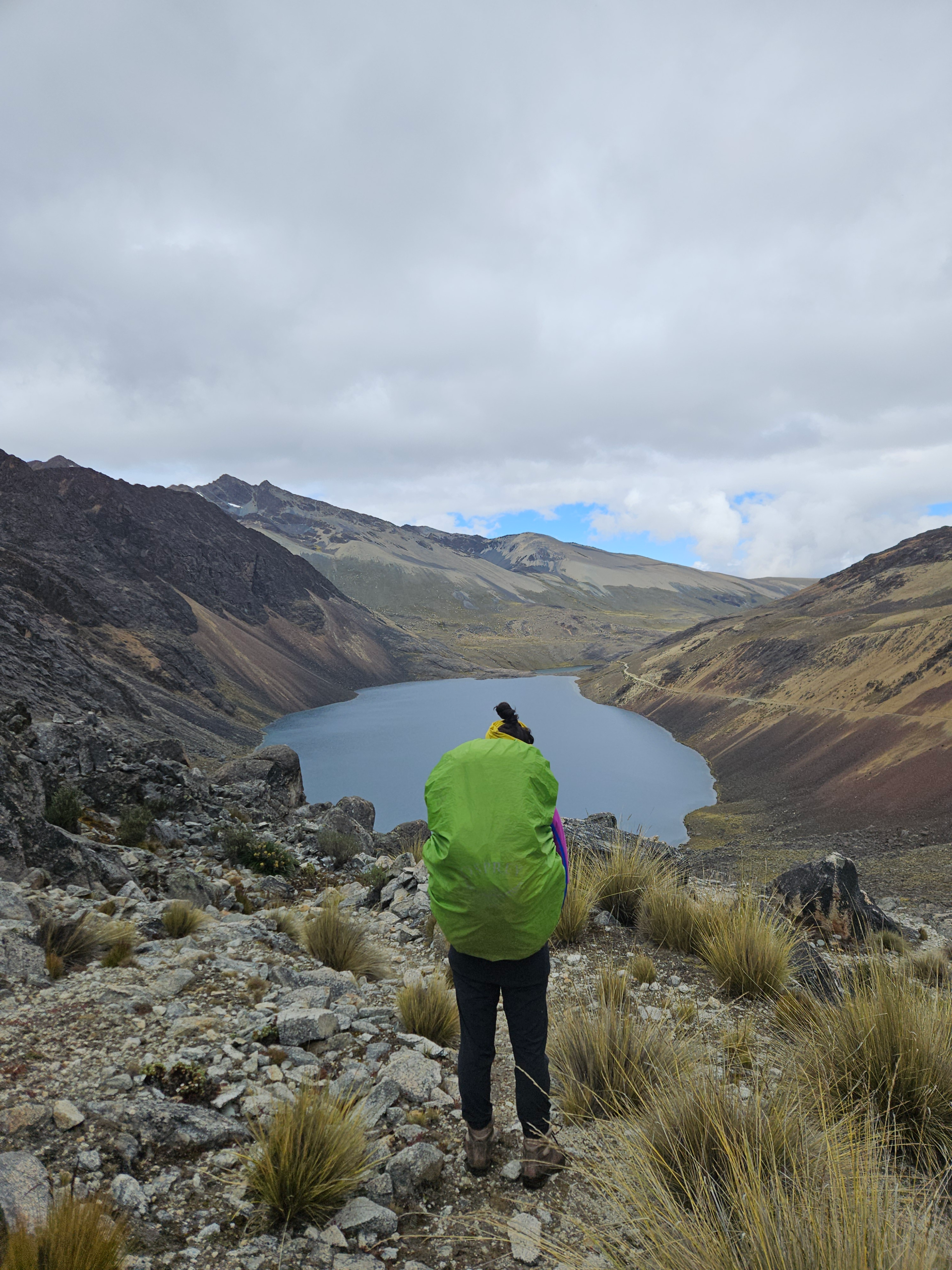
We mentioned it in a previous post, but hiking in Bolivia is a little unusual. Poor trail quality, limited information online and from tour operators, human habitation everywhere. However, our experience with the Condoriri didn’t put us off – there is incredible beauty and a spectacular challenge in hiking at altitude in these less-travelled areas. The Illampu is particularly special because it circuits the Illampu mastiff – snow capped mountains are almost always on your right (going clockwise), with multiple peaks over 6000m sitting in the sub-range.
The Illampu Circuit itself is particularly strange because much of the trail is now a basic road – nothing paved, and it’s still very remote and with low populations, but we were passed by a few jeeps and a couple of diesel-spewing trucks on day three. It takes away from the serenity of nature when someone honks at you from behind. We understand that the main reason for the road building has been to facilitate mining in the mountains – an unfortunate example of ‘progress’, as in natural exploitation, changing the feel of a hike. While some of the passes are proper Bolivian track (inconsistent, unsigned, beautiful), there is a reasonable amount of walking along the rocky-gravel road. However, with the elevation changes, the gradual incline that comes with the road is quite welcome, and there are very few vehicles overall. And – the views are still incredible.
If you want something shorter in the range, you can also hike up to Laguna Chillata, which is an overnight glacial lake at the foot of Illampu. This can be connected into a mini circuit if you start at Lackathiya and walk along the side of the range.
Even if you’re not looking to hike, Sorata is a lovely place to visit. The town sits in an incredibly picturesque valley, and boasts a few homestays and basic restaurants. The climate far more mild than the plateau, though be warned that the descent into the valley is terribly windy – grab a front seat if you get carsick easily. And watch out for the tiny sandflies – they leave nasty bites!
Keeping it
short and sweet
Description
Hike 5 or 7 days around one of the highest points and mythic figures of Bolivia’s section of the Andes, Illampu. The classic hike starts and finishes at the village of Sorata, beginning in the humid jungle of the town and ascending through alpine grass into high passes at and near 5000m. There are many hamlets on the route, including the village of Cooco where there are a couple of stores to restock basics. This does mean that the majority of the hike is now connected by road – in particular, the first and final days on the full loop are completely on the road – so we shortened the hike to 5 days by catching a cab, also avoiding about 1500m of ascent and descent.
Climate
Drier, clearer skies in winter (April – October), wetter and warmer in summer (November – March). Starts in humid jungle, quickly moves to alpine walking (above 3500m), therefore very changeable weather. Cool during the day, fairly cold at elevations at night.
Distance
69km (110km)
Elevation
3480m to 5050m (5 days) (2680m if starting/finishing at Sorata).
Costs
None!
Track
Predominantly on the road, with sections/options to walk offroad in some places. Non-technical where it is not on the road. Does disappear at times – GPS required.
Facilities
None. Bury your poop, filter your water, leave no trace.
Notes
Because the track is so well marked, and most of the trail is near roads, we believe there is no need for a guide on this hike.
Getting there
The track starts at Sorata. There are collectivos going from La Paz to Sorata all day, though the majority of people will leave in the morning, so that will be your best bet for getting there without waiting too long. Taxi to near the cemeterio general, and tell your driver that you want to go to Sorata.
Day 0
Sorata – Lackathiya (9.4km, 1500m ascent, 330m descent) – we skipped this day, but the track and the road are the same. If you take this route, there is a lot of ascent with a big pack. If you want to skip as we did, the taxi to Lackathiya was 150bol.
Day 1
Lackathiya – near Ancoma (13km, 1230m ascent, 1100m descent) where we started – from the village of Lackathiya begin ascending towards to the Illampu pass, initially through farmland, and eventually up a steep scree pathway. If you get good weather, enjoy views of the mastiff the whole way up. Then descend gently through the neighbouring valley, curving to the right as it opens up into a perpendicular valley and eventually meeting up with a road. Follow the road for a few kilometres before turning off into another adjoining valley, and make camp next to the river.
Day 2
near Ancoma – near Cooco (14km, 1060m ascent, 1140m descent) immediately ascend the steep wall of the valley to the southeast. This leads to a different gently climbing valley, so follow that until the next pass. The descent on the other side is very steep but the trail is generally well marked. Once at the base, follow the road until the village of Cooco. You can restock the basics here – we bought a little bread and fresh vege for the night. Then, continue through the village still southward – you can walk on the road or divert off onto a slightly older path for three kilometers before stopping for the night. There are plenty of spots to pick from.
Day 3
near Cooco – near Abra de la Calzada (16km, 1500m ascent, 660m descent) This is the biggest day for elevation, though the ascent is broken in two. Begin the day ascending to the pass in the current valley, predominantly along the road. Descend along llama tracks and the road (a combination is fastest) until you hit the bottom of the next valley and several farms. Continue south along the flat road, but eventually it starts switchbacking upwards. The best campsite (flattest) is right next to the road.
Day 4
near Abra de la Calzada – Laguna San Francisco (14km, 630m ascent, 880m descent) Finish what you started yesterday – immediately ascend to the highest point on the track, then descend gently next to a beautiful alpine lake. After this lake and before the lower, the track diverges from the road and begins to climb again along the side of another hill. Continue climbing into a saddle, then pick a trail until you hit the next ridge. The track descends through another sandy bowl, angle always to west and slightly north until you can see another lake – Laguna San Francisco. Camping can be a bit of a nightmare – or it was for us – as the base of the valley before the laguna is a massive bog. The marked camp spots here are a bit questionable, so you may have to pick your way up the valley (northeast) to a rocky outcrop that is drier).
Day 5
Laguna San Francisco – near Millipaya (17km (12km), 410m ascent, 1500m (940m) descent) Our last day – again start with a steep ascent up the side of the valley wall. Enjoy spectacular views to the north of the mastiff. Once the switchbacks of an old road even out, the trail evens out over a low saddle for your last pass. On a clear day, you’ll see Lake Titicaca, and the mastiff on the other side. The next part of the track winds up and down the foothills, changing from alpine grass to real grass, farmland and trees. The path winds fairly randomly (e.g. it’s non-existent – walk where you please) until you hit the road. From there, it’s about 6km of descent until Milipaya, where you should be able to find a taxi, or someone’s yard to camp in. We got picked up by a random couple about 1km down the road, and they served as our taxi back to Sorata. Locals are always keen to help and make some money at the same time so if someone drives past you, wave them down and have a quick chat to see if they’re interested to take you. We got into the tiniest jeep in the world but it worked out!
Day 6
near Millipaya – Sorata (18km, 1500m descent) If you decide to hike the whole loop, it’s another big day with a lot of downhill, again down the road. The change in scenery is incredible.
getting out
As above, the collectivos run from Sorata to La Paz all day and into the evening. You can get back to the big centre the same day that you finish, easily.
Tell me everything
We ended up staying two nights in Sorata before we left for the circuit. Because we were uncertain about the track, mostly misgivings about the altitude, we hired a guide… or tried to. This was a real palava – the three guides on the Sorata tourism website didn’t respond to my Whatsapp messages; there was nobody at the tourism office on the first day; we managed to find someone on the second day, one Don Julio, and all was well for a time. Then after we’d sent a few messages to confirm the route details, Don Julio called back, to check if we had a tent… for him! It turns out that while Don Julio was a local experienced in wandering the mountains themselves, he didn’t quite have the gear to get himself through as we were hoping. It was all in all a hilariously chaotic situation – his strategy was to walk with us to the campsites, then find someone at each of the hamlets that he could bunk with, before running to find us again in the morning. The first day, he actually told us he was just going to head home for the evening. While we committed to the first day of pay and guiding, we quickly realised that we could probably make do by ourselves, and also that the sleeping situation wasn’t ideal for anyone, and excused ourselves of his services for the remainder of the hike.
Don Julio did provide interesting information for the first part of the hike – hiking tourism used to be far more prominent in Sorata, but post COVID (and probably since the roads were built) the allure of hiking and tourism agencies have diminished. He used to be a porter for hikers and climbers in the area, and is a native of the mountains, so was very comfortable with the track we walked.
Day one started with the three of us taking a very bumpy road for over an hour up to Lackathiya – a small hamlet where there is also an unused tourism office, a relic of previous years. The track ambles over various tracks in farmland to the east for a while before beginning to ascend steeply to the Illampu pass. This used to be the only track to the mines in the mountains – so a highway, essentially. On a good day, there are incredible views of the mastiff, but we only had a few sneaky peaks before the clouds made their bed. Before the road was built, this section was the main connection into the villages in the range – it’s a fairly rocky climb, and if you’ve also taken a taxi, make sure you walk slowly to prevent the altitude from doing anything weird to you. Stopping for lunch at Paso Illampu should give you incredible views, before dipping down the other side through a much more shallow valley. Descend for some time before eventually reaching a perpendicular valley, tracing the valley wall, and meeting up with the road. It’s easy walking along the road for a couple of kilometers until Ancoma, where the ‘track’ dips behind a property and follows the adjoining valley. Walk until you find a suitable place to camp – the trail continues the next morning on the true right of the stream (straight up the valley wall, into a different adjoining valley for the next pass). We camped on the true right in an old stone walled pen, taking off our boots a little early to cross the stream. The weather cleared up a bit, so the view up the valley to the snow peaks was incredible that night and in the morning. This campsite is at 3800m, so it’s reasonably warm overnight, but still high enough to see you hurtling into the tent after sundown to escape the cold.
Day one’s campsite is at the bottom of the valley, and the track for day two starts by heading up the valley wall – about 100m. This is a rough start to the day, take the time to use switchbacks when you can. Because of the easterly angle of the next valley, you should get sun once you finish this particularly steep bit. It’s then a continuous trail up this new valley for a couple of hours – the path becomes more unclear as the valley lengthens, and is at times boggy, so pick your path. Once we reached the pass top (4400m), we took a break before a muddy descent on the other side. Make sure you descend on the true right of the river for the easiest (and eventually correct) path. A number of switchbacks gave us great views of the valley Coyoco sits in, but it’s rough on the knees. Once you make it to the bottom, follow the road until you reach the town. We picked up some extra bread here, the stores are pretty basic so don’t rely on them too much. After a break and a restock, cross the river at the bridge, following the road to the south. This climbs again with the track remaining as the road, although it splits into the new road and an older one, to the right. The right-hand ‘road’ leads to the campsite marked on the map, and is much more private (the ‘old’ road is eventually blocked for cars). There are a few random houses in this area and plenty of old stone ruins, though we didn’t see anyone around. Despite the proximity to the road, there were some nice grassy areas and a bubbling brook that we pitched up alongside, and we had a really lovely night’s sleep here, at about 3900m. One thing to watch out for is the prickly grassy mounds that exist around this altitude. We initially thought we’d picked a lovely soft spot, but the grass is so sharp it breaks off into anything in touches! Thankfully, we didn’t stick any holes into our groundsheet.
Day three is rough. Like, insanely so. The day starts with the remainder of a gentle (relative term?) ascent up the current valley. Continue along the old road until it meets up with the new; you’ll have to cross the river at some point, we did so at a vehicle ford. The present pass ends at 4500m, offering some lovely views of the massive valley as you tramp along. The other side descends more steeply – follow a mix of the road and llama trails into the base of the next river valley, about 4000m, then it’s back up again. This whole section is on the road, and is where we were passed by all the ‘traffic’ – a handful of jeeps and trucks. While it’s gentle (with lots of vehicle-friendly switchbacks), it’s a fiendish ascent of 700m until the campsite. We also had pretty average weather coming up here, with the clouds packing it in again and some light drizzle, so it wasn’t a great end to the day for us. The campsite for day 3 is a little strange – it’s a ‘laguna’ on the map but really a bog for the most part. There’s a sandy patch which is nice and flat for pitching right by the road, as you arrive at the laguna. There are a few rocky/uneven spots toward the other end of the laguna, though the running water is closer and it’s a bit more private it would be a much less comfortable sleep. This is the highest campsite – at 4750m – so be prepared for a cold night with frost.
Wake up the next morning ready to hit the highest point on the track. If you go for an early start, make sure you take care with any frozen poles – they’ll be much more prone to snapping. The highest point is called Abra de la Calzada, after which there’s an opportunity to diverge from the road and wander along the old hiking trail. This whole section has awesome views of the two lagunas below. However, there is a portion which traverses a boulder slope – which had suffered from a slip when we were on the trail, meaning it disappeared and turned into some dodgy path-picking. We had to scramble back up to the sturdiness of the road. And, once we’d got back on the road, it started snowing! Very cute at first, but it quickly became a bit problematic as the wind picked up and turned it into sleet. We hadn’t yet stopped for lunch, and with the sideways cold – now we couldn’t. We then lost trail again as it diverged from the road (cattle, llama tracks are everywhere!), and getting back on it meant sleet straight into our faces. We struggled on for about an hour, but thankfully the weather cleared up for our final climb onto the tops, which meant we could finally have some lunch before the wind picked up and got us moving before freezing. We had some lovely views over the tops, although our reactions were a bit dulled due to exhaustion. As always, the trail appeared and disappeared, but the general direction is clear for the descent into the Laguna San Francisco valley. This particular section on the mountain is very cool – it really feels like remote foothills, as you are finally completely away from the road.
However, the map had yet to give us the biggest lie! Laguna San Fransisco is a beautiful colour and looks like a lovely place to camp. As we descended, it appeared as a flat grassy old glacial valley, and the map told us the camping spot was right in the middle. Quite exposed – considering our experiences of mountain weather, we weren’t super keen to pitch up in such an open place. Then as we tried to explore the “track” to the campsite, we found the entire valley to be a bog. Fair warning – walking is really tough, and on the far side there are streams which can make your track impassable. We aren’t sure if it’s because we were so close to the rainy season, or if it’s always like that – but in our opinion, there was no way we could pitch up anywhere in the middle. Both sides of the valley were steep and full of thick alpine grasses and a variety of nettles – there’s an old stone hamlet on each side, but there’s no flat ground in either. It was one of those times where we were exhausted, underfed, over-altituded and filled with decision fatigue. Eventually we made our way further up the valley, after crossing, to a rocky outcrop, and were lucky enough to find a grassy spot (without bog!) to pitch up at. 5:30pm pitch and 6pm sunset meant a rushed dinner and a short evening to relax. If you’re doing this trek, learn from our mistakes! Head straight across the bog, don’t muck around with the map campsite, and head up the valley – the rocky outcrop is obvious from the top valley wall. There’s also a tepid stream (termas) on the way.
The final day begins with another ascent to the final pass. Head right up the valley wall along a mixture of old road and wide trail, and finally a gentle ascent through alpine grass. The pass is marked with a cairn shaped like a fullah with a hat on, and on a clear day you can see the spectacular blue of Lago Titicaca ahead, and the peaks on the right. The rest of the track descends randomly through farmland which gets progressively greener. Llamas turn into sheep into cattle as the pastures become lush. We lost the track a lot, ended up in several bogs, and generally were a bit irritated from exhaustion. However, luck stroke only a couple of kilometers after we reached the road. We were planning to walk to Milipaya, to then catch a taxi to Sorata, to then score a collectivo back to La Paz. However, a couple drove past us and offered us the lift to Sorata (for ‘un rojo’ – a 100 bol bill), saving us the 6km of walking down the road. So this walkie ended, with the kindness – well, opportunism – of strangers, and the chance to gaze at the changing scenery from the comfort of a seat rather than our two feet.