Category: South America

  • Everything you Need to Know About Exploring Southern Bolivia: Potosi, Sucre AND Cochabamba

    Everything you Need to Know About Exploring Southern Bolivia: Potosi, Sucre AND Cochabamba

    Two essential pieces of information for this post: first, that the currency in Bolivia is going through some crazy times, so visiting with foreign currency in hand means that everything is half the price*. Second, that we absolutely adore eating. Here we have cheap cafes, markets and restaurants, and two hungry kiwis who’ve spent the last 2 months cooking for themselves almost exclusively in Argentina and Chile. 

    Across our next three stops, PotosI, Sucre and Cochabamba, we didn’t do a lot. Although there is a lot to be done across all of the cities, we mostly enjoyed just being present. Visiting markets, wandering streets, appreciating the performances of marching bands that seem to be a constant in Bolivian life, and nibbling on food in plazas or cafes. 

    Bolivia is full of complex and sometimes uncomfortable history. Potosi and Sucre are two places where the Spanish were particularly present, which has impacted the development of these cities and its people. If you want to understand more about Bolivia, taking walking tours and visiting museums in both of these cities is a must. 

    * See our general post about Bolivia for a full description on how the currency discrepancy works.

    Keep it Short & Sweet:

    Potosi: Now a small town with a decreasing population, Potosi once fueled the Spanish presence in Bolivia through the richness of the Cerro Rico silver mine. The town exists with incredible, if disturbing, history. Take a walking tour (Mariam from Koala Tours was excellent) for a detailed, local view. Many tourists take a tour through the mines of Potosi – now bereft of silver, local workers still try to exploit it for less valuable metals. Conditions are still pretty dire and while companies claim to give back to the community and the families of miners, many are questionable. We were not convinced that this is a good way to support, and if you’re interested in doing this kind of exploration we urge you to complete research thoroughly.

    Sucre: Bolivia’s capital, nicknamed the White City for the preservation of its historical centre in traditional colonial white, is a beautiful place to park up and take a break from constant travel. There’s not a lot to do here, but the vibes are great, there are plenty of lovely hostels to pick from, and if you have the time, it is an excellent place to take a week or four of Spanish classes. The quality of classes in Sucre are really high, there are plenty of schools to pick from, and the prices are much better than other places in the country. There’s a sizable rich immigrant population, and the large number of gringos has led to considerable gentrification of the centre – take your pick of cafes to complete your homework.

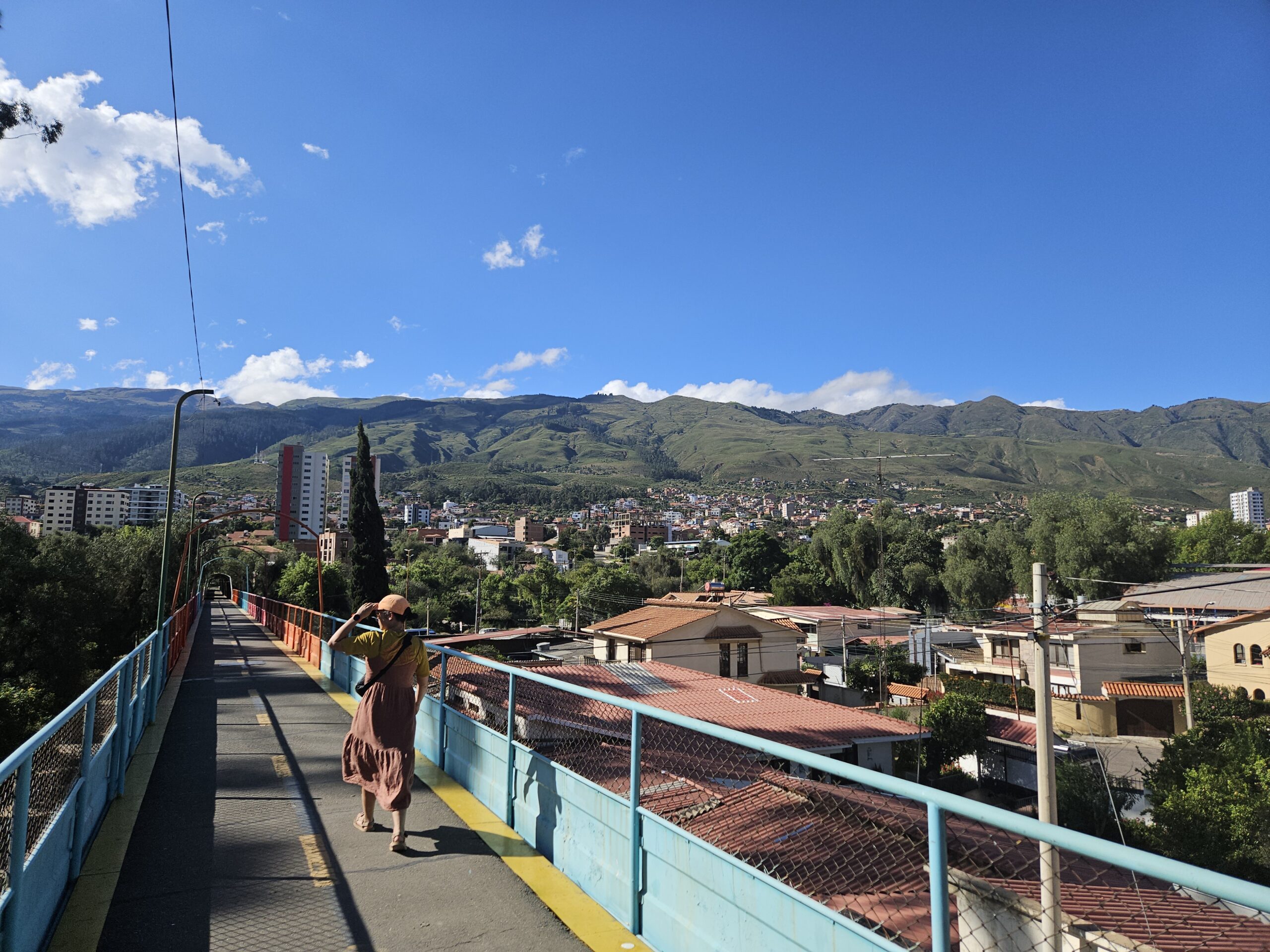
    Cochabamba: ‘Cocha’ has a little bit of everything, but is prized as Bolivia’s gastronomic centre. The country’s third-largest city has a large, fun historical centre, with multiple markets to explore, and a beautiful plaza to hang out in. The city sits in a valley of towering peaks, so there are a few high altitude day hikes that you can tackle. Easier to achieve but also enjoyable is the walk up to Cristo de la Concordia, a massive monument to Jesus with incredible views over the city. Cochabamba is a good base to visit Torotoro and the national park there, or the Canyon Tuta Wallpas (though we didn’t make it to the latter, it seems to be growing in tourism but is still off the beaten path!)

    Tell me everything:

    Potosi

    We travelled to PotosI immediately from Uyuni – as we mentioned, Uyuni is very much a tourist town, with people visiting almost exclusively to see the Salar. We read it’s pretty seedy and there isn’t a lot to do other than the Salt Flats – so we were straight on the next bus, along winding roads up to 4000m and PotosI.

    PotosI is centred around an old, Spanish centre. The plaza is lovely, with an ancient cathedral and old government buildings surrounding the corners. Because of the historical concentration of wealth in the town, there are plenty of fancy facades to admire, and historical names have resided in many unassuming buildings. The streets are narrow and winding in this mountainous town, which makes exploring a breathless exercise – again, the altitude here can mess you up, so take it easy! 

    The best SalteNas in Potosi can be found at la SalteNeriael Hornito. Get in early as they are super popular, and do sell out. They are spectacular. Also try the K’alaphurca, a local delicacy of beef & corn soup – what’s special about it is they throw in a fire-hot rock in before serving, which initially keeps the soup splattering all over you, but does ensure that it doesn’t cool down too fast in the freezing air. We ate at Restaurante Tambo SeNorial, which was a lovely traditional restaurant with a cute vibe.

    We stayed at Hostal Los Faroles – a really lovely homestay with a delicious breakfast and large, comfortable rooms. It’s really well placed (right next to the market). We took our walking tour from Koala tours, with Mariam – she was so awesome, even though it was just the two of us and her, she was really detailed and when we started asking questions about food she got us a few treats to fuel us on the way. We really recommend asking for her if you are in Potosi!

    It’s popular to take a tour of the mines in PotosI – we didn’t think this was a super ethical thing to do, so preferred the Walking Tour only, although Koala Tours has great reviews for the mine tours, you can never be 100% sure where your money is going. If you’re going to take one of these tours, make sure you do your research before, understand the history of the mines and the current working conditions, and make sure you are comfortable with the impact you’re having.

    We also visited the National Mint of Bolivia, where the silver collected in the mines was minted into coins during the Spanish rule. The tour was really interesting but in Spanish, so we missed quite a lot of content – there was meant to be an English tour, but it never happened and we just got lumped into a Spanish one. Still – worth it for the history!

    Because PotosI is in the mountains, you can imagine that there should be some nice hikes to gorgeous viewpoints. There are, although the ‘niceness’ of the hikes seem debatable, as PotosI is an industrial/mining town outside of the city centre, so the walking is mostly along rough roads. However, on these hikes you have to be super, super careful of dogs, which can be really aggressive in this area. We met one guy who actually got bitten on the way to Laguna Kari Kari, and Emma was exploring PotosI a few blocks to the east of the city centre, and got barked at (almost to the point of snapping) by a dog. It was totally out of nowhere – I was stopped on the roadside, there were other people out, I was checking my phone – and this dog wandered out of the corner of my eye and turned on me – at least it was a busy road, so I could run behind a moving car, but it was so bizarre and pretty scary!.

    We spent a couple of days in PotosI – eating treats and exploring, before moving on to Sucre. This trail also takes you down more of the historical trail of the Spanish. The altitude of PotosI makes it a pretty undesirable place to live; it’s cold all year round, and bitterly so in winter. Sucre, sitting at about 2800m, is much more mild, with cool nights but warm days, and consistently pleasant weather. It’s also still close to PotosI (today, only a 4 hour bus ride), so the Spanish had much of their government working here.

    Sucre

    In Sucre we were planning to finally take a bit of a break – we could stay in affordable hostels, do a mix of home cooking and eating out cheaply at the market – and most importantly, we could finally, officially learn some Spanish. We’d both been learning haphazardly on the road, using reels, podcasts, conversations and Google Translate to pick up words and grammatical structures, but really nothing beats some structured classes. There are plenty of Spanish schools in Sucre – pick based on your preferred style of learning and the Google reviews, although almost all are favourable. We decided to go with Spanish Friends School – they had a good deal including a private room and the private classes for a week, and they were one of the few schools which offered a focus on speaking rather than technicalities and grammar – which is exactly what we were looking for. While initially, Awal wasn’t super interested in the classes (as he’d been leaving the learning and talking mostly to Emma), the price was so reasonable that we decided ‘why not’, and doing a class together (and having shared homework) is always a fun way to bond.

    Unfortunately, we also both got food poisoning during this week. Emma was first, and was up all Monday night, and was totally wrecked on Tuesday, so we had to postpone the day’s classes until Saturday. Awal’s reaction was more mild, but lasted longer – he felt ill, though never actually threw up, throughout Wednesday, Thursday and Friday. What’s more – we were cooking for ourselves at the time, so it was our own fault that we got so sick! 

    Classes were in the morning until 1pm, so we had the afternoons to ourselves – more practice, or feeling unwell, eating, and a little bit of exploring. In total, we spent two weeks in Sucre – a few days before the classes, and a few days after. The Freedom House National Museum is a great place to visit for some history. There aren’t a lot of plaques, so make sure you take a guided tour – they have them in English in the afternoon, though it’s best to check in person when exactly they run. The Mirador de la Recoleta is a great place to visit for stunning views over Sucre. Adjacent to it is the Museo de Arte Indigena – also a really cool museum which focuses on detailing, preserving and revitalising indigenous art forms. There’s a store out the front with beautiful works of art from the artists participating in the revitalisation, particularly of weaving, and you can have a complimentary tea in the garden afterwards. It’s a great spot.

    While we stayed at Spanish Friends School for the classes, we preferred staying at Hostel Pachamama – we got a room on the top level of a three storey complex, with a lovely view over some of the city, in a beautiful courtyard filled with blooming flowers. The family living there was incredibly lovely and welcoming, and we were always stoked to hang out with Mango the dog!

    Special food mentions in Sucre:

    • Wawa Pizza for affordable, delicious pizzas
    • Bienmesabe for really flavoursome, healthy Venezuelan-style arepas. Really great for post-food-poisoning stomach.
    • The Mercado Central for all the different typical local foods – they aren’t as cheap as if you find a small specialty shop, but the convenience is worth it.
    • SalteNeria el Patio – delicious SalteNas and an amazing setting to eat them in! Don’t spill the juice!
    • Cafe Mirador San Miguel – have a drink at the top of the bell tower at sunset for a stunning view. The cakes are pretty tasty.
    • And of course, SOMOS, our favourite cafe and consistent haunt in Sucre. Get a cinnamon roll! We’re still dreaming about it.

    Our favourite experience in Sucre was a totally random one. Our friend Guilherme was also in Sucre learning Spanish. He was immersing himself properly, going to community events wherever he could find them, and kindly invited us along to a painting workshop at the cafe at the Mirador de la Recoleta. We learned to paint with instant coffee, practiced our Spanish and met some other locals – one of whom, Elida, invited us over for coffee the next afternoon. We were a little hesitant – without Guilherme, whose Spanish was already skyrocketing, we were both a little shy and uncertain in casual conversation. But politeness and a desire to connect pushed us through the nerves. We turned up with some treats to share, and ended up having an incredibly lovely afternoon. Elida’s two dogs were hilarious – a silly boxer and a big german shepherd – her son was hanging around as well, and he had a little english, so when our Spanish fell short we could use some Spanglish. We had Colombian coffee and cake and chatted about our trip and life in Bolivia. Eventually, Elida’s granddaughter woke up from a nap, so her daughter brought her down to say hello – and then another of her friends came over, just to visit. It ended up being eclectic, wholesome and such a lovely time – one of those unexpected interactions that makes you love a place so much.

    Our two weeks in Sucre came to an end – our Spanish was better, we’d met lots of new people, made some amazing connections, eaten incredible food, and in general had time to recharge and relax from constant movement. Our next stop – Cochabamba, Bolivia’s gastronomic city.

    Cochabamba

    Cochabamba was a bit of an unknown to us, but we luckily picked an awesome hostel called El Pueblito – owned by Sergio. Sergio was a real king – he let us check in at 6am, and gave us sooo many tips on how best to enjoy Cochabamba. Cocha is a newer city – think upmarket restaurants, big boulevards, malls. There’s still a real sense of Bolivia as you know it in the historical centre – tight streets and a chaotic market spread over several blocks. But modernity is prevalent. One of the benefits of this is the bike path, which extends over much of the city, including past the iconic monument of Christ and around Laguna Alalay. Renting a bike or spending a few hours walking (or running!) along the bike lanes is a great way to see some of the city safely and without worrying about traffic. 

    If you’re looking to do something more active, there are a few day hikes in the hills surrounding Cochabamba. The city sits in a valley at about 2500m, but the surrounding hills rise up to over 5000m. One peak that you can climb is Tunari, to the north west of the city. It can be reached via public transport by taking a trufi to Quillacollo, and then another minibus to the trailhead, going towards Piusilla. We didn’t end up completing the hike, but it sounds like an awesome adventure for a day – even if you don’t make it to the top (with that altitude, watch out!), the adventure of getting there and back is definitely worth it.

    There are some other treks in the area too. We’d read about the Circuito de 20 Lagunas, an overnighter to the north of Cochabamba, but getting there required a taxi and was a bit pricey. We’d also read that some of the trails are now mostly mountain roads, rather than tracks in the hills. Instead of exploring this area, we decided to move on to Torotoro – a small town with an increasing popular national park, a couple of hours (and a very windy road) away from Cocha.

    When we stayed in Cochabamba, there was actually a real lack of hostel options – there only seemed to be El Pueblito and another in the middle of town. This should give you an indication of the number of backpackers this town sees. However, despite not being a popular tourist centre, as above there is still a bit to do – and it’s a great launching pad to get to Torotoro if you want to explore canyons and caves.

    Torotoro exists as a tourist location to service its National Park. In the way that these things go, this means it’s a little bit of a tourist trap, but we do think that the excursions are pretty cool and it’s worth a visit (especially in the current Bolivian economy). The National Park access system is a little strange. It’s impossible to enter without a guide – which makes sense, as the two main tours are canyoning and caving. You must get a group together before booking a tour – splitting the tour cost across your whole group. If someone wants to join after you’ve signed the paper and paid, it’s strictly not allowed. Staying at a popular hostel is your best bet for meeting a group – or finding some people in Cochabamba before you arrive. Of course, people will always be on the lookout, so you can loiter outside once the offices open to try find some random friends.

    On top of the tour/guide payment, you must pay entry to the national park – which is 100Bs pp, although the ticket lasts four days, so if you are planning to take multiple tours you won’t have to pay again. The tour guide office and the ticket office are adjacent to each other, and you can get all the information you need there.

    As mentioned, the two most popular tours into the National Park are a hike into the El Vergel CaNon, or a caving experience in Umajalanta. We only did the former, as we are both a little claustrophobic, and we’d read a few things mentioning that the quality of the guides is quite varied – not what two first-time, nervy people are keen on. The hike to El Vergel was a half-day activity, but we really enjoyed the wander round the park, and then the descent into the canyon, jumping across rocks, and finally the view across the canyon – it was a really enjoyable morning. The tour cost 250Bs for the group. The caving tour cost 700Bs, but it is more of a full day excursion. For people who are hoping to cram both into a trip – catch an early collectivo from Cochabamba to Torotoro, drop your bags off at your chosen hostel, and head to the offices. Head out on a tour of the canyon that afternoon. That night, meet some people at your hostel who are keen to jump on the caving tour the next day. Book the tour the next morning – spend the day squeezing through little holes and having a real adventure – then return to Torotoro. Either stay another night, if you’ve got time and prefer to relax, or jump on the next collectivo back to Cochabamba, as they run pretty constantly. 

    From the collectivo stop at Cocha, we walked straight to the bus terminal and booked our bus onwards – our next stop would be La Paz, the highest capital in the world!
  • Visiting the Uyuni Salt Flats From Tupiza (Bolivia): Everything you need to know

    Visiting the Uyuni Salt Flats From Tupiza (Bolivia): Everything you need to know

    The Salar de Uyuni (Salt Flats) is Bolivia’s major attraction. The greatest salt flat in the world brings in thousands of tourists annually, both in the dry season for blinding white perspective, or in the wet season to see the world’s largest mirror. Both are famous for the extraordinary photos that arise from them, but it’s not just the Salar that is popular. While you can ‘just’ tour the Salt Flats, the surrounding desert offers plenty of sights to see. 

    Otherworldly rock formations standing randomly amongst otherwise empty desert. Snow-capped volcanoes rising up far above your bumpy 4×4 route. Toxic lagunas of all kinds of colours – pretty means don’t touch. Flamingos and alpacas galore! All await on a multiday tour of the Salar de Uyuni.

    Keep it Short and Sweet:

    Touring the Salar & Surrounds:

    • Start from: Uyuni (cheapest (BOB) – salar first), San Pedro de Atacama (more expensive (CLP) – salar last), or Tupiza (more expensive as there is an extra day – Salar last)
    • Booking in person is cheapest, and the tours leave from Uyuni/San Pedro daily – the market is smaller in Tupiza.
    • Be aware of the altitude – if you can acclimatise beforehand, that’s best!
    • Bring your own snacks – you’ll get hungry
    • Be ready for lots of driving and viewpoints, but not a lot of walking.

    Tell Me Everything

    Tours of the Salar begin in three different locations, Uyuni (Uyuni), San Pedro de Atacama (Chile), and Tupiza (Bolivia). Generally, people will take the tour from Uyuni to San Pedro (or vice versa) to combine it into the rest of their travel, although you can return to your start point – but the costs may be different. This tour takes three days. The tour from Tupiza to Uyuni (which we took), takes four days, but only the first, and part of the second day, is really very different. 

    So which tour is the cheapest:

    Tours from Uyuni will give you the best chances of getting a good deal – there’s lots of competition and the Bolivian exchange rate is very favorable to foreigners. Tours from San Pedro de Atacama will be more expensive, as the Chilean Peso is much stronger, and Tupiza will be slightly more expensive, as there is an extra day involved and there is less competition amongst tour operators.

    However, the great thing about starting from either San Pedro or Tupiza – your tour finale is the Salar. While everything included in the three/four days is cool, nothing comes close to the beauty and otherworldly feeling of the salt flats, so finishing off on that high is, in our opinion, the best way to complete your little adventure.

    Additionally, Uyuni is not a lovely place to be – it’s not a wealthy city, although during the age of silver mining in Bolivia, it was a central point for the movement of the metal throughout the country. It’s cold and dusty, with people really only arriving with the aim of touring the Salar. We left immediately after our tour, preferring to catch the bus to our next stop (Potosi) and rest there, rather than risking a bad experience in Uyuni. If you start from the other two cities, you can do the same, but it’s nearly impossible to book a same-day multi-day tour (as they start so early), and if you book a same-day single day tour you’ll be pushed for time… so staying a night is basically unavoidable.

    How to Book a tour and whats included:

    Booking the tour itself is pretty easy, just check in with some operators for prices on Whatsapp (or in person – you may get a better deal, though we’ve generally found that the Whatsapp prices are fair – much fairer than those online, for sure!), make sure their Google Reviews aren’t horrific, and confirm that they’re able to start on your preferred day – you may have to shop around to find a combination of best price and starting date, as they’ll only send a car out with 4 people minimum. Of course, if you’re on a very tight schedule you’ll probably want to book online in advance for peace of mind, but as always this costs far far more than it needs to. 

    As far as we know, all the tours go to the same attractions – it’s just the hostel at the end of each day that differs. Whatever you pick, there is very little walking involved, only short opportunities to stretch your legs by wandering the shores of some lagunas or around windswept rocks. We found that the food on the tour was somewhat lacking – good quality, but low quantity. We heard that this is pretty consistent across the different tour companies, so bring your own snacks! One thing that they may be relying on is the altitude. The tour takes you up to nearly 5000m on one day, and you sleep at over 4000m most nights, so there is a real chance of altitude sickness – if not serious (one guy on our tour spent a whole day wiped out – it seemed like food poisoning, but could’ve just as easily been the altitude. He didn’t eat anything!), often one of the minor symptoms is reduced appetite. Do take it easy and go hard on the sweet treats, coca and water – altitude sickness can really ruin your trip. Don’t push yourself on the walking parts, just enjoy stretching your legs, and always, always be realistic with how you’re feeling – altitude sickness is no joke and can be fatal!

    While it’s a lot of time driving, it’s a nice way to bond with some people over your country’s most iconic tunes, stare at incredible moonlike landscapes, practice your Spanish with the tour guide, and really experience some 4×4 adventure. For parts of the Salar, especially the route from Tupiza, there is no true road – paths will disappear into the dunes, or your driver will be picking one of many tracks winding all over desert hills. It’s a pretty humbling experience, as you’re entirely reliant on the memory of your driver and their skill at handling an old Toyota in these freezing sands. Google Maps isn’t helping anyone!

    We really thought that the build up of the tour, through the desert scenes and alpine grasses, checking out alpacas and llamas and flamingos and rheas (seeing them run – simply hilarious), made seeing the Salar at the end that much more exciting. The whole tour is worth the time and the money. However, if you really are on a short holiday and don’t have that much time, and just want to check off the Salar, that’s okay too – as mentioned many times, it really is the highlight. Make sure your tour gets you either a sunrise or sunset on the Salar, as the flatness makes it a stunning place to watch from (and if you’re there when it’s wet, the mirror effect with the sun is truly incredible).

    Mirror effect on salt flats

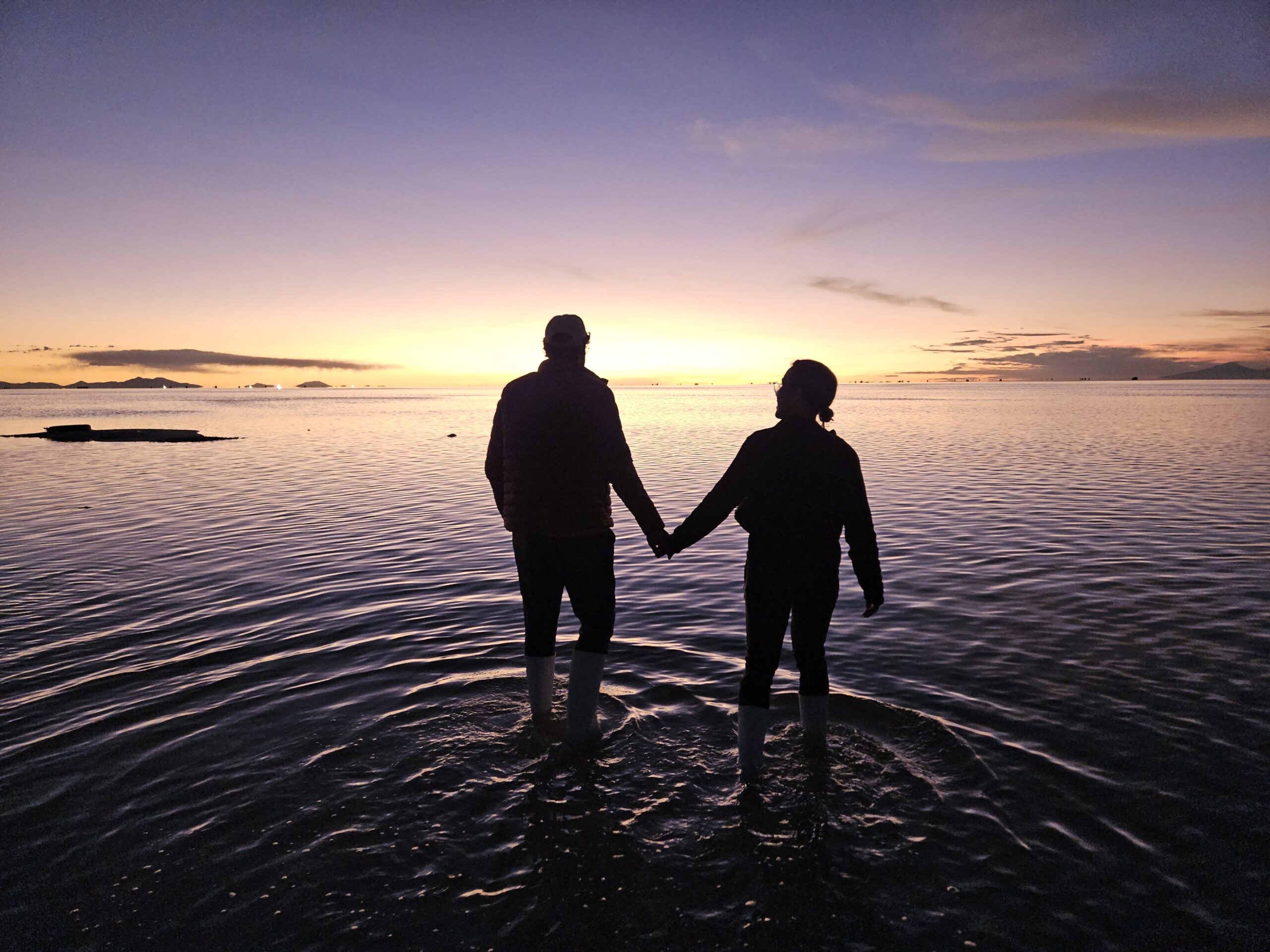
    If there is water in the Salar, you may need to hire some gumboots – when we were there in April, it was so deep that Emma’s gumboots were almost not tall enough (short person problems). Basically, if the whole Salar is covered, there will be deeper and shallower sections, which are inconsistent, and the cars driving around create lovely wee waves that will send you jumping for higher ground. It’s important to have protection because the salty water can really irritate your skin. If the water is low enough to use your own boots, probably in the shoulder seasons, take care to clean them afterwards to prevent damage.

    Another curious thing about the Salt Flats – they are a highway, as the salt is mined in parts of it, and it’s an easier, flatter path to enter Bolivia from Chile. Expect to see some big trucks randomly moving though, plus locals using it to get from place to place. However, the composition of the salt flat does make this complex. It’s not the most stable of ‘roads’ due to the compacting and crystalline patterns of the salts. There are sometimes massive pockets under the top layer of salt, which can cause a vehicle to sink entirely! The salt itself is problematic too – it can do some major damage to cars if left to marinate on the metal, so it’s important to clean it all off once you’re off the flats. 

    A Day by Day Summary of a Tour From Tupiza:

    Day 1: Lots of driving! We didn’t stop a lot – first, to enjoy the view of the hills around Tupiza. Then to watch some wild alpacas. There was a ghost mining town with a pretty crazy story to it. All day the views are great, but it is a long one!

    Day 2: Is inside the National Park. More llamas and flamingos today! Plus rheas and foxes on the roadside, if you’ve got your eyes peeled. Visit lots of lagunas of all different colours, take in desert vistas, listen to bubbling geysers and top it off with a relaxing stop at natural thermal baths. The views from the baths are pretty special too – Instagram worthy, if you’re going for that kind of thing. It’s a stunner of a day!

    Day 3: Start the day off by checking out some eroded rocks just sitting in the middle of the desert – if you’re good at taking photos, they’re great material, otherwise they’re just so curious to look at and consider just how they ended up like that! More lagunas await – we loved the vibe at Laguna Negra, which is one of the few lagunas which isn’t full of toxic chemicals. This means no flamingos, but a great variety of other birds – including Emma’s favourite, the Giant Coot, which builds a nest of reeds on the surface of the water and makes a call like a crazy person laughing – it’s incredible to hear. The last stop of the day is the train graveyard… we remarked that it’s impressive that they’ve managed to turn a bunch of useless junk into a tourist destination. It’s not super interesting for those who aren’t train spotters (and we think it’s also a great place to get tetanus, so watch out for the sharp edges), but it’s nice to wander around before settling in for one last night.

    Day 4: The Salar. Wake up before the sunrise, and be out on the Salar for the changing colours of the sky and some unbelievable reflections. Take breakfast with your group in the salt house, then spend some more time mucking around, taking photos, videos, wading through the flats, and generally enjoying this special experience. 

    If you’re starting from San Pedro de Atacama, cut out day 1 and the schedule should look basically the same. Reverse that – and it’s the tour starting from Uyuni. 

    There are plenty of ways to enjoy the Salt Flats, totally dependent on your trip length and the time you have available, but if you have the flexibility, visiting Tupiza in the first place (as detailed in our last post) and starting the tour from there is a great option to experience a little more about Bolivia and still end your tour at the Salar.

  • Travelling to Bolivia 2025/2026: Everything you need to know!

    Travelling to Bolivia 2025/2026: Everything you need to know!

    Bolivia is a seriously underrated destination. We were just planning on ‘passing through’ and ended up spending 2 months there. It is filled with an incredibly special culture, marked by a strong blend between pre-Hispanic indigenous groups and Spanish, catholic influence. Pachamama is as important, as figures from the bible; pagan rituals are as impactful as Sunday mass. The mountains and the jungle are sacred in many areas, with tribes continuing on with their traditional rites. Communities maintain strong bonds, celebrations are common, and the people are so varied – from the altitudes of the altiplano to the heat of the jungle plains, ways of life change immensely. It’s a country that has so much to offer, but that is best explored with time and plenty of patience.

    Many travellers don’t dedicate a lot of time to Bolivia – they’re in and out with a few key sights – Salar de Uyuni, Death Road, La Paz’s night life and teleferico, maybe a quick stop at Copacabana and Isla del Sol on the way to Peru. But there is so much to see in Bolivia, with some truly awe-inspiring mountains, so many quirky cities, a really pleasant climate (god, we miss the cold), and an incredible culture.

    We’ve read some blogs that interpret Bolivianos as colder, less welcoming than other South American countries. We think that this is a miscommunication. Across the board, our feeling is that Spanish is a language of love, of welcome, of hospitality. But so often our sense of warmth is linked to a feeling of hospitality, and that can really be a Western Thing – experiences in the traditional settings of cafes and hostels and restaurants. But Bolivia is far from the Western World – and more so than its neighbors. It receives less tourism, and it’s less influenced by international parties. Its indigenous roots have more of a say in the overall country of the culture. It’s different. And a western mindset is different to the people – maybe it makes them uncomfortable, maybe it makes them shy. Understanding that and being open to that is important to making yourself recognize the hospitality in Bolivia. Making all efforts to speak Spanish – visiting local markets with real local people – being respectful of people’s dress and culture – there are a myriad of ways to engage in a scenario where you are speaking to a local as an equal – rather than as a foreigner.

    Hands down, the kindness, smiles and hospitality we received in Bolivia was second to none when compared to the other beautiful south american countries we visited.  

    Click here to take you to short and sweet that summarizes this blog post

    Tell Me Everything

    Altitude & Coca Leaf

    One thing that can really mess up your time in Bolivia is the altitude. If you are coming by land via Brasil or Argentina, you should be travelling a route that ascends gradually – this is perfect for acclimatizing. If you come through Peru, Copacabana and Lago Titicaca are high, but if you’ve already been to Cusco or Huaraz, you should be somewhat acclimatized. If you travel across the desert from Chile – well, that’s a high altitude journey in its own right, so take care. And if you’re flying directly into La Paz, don’t forget that you’ll be resting in the world’s highest capital city. Seriously – altitude sickness feels shit, can ruin your trip plans, and, worst case, genuinely cause fatalities – so don’t go messing around when you first arrive! Our advise is to take 2-3 days walking around the city, drink lots of water and eat alot during the day. Your body will be working on overtime as there is less oxygen in the air so you need to fuel it properly. Dont try walk superfast up the hills, listen to your body and try keep your heart rate in zone 2.

    Coca leaves are the Bolivianos’ answer to the altitude. Coca tea, coca leaf for chewing, coca lollies – all are widely available and are touted to be an excellent way to stave off altitude sickness. While we’re not sure at the effectively against altitude sickness, there is no doubt that coca leaves have a real impact on your system, and it’s a huge part of the local culture (there is even a specific coca museum in La Paz!). Purified cocaine is made in a pretty complex process from the plant, but the leaves themselves have only a small amount. Consuming coca leaf is similar to drinking coffee – it helps you focus, keeps you more awake, leaves you on a little buzz. It also tastes fantastic! It’s easy to spot locals munching on leaves – the normal thing to do is to shove leaves into your mouth (don’t chew them too much), until you have a little ball in the side of your check – 10-20 leaves should do the trick. Then you just… leave them there, letting the coca-juices mix in with your saliva and slowly make its way into your system. Don’t swallow the leaves!

    Pro tip from Awal: If you’re feeling a bit tired on a hike, put some coca leaves in your mouth and watch the magic happen. I dont know if this was placebo but i was boosting up the hill for several hours.

    The Blue Dollar

    Up until at least August 2025 (as of writing), Bolivia’s economy is a bit… fucked. In the same way that Argentina had the Blue Dollar rate for many years (the ‘tourist rate’), Bolivia now faces the same situation. Today, the Bolivian dollar is officially valued at 7Bs per USD – but to someone in Bolivia, the dollar is actually for 13.5Bs. Why? Some weird economic thing, where the trust in the Boliviano currency is so low, the locals tie it instead to a cryptocurrency. Awal can explain… 

    But while this is rough for locals, who are constantly seeking USD to exchange, it means that as a tourist – you have a real advantage. Bringing in physical USD (or euros – there is also a Blue Rate) will mean you can exchange your cash at any casa de cambio and more than double the official value of your money. Official exchange houses may display the official dollar – but if you enter and ask, they will give you the blue dollar rate. There are plenty of people exchanging cash on the roadside too. This makes travel in Bolivia at this time incredibly cost effective. Double your money – half the cost of everything. This is a major reason we could spend so much time in Bolivia; we could do so much, for sure good value.

    Its important to recognize that although this is incredibly advantageous to yourself, locals do not feel the same way. Its important to remain respectful towards locals, especially with regards to comments made. Saying things like ‘omg thats so cheap’ is incredibly disrespectful when general locals are really struggling to make ends meet and can only earn in BOL. This topic is the top of every locals mind and once you get to chatting to a couple of locals, the topic will come up.

    A scenario to explain how this is impacting the locals is to use your hostel for example. Booking.com will take a cut from the booking made, the price advertised on booking.com will likely be bolivianos, even if it is advertised in USD, the hostel will use a conversion close to the official exchange rate, something like 7-9bol max. This means that when they pay their commission to booking.com, they will pay in USD, which they can only exchange at a rate of 7bol, when compared to the 14bol you exchanged for. YES, this is an unrealized loss, but the feeling of ‘missing out’ when you’re trying to run a business is a tough one!

    Accommodation:

    Your best bet for booking accomodation is to message the hostel directly on whatsapp and locking in a price in Bol. The last thing you want to do is book on a platform like booking.com, show up and have a disagreement on the exchange rate used. You will definitely feel like you are getting ripped off even if the hostel is using a slightly higher rate than the official rate as their standard practice.

    In our experience, booking through what’s app gets you a better price anyway as there isn’t a 10% commission added on top, with regards to these booking apps.

    Safety

    We found Bolivia overall to be incredibly safe. People were welcoming or shy and very rarely did we feel watched. Homelessness and substance addiction wasn’t prevalent in the places we stayed or explored, even though it was readily available. Obviously, this is our personal experience – the political climate can change drastically over the months and years. And we travel as a couple – which generally makes a lot easier, we know. But truly, the most concerning thing in Bolivia is the number of stray, feral dogs. The dogs around towns and on the surrounding hiking tracks can be a major issue – having a few rocks in your pocket (or a pair of hiking poles) is the best deterrent, as unfortunately they seem to only respond to aggression.

    Climate

    The altiplano holds the major part of Bolivia’s main attractions, and many more besides, High altitude means freezing nights, cold days (even with sun), and a much higher chance of sunburn. Lots of layers and good sun protection is important. Don’t expect to walk about in your shorts and jandals – your gringo ass will stick out like nothing else.

    While still on the altiplano, towns like Sucre and Cochabamba are in valleys at far more reasonable altitudes – and to match, there is more mild weather.

    Bolivia also stretches out to the east into the plains towards Brasil, and north into the Amazon. These regions are hot, humid and full of biting things. 

    Being near to the tropics, Bolivia experiences a pretty mild temperature change between summer (Dec – Feb) and winter (Jun – Aug), but the more distinct difference is the amount of rainfall. The summers are wet and the winters are dry. The shoulder seasons are the best for the Salar – getting a combination of wet and dry across the desert gives you the best of both worlds (although – when it is completely full of water, it is a real spectacle). The dry season is the best for hiking, and although it will be a little colder it’s always tit-freezing cold on the mountains, so it’s no big deal.

    Getting Around

    Bolivian bus terminals are an experience. There is no quiet terminal; upon entry you’ll be assaulted with the cries of sellers and their wares – namely, the titles of cities that companies run to, at full volume. This can make it easy to find the company you need, but always check around the terminal (or on an App like busbud, although it may not have all the optional) for the closest leaving time – and to check you aren’t getting a cheeky tourist tax throw on top. Because of the Blue Dollar, we definitely recommend buying tickets in person or via WhatsApp rather than reserving and paying online. All Bolivian terminals also have a fee associated with them, so you’ll have to pay a few BOL as you leave the terminal. This also means that the bus will stop a minute outside the terminal to pick up locals who don’t want to pay the tax – fair warning to take scheduling in Bolivia with a grain of salt.

    Overall, buses are the way  to go in Bolivia. Flying around is always an option, but it’s pricey, and the bus system is great. Even the bus we took to Rurrenabaque (often travellers’ ‘worst bus experience in South America’) was reasonably comfortable, although it was delayed a few hours due to awful roads. The buses consistently have fold out leg rests, even if they’re older, which makes a huge difference to comfort. Most of them don’t have seat belts… but that’s just the culture. We met one traveller at the terminal in Potosi who said he will only go on a bus with seatbelts, I think the brother is still looking for that bus!

    We’ve heard that there can be blockades which can really mess with your travel plans, usually in major cities like Cochabamba and La Paz. We didn’t experience this at all, but that’s pure luck. Keep up to date through your hostel.

    If you’re planning to drive through Bolivia yourself – fair warning that the fuel situation in Bolivia is complex and rather dire. The supply of gasoline is inconsistent and seriously inhibits foreigners, both in terms of price and availability. The locals will get served first and only if there is more to go around, foreigners will get fuel at an inflated price.

    Taxis are a fine way to get around in Bolivia. Uber isn’t really a thing, but with the Blue Dollar again – taxis are fine and economical. Just check with your hostel or a friendly local what the price should be, and try name your price rather than letting the driver do so. Never ask ‘how much?’, always say the price and then stick to it. Because youre a tourist, you will likely pay 10-20% more – if you are good at haggling – so just take it.

    Food

    Bolivian cuisine may not be the most inspired – but there are some gems out there to be found. 

    If you’re on that shoestring budget, finding a menu del día is key – ask your hostel for the economical options in town (we learned not to use the word ‘cheap’ – it doesn’t have the same connotations in spanish), or spend some time wandering the streets. Google Maps will often not show you what you want! They’re also rarer in the night, it’s more commonly a lunchtime offer.

    If you want to cook (although, it’s often just as economical to eat a menu del día), the quality of produce is excellent, and the markets in Bolivia are so so fun. We’d definitely recommend picking up produce and staying in a hostel with a good kitchen for at least a couple of nights, to make the most of all the amazing fruits and veges to eat.

    We’ve got a few core memories of Bolivian foods: namely, Saltenas, Bolivia’s greatest gift to the world. Saltenas are a Bolivian creation; while the name alludes to the Argentine city of Salta, the story goes that the creator moved from Salta to Bolivia, and the idea was first birthed in Bolivia itself. I don’t think there’s much of a contest from Argentina for the rights to a Saltena (they seem to prefer their empanadas), but my god – a Saltena takes the crown on all stuffed pastries. The filling is sweet, spicy and liquidy – the act of eating a saltena successfully is honestly an art, and if you’re not careful you’ll lose all the tasty juice and burn your hands while you’re at it. The pastry is short, not puffy, but also a little sweet, and pleated like a dumpling or curry puff to make a cute wee package. 

    Other outstanding foods that come to mind include papa rellenas (stuffed, deep-fried mashed balls), charqukan (a dried meat typical of the altiplano, served with mote and chuno), and anticuchos (pieces of heart skewered and cooked over a grills). Both papa rellenas and anticuchos can be found in Peru, although the style is slightly different. 

    Soups are another staple of Bolivian food culture. With your menu del dia you’ll receive some soup to start, most often with pasta (fideos) or quinoa. However, our personal favourite is Chairo, which is a rich beef stew. 

    Another major, major prevalence in Bolivia – potatoes. There are so many different varieties of potato in the region. We think that the most curious one is ‘chuno’, which is a potato that’s dried to last multiple seasons. They must be rehydrated for hours before they can be eaten, and this results in a really curious texture but a lovely flavour. They’re also black – which is kind of wild.

    I wouldn’t say that we’re connoisseurs of fried chicken, but I think we’re pretty close – and the quality of the dirty bird in Bolivia is OUTSTANDING! Whether youre buying it from the side of the road, from a chinese restaurant or a chicken shop, Awal will be the first to tell you that Bolivia has consistently the best fried chicken in the world. It’s consistently fresh, crispy and never too oily. Chicken shops are everywhere, and our favourite thing about it was something we’ve affectionately named ‘the holy trinity’ – with your chicken, you’ll receive fried rice, some noodles (well, pasta), and fries. It’s a meal that’s cheap, massive, delicious and an absolute recipe for gaining some weight. 

    The last point on the food list is an honorable mention; not Bolivian cuisine. We spent two weeks in Sucre, and so got to know it’s cafe scene pretty well… and we’ll never forget SOMOS, a cafe near Parque Simon Bolivar which served excellent coffee and the most exquisite cinnamon rolls – as i said, not a Bolivian staple, but a pastry that i will dream about my whole life. Don’t miss it if you’re there!

    Availability of International Goods

    Because Bolivia had no port and a fraught relationship with the USA, many international brands simply cannot be found in Bolivia; or if you can find them, they’re hellishly expensive. Expect to live without a few of the classic haunts, and don’t plan to do any branded shopping in Bolivia.

    Navigating While Hiking

    Tracks are not well defined in Bolivia – trail management is not a thing. This is an iconic part of the Bolivian trail experience, but don’t let that put you off. A bit of bush bashing or back-tracking never did anyone any harm! Mostly…

    We also found that (at least in the altiplano), the ‘tracks’ that we walked tended to be near mountainous settlements. People live traditional lives all over the place in Bolivia, so you’ll never be far from a random homestead… or a misleading cattle track. Our best advice is to check your GPS regularly, and trust your trailfinding instincts a little less than usual – cattle, sheep, goats, llamas – they’re all out there walking tracks that will not take you where you’re planning!

    Rubbish

    It’s not the worst place in the world, but Bolivia, like many places in South America, does have a considerable amount of rubbish that piles up around the place. While there are often signs which state ‘no botar basura’, it is not followed or punished. There isn’t the culture in the local populace to maintain the environment trash-free.There’s not much that can be done, so fair warning.

    Keep it Short and Sweet

    • The altitude is no joke – take it slow and always listen to your body.
    • Make sure you know if the Blue Dollar is operating when you leave; bring in physical cash accordingly. Check our budget post for an ideal of how much you might need.
    • Always make your own assessments and read the latest political news, but in our opinion, Bolivia is a safe place to travel.
    • Take clothes for all seasons – but mostly for the cold! The altiplano is frigid att night.
    • You could travel by plane, but the bus system in Bolivia is great and works fine.
    • The local food can be tasty! It’s generally not full of flavours – spices are lacking! – but they do the basics well and there’s definitely stuff to appreciate. If you’re vegetarian, it’s a little difficult…
    • Hiking is amazing in Bolivia, there are so many mountains and gorgeous views. However, the tracks are not necessarily easy to follow, and we didn’t come across any trails where you actually completely avoid people – there are people living all in the mountains.

  • An Essential Guide To Hiking in Northern Argetina: Tilcara-Calilegua Traverse (4 days)

    An Essential Guide To Hiking in Northern Argetina: Tilcara-Calilegua Traverse (4 days)

    This walk was a lesson in “if you’re willing to wing it a bit, it may just surprise you”. The Tilcara Traverse was a trail we picked based on a hasty search of Wikiloc, after a hot minute of deprivation from trekking (okay it was maybe three weeks… but it felt like months since Patagonia!). We weren’t certain what the hiking would look like in Bolivia, so we were willing to try something out before crossing the border. 

    We knew that we were going to be walking on paths less trodden by tourists, as all of the recommendations were by locals with local guides (and there were no blog posts at all!), but the kind contributors to Wikiloc had left great detail. The paths would still be well trodden, as the route we were going to take is one used by the people who live in the mountains – the range is dotted with pueblitos, so they need ways to connect to their neighbours, and to the roads for supplies. While the crossing from Tilcara to Calilegua is one of the most direct ways across the range, there are plenty of small trails that veer off to other villages and individual homes along the way. It’s an insight into a totally unique way of life in a really special part of the world; being able to see it first hand is a true privilege.

    It was also technically the ‘low’ season for this part of Argentina – being so far north, the summer/winter seasons are more like wet/dry, and of course hiking in the wet season is never ideal! 

    Click here to take yourself to short and sweet where we summarize this blog post.

    Tell me Everything

    Because the trail runs between villages, and actually amongst a lot of private land, the trek is a homestay to homestay number. We camped nights 1 & 3, and stayed in beds on night 2 (the weather was rubbish and the price was great… who were we to say no?), but even on the nights we camped, we were on someone’s property and were able to use a flushing (!) toilet and a makeshift shower. The relevant people can be contacted on WhatsApp before; this is most important for night one as the Yuto Pampa is not a village, but is a loose collection of houses – other homestays may be in the area but it’s not clear.

    Our original plan was to hike from Tilcara to Molulo, then return by the same route to Tilcara – because the trip back to Tilcara via road is so convoluted, and there are so many buses to catch, we were a little hesitant to waste a day or two travelling back around when we wanted to get to Bolivia (read: had meant to be in Bolivia two weeks prior…). However, the first two days were so spectacular (and we had descended SO much), that we decided to continue in the spirit of ‘just wing it’, and figure out the buses as we went along. And well… read on to see how that went!

    Day 1: Tilcara to Yuto Pampa (7-9hrs)

    It was not a good start. Our hostel host had organised a taxi pickup at 8am to the trailhead, which is at Casa Colorada, with an agreed price of 35000ARS – which was on the limit of what we were willing to pay for a 50 minute taxi. Halfway through breakfast our host burst in to inform us that the taxi was actually only going to take us to La Garganta del Diablo for 35K (a 30 minute drive, but the day before we’d walked it in one hour!) – and if we wanted to go to Casa Colorada, it was dependent on the ‘condition of the road’ (the weather had been perfect) and was going to cost us 50K! Clocking out at nearly 75NZD just to start our hike was an absolute no-go for us, and we were pretty upset as we felt like our host had been untruthful and it was feeling really, really scammy. We told him we couldn’t catch a taxi for that much and he got pretty mad – in Spanish, so unintelligible to us – and pretty much stormed out of the dining area while saying we had to follow up our end and take the taxi regardless of the cost.

    That was a pretty bad vibe – we had been planning to leave our spare kit at the hostel, but we really couldn’t afford to take this taxi, and we didn’t want to leave our stuff in the lap of someone who was potentially going to be looking for revenge. When the taxi arrived, we had a conversation about the mishap – the driver was very amicable, and relaxed about letting the job go. Nevertheless, with a few angry WhatsApp messages waiting on the phone, we shot out the door with all our things and spent the next 30 minutes finding a new hostel to book a room post-hike to secure our bag storage.

    In hindsight – we do think it was a genuine mistake by the host, and not that he was in kahoots with the taxi driver – partially because we walked past the taxi stand on the way out and checked their (always inflated) prices. The language barrier is always tough with this kind of thing. We spent the rest of the day to-ing and fro-ing – we were in the right, we were in the wrong. But at the end of the day it was done, and we had an extra 600m elevation and 6.5km to tackle!

    From Tilcara village, follow the track to La Garganta del Diablo. Without packs, this takes an hour – with packs and a burning sense of injustice, it also takes an hour! Continue along the road for another hour, climbing steadily, until you reach Casa Colorada. When we passed by, it seemed deserted; we had contacted them on WhatsApp for room prices out of curiosity, but there was no response at all, so we aren’t sure what the deal is there. Either way, it’s the last place you’ll find real shade the rest of the climb – so take a break!

    The road then continues on vaguely, but eventually peters out and becomes a normal track. The trail really just is switchbacks, cactus, and views over the valley until you hit the saddle. We were incredibly lucky with a cloudless stunner of a day but with a decent breeze, so we never got too hot. At beginning of the saddle, there’s a small river crossing via rock bridge, and then you enter a flatter valley filled with flowers and lush grass that rises to the maximum point of the hike, before descending somewhat to Yuko Pampa and El Cokena Refugio for the night.

    We would love to tell you that the views are gorgeous, that the descent into the pampa is magnificent – and while we’re sure it is, we have no clue personally, as the weather completely clouded over for us before we even reached the high point! We reached the refugio damp from cloud, rushing from impending rain, and feeling a little off from the altitude. It’s an important point to consider – even if you start from Casa Colorada, it’s a massive gain, and you’ll be sleeping quite high. We’d messaged El Cokena’s owner in advance, so they knew that we had our own gear – we guess that was why there was nobody there to greet us, and why the dorm rooms were firmly closed & locked. They don’t seem to live in or near the refugio (again, visibility was terrible, so we could have missed something), but there was a flushing toilet (that is, a toilet designed to flush, with big buckets of water to flush it yourself! No plumbing needed) and shower under a concrete shelter which were open to use. We had a bathroom, running water, and a flat space to pitch up – what else could you want!

    With the altitude playing tricks on our appetite, it was cookies with nutella and peanut butter for dinner, and an early night.

    Day 2: Yuto Pampa to Molulo (5-7 hrs)

    Day 2 also started a little miserable – the cloud hadn’t cleared, so we woke up fairly damp and still without a view. The altitude sickness was still playing on us, and who wants to cook breakfast in misty rain, so it was a quick pack down and off we went. The track continues to descend into a valley – and with this descent, we finally got some clearing clouds and some very cool sights of red clay against green hills, with horses and cattle peppering the hills. Down it goes (and down slips the hiker!) until the river that carves out the valley, and then it’s back up the other side. The track is not entirely clear in this section due to the livestock, so check your GPS regularly. The trail then winds around the tops of this part of the range for some time, which we think would give incredible views on a clear day – maybe even all the way to the yungas forest from certain points. We were lucky enough to see sporadic vistas of our close surroundings – little hamlets would appear randomly at the base of the ridge we were walking; peaks would suddenly loom out from across the valley; sunlight would peek through to warm and dry us off for a few minutes. Not quite knowing what we were walking through really added a layer of mystery to the journey. 

    Yea, couldn’t see nothing!!!!!

    The track eventually leads you into the village of Molulo. Here, there is a school and a little hospital, and a collection of houses and two or three homestays to pick from. The popular refugio in the pueblo is Refugio Lo de Lili (according to Wikiloc), but we found an alternative called ‘Mi Esperanza’ – and we couldn’t have been happier with our choice! The area is generally quite muddy, there’s not a lot of grass, plus we’d been walking in rain all day, so we elected to splurge for the night on a dorm bed each – 15K ARS each, about 21NZD. The family we stayed with were so kind and welcoming – plenty of chooks, a couple of friendly dogs and a tiny wee puppy wandered the yard, and along with Soledad, our host, there were four relatives of varying ages. They were all a little shy (except for the youngest – she was so curious, of course!), but we felt very welcome. The accommodation was basic, a mixture of traditional adobe and concrete, but so comfortable. Another ‘flushing’ toilet, too! They gave us some space once we were settled in by heading out (to a market, or a friend’s place – we weren’t sure), so we cleaned up and relaxed in the common area, had a hot drink and finally got set on cooking a hot meal!

    By the time our host Sole and her family returned, we were feeling pretty chuffed with our decisions and comfortable and warm inside. We knew a good night’s rest was just around the corner. We also knew that if we followed our original plan of an out-and-back, we were going to spend tomorrow hiking up all the downhill we’d just trekked down… so we decided to continue down the trail to Calilegua. We toyed with the idea of walking all the way out the next day – but Sole laughed at the idea, telling us that while she could walk all the way out in one day if she needed to, there was no way that us gringos would match her mountain pace! Our plan the next day would be to head to the next pueblo of San Lucas, and stay the night at Sole’s recommendation of Refugio Montana Ramona. 

    Day 3 :Mololu to San Lucas (6-8 hrs)

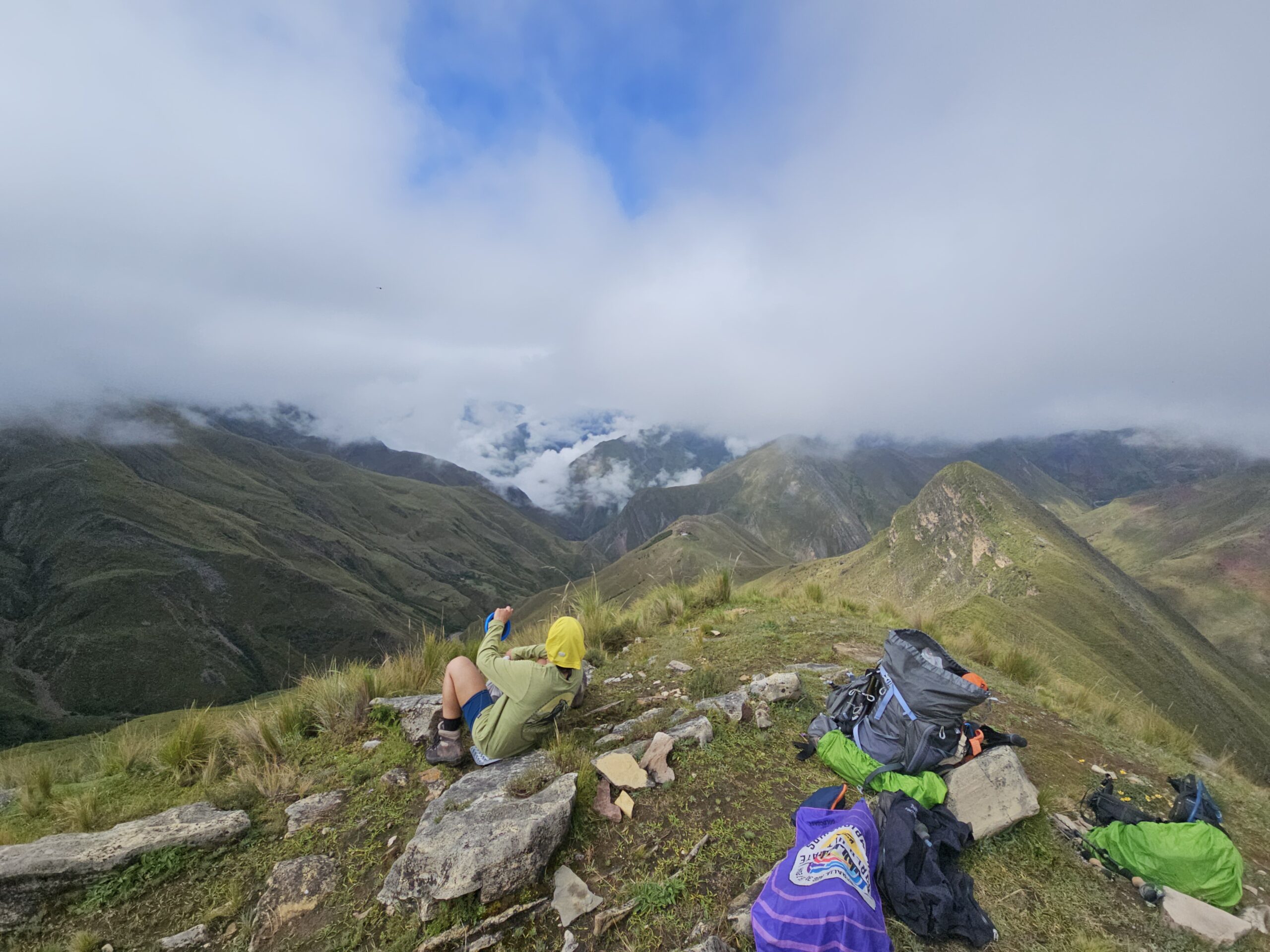
    We woke up early, (just in case we made good time and could make it all the way to the road) to clear skies on day 3. With a quick breakfast we began the trek down to San Lucas. The first part of the day was unbelievable – Molulo sits tight up against the hills facing east, but the refugio itself was tucked in behind some trees, so we couldn’t see the sun rising. However, once we were out of the village and onto the trail – the vistas were insane. We finally got the full picture of where we were walking. The track is reasonably flat to begin with, cut into the side of a hill. An alternative track runs along the ridgeline above you, if you want to start the day with an ascent to see a different view, but there are plenty coming. Our initial views were just across hills of alpine grass, but as we continued we got an idea of where we’d come from – even higher hills – and where we were going. The yungas were covered in cloud, as rainforest is so commonly, but the sights of the yellow-green of the pampas graduating into verdant forest, which quickly disappears into a blanket of cloud as far as the eye can see – well, it’s a pretty humbling perspective. 

    The track follows the sights – the rough alpine plants were replaced by bushes, then eventually trees began to surround us, and suddenly we were back amongst humid clouds. The altitude is still reasonable at this point, so it’s not hot – yet. The trail is pretty well worn and clear for this section, and the whole section is mostly downhill – but it still requires concentration, as it can get very, very slippery, especially on sections where the red clay is the prominent. There are a few small uphill sections, and throughout the trail enjoy the variety and beauty of the jungle growths.

    Walking into Refugio Montana Ramona

    Coming into San Lucas, the track widened out into a grassy area, with horses popping in and out of the bushes. Refugio Montana Ramona is well signposted and is the first dwelling in the village proper. The Refugio is run by two kindly old sisters; we arrived as they were doing some building work in one of their rooms – the language barrier meant we didn’t quite know what, or why, but we were eventually able to communicate that we just wanted a spot to pitch our tent, and we didn’t need food – it seemed like they weren’t keen to take dorm visitors and didn’t have the time to ‘host’ properly. Once they realised we weren’t going to be a hassle, they were happy for us to hang out. This refugio was so lovely. As it’s the first property in the village, it sits at the top of the hill with a great view of the valley. There’s an outdoor undercover space to hang out in, with a big table to sit and cook and eat. There’s only enough lawn to pitch one or two tents, but as we were the only ones there, it wasn’t a problem. And there was a proper flushing toilet, and a hot shower if you were feeling fancy! There are lots of other homestays in San Lucas, as it’s a reasonably big mountain village, but if you can get a spot at Ramona we would highly recommend it. 

    We had arrived quite early, so we spent most of the afternoon lounging, drying off our gear, playing with the kittens and the dog (or watching them get uncomfortably close to our tent), and generally enjoying life. Eventually the views turned to rain for the evening, so we were very happy with some shelter from the rain.

    Day 4: San Lucas to Pena Alta (2.5-4hrs)

    We woke up before sunrise to get on our way. We’d done some research before we left (and hence decided to only go halfway-and-back…), and our hosts confirmed that there was only one bus from the trailhead to Libertador General San Martin, and it came at 4pm. From Libertador General San Martin, we’d have to catch another bus to San Pedro de Jujuy. Then another to San Salvador de Jujuy. Then another to Tilcara. A logistical nightmare! But we were filled with hope – for hitchhiking is common enough in Argentina; all we needed was someone to be driving along the road.

    So we were off early, slipping and sliding through the clay tracks of San Lucas, in the morning mist. The track is a little convoluted through the town as there are lots of houses and connecting trails, but once you’re out it’s very straightforward to the road. The track descends quite a lot to start, down into a ravine. The track then follows the wall of the ravine, which is pretty spectacular, occasionally passing over or through connecting waterfalls. The descent is slow along the ravine, until it’s not! But this is the final section – a drop down to the water, across a bridge, and then back up 100m or so until the trailhead. By this time you will be sweaty – the altitude isn’t enough to stop the heat and humidity, and it’s really mosquito central. Have your bug spray ready if you want to stop. 

    We really hustled through this section, and took a short break at the road before beginning to walk towards San Francisco – the closest town about 7km away – as we thought that getting a hitch might be a bit more likely from there. Luckily, we weren’t walking for 20 minutes before a ute stopped for us – a friendly young Argentinian guy who was happy to take us to San Francisco, although his plan was to head to Termas del Rio Jordan, a famous thermal spot on the river, to pick up his friends who were kayaking down towards there. We thought that sounded ideal – a touristic area was way more likely to have people coming and going, and our chances of snagging a ride would be way better. Our new friend was munching on coca the whole way, and was happy to practice his English with us, so we had a good yarn before he dropped us off at Cañon de los Loros – a little further than he’d meant to go, as he needed to find a local guide to take him down to the termas. There were plenty of people at the Canyon, so we were hopeful, but all of them were tour groups who were just starting their canyoning tours, and then continuing onto San Francisco – so, the wrong way! 

    We hung around for 20 minutes or so, before Awal suggested continuing walking away from the groups of people. We looked a little out of place, there was a bit of traffic around, and there was a little bit of a mind game behind it, too. Do you think you’re more likely to give someone a hitch if you see them struggling? Looking miserable? Or just hanging out at a touristy area, looking hopeful and bright… Awal thinks the former is a better play, so we got our packs on and started walking (again) along the road. Now, it was really just luck, not strategy, because the first car drove past us while we were walking without a second glance, but the next car – well, it was our saviour! We were picked up by a super kind Argentinian couple from BA, who were on a birthday holiday in the north. We spent the whole drive out of Calilegua yarning – in broken Spanish, with a bit of Google Translate thrown in, but they were so interested, kind, and welcoming to their country. AND in a stroke of complete luck, they were staying in San Salvador – so they offered to drive us all the way there, directly to the bus station. We were totally overwhelmed with kindness – and the pure luck of being able to get back to Tilcara in a single day. 

    Lovely Argentinean couple that gave us a 4hr hitch

    This was one of those hikes that totally, unexpectedly worked in our favour. The views were sporadic but it meant they were so much more memorable. The locals were kind, helpful and welcoming – not just our hosts, but the people that we met on the trails who were going about their day to day. And of course, without the kindness of friends who offered us a ride all the way to San Salvador (4 hour drive), our experience would have been completely different. We finished up in Tilcara with warm hearts and full of gratitude.

    Keep it Short and Sweet:

    Climate: Wet in summer – December to March ; dry in winter – June to August

    Total Distance: 65km

    Elevation: 4500m up and 5780m down

    Description: A one way; homestay-to-homestay (book in advance via WhatsApp) track that traverses a mountain range. Walk between small mountain villages in alpine grasses into a humid jungle. If it’s not overcast, there should be fantastic views from the alpine hills across the jungle plains.

    Track: Non-technical, mostly well trodden, not always well marked.

    Facilities: Homestays with dorms or a space to camp; flushing toilets; makeshift shower; running water (filter needed); food available if you book in advance

    Getting there: The track can start from the town of Tilcara. The ‘road’ ends at Casa Colorada, so it’s possible to take a taxi if the conditions are good enough (50000ARS) or walk there from the town (extra 2-3 hours). 

    Day 1: Tilcara -> Yuto Pampa. Steep uphill most of the way, with views of Tilcara and the surroundings in the valley. At the ridge, take in the views then continue to descend into the pampas. The homestay we contacted didn’t have the bunkroom open, I believe because we had our own tent. The toilet and a makeshift shower were accessible. You will have passed through some substantial altitude, so increase your water intake and be sure to eat well. Homestay: El Cokena – Marcela (+54 9 388 477 9368)

    Day 2: Yuto Pampa – Molulo. Descend into the valley, cross the river, then ascend the other side. The track can get a little unclear in patches after this, so check your GPS to eventually descend into… and stay at the home of Sole Martines (+54 9 388 462 4023), Refugio Mi Esperanza

    Day 3: Molulo -> San Lucas. Continue around the alpine ridges for a few hours before descending into the jungle. It should still be cool enough that there aren’t any mosquitos. Stay at one of the homestays in San Lucas – we camped at Refugio MontaNa Ramona, which is the first refugio in the village, without a booking. 

    Day 4: San Lucas -> PeNa Alta (trailhead). Descend for about 4 hours, mostly alongside the river, in a ravine, until reaching the road at a point called PeNa Alta. You’ll be watching out for mosquitos by the end of this track – keep your repellent handy.

    Getting out: Is complicated! The range you’ve just walked over is not passable, so you have to drive all the way back round (or double your distance – hardcore). The bus only runs once a day from the trailhead to Libertador General San Martin at 4pm – 5pm. From there, take separate buses to San Pedro de Jujuy, onwards to San Salvador de Jujuy, then finally to Tilcara. Factor in an extra night to travel back. Agencies may offer private transport if you’re willing to pay. We were able to get a hitch hike straight back to San Salvador – which was incredibly lucky, as we only had to catch one bus.

  • Border Crossing From Argentina into Bolivia & The Wild West of Tupiza: Everything you Need to Know!

    Border Crossing From Argentina into Bolivia & The Wild West of Tupiza: Everything you Need to Know!

    From Humahuaca, we caught the night bus to La Quiaca, which is the border town in Argentina to Bolivia. The night bus arrived at about 7am in La Quiaca, which is when the border opens. We walked around 15 minutes through La Quiaca to the border, as there were two of us and it didn’t feel particularly unsafe (contrary to many things that we’d read online). What happened next… was the quickest border crossing we’ve ever done. There was nobody else approaching the border from the Argentinian side, so we were stamped into no-mans-land within a minute. Then we crossed the bridge toward the Bolivian side only to see a line of people waiting outside – as Bolivia is an hour behind Argentina, the office wasn’t open yet! But when we asked one of the security guards what to do, he encouraged us to just pop our heads in – when we did, a bored-looking officer took our passports and disappeared for another minute, came back with our Bolivian immigration slip (DO NOT LOSE) and waved us on our way to Villazon. The line waiting outside the Bolivian immigration office was to exit Bolivia.

    Click here to take yourself to short and sweet where we summarize this blog post.

    Tell Me Everything:

    Overall the border crossing genuinely took about five minutes – and we ‘gained’ an hour of time, just crossing the border. We also found that the exchange houses at the border actually offered a reasonable rate – or, perhaps that with the Blue Dollar rate the difference was not going to bother us. However, we did get played for buying the first SIM card we found – 50 bolivianos for the SIM itself! When we bought a second in Tupiza, it was only 20BOB. But with our access to the internet restored, we walked to the bus terminal – again, the town felt safe and we were comfortable to walk rather than take a taxi, and it took about 30 minutes.

    From the Villazon you have a few options for a direct bus, depending on what you want to do. 

    • Tupiza, 4 hours: we took the bus directly here, to settle into Bolivian travel and then start our tour of the Salt Flats. However, by heading immediately west, we missed out on…
    • Tarija, 8 hours: we learned afterwards about this stunning town at moderate altitude in Bolivia. Tarija has plenty of swimming spots and beautiful architecture to occupy you inside and around the town. Besides, it is part of Bolivia’s wine region – a drawcard for many! This is a location of the beaten track but still with plenty to do. If you have the time to explore, we’d suggest this as a stop in your route. 
    • Uyuni, 8? Hours: Salt Flats tours are a day shorter from Uyuni, and with many more operators driving competition, your overall spend can drop decently. However, unless you’re really short on time we’d definitely recommend visiting one of the above options and potentially taking a tour from there!
    • There are other options further afield – Potosí, or Sucre, though it’s most efficient to tour the Salt Flats before exploring the rest of Bolivia – unless you’re trying to wait for the mirror effects of the wet season (Jan – Mar).

    Tupiza:

    We didn’t really have many conversations in Villazon, so it wasn’t until we arrived in Tupiza that we began to get a feel for Bolivia. I’ve read quite a few blogs which comment on the reserved nature of Bolivianos – especially compared to the hospitality found across the rest of South America. We found that this was so far from the truth. 

    Fewer tourists in Tupiza mean that the locals are much more interested in your story – I had a lovely conversation with a couple of ladies selling tamales, who were confused (yet excited) as to what I was doing in their little town. 

    So what were we doing in Tupiza? Primarily, using it as the third (least popular) location to start a tour of the Uyuni Salt Flats & surrounds. The tours from Tupiza are a day longer than those starting in San Pedro (Chile) or Uyuni, so they’re a little pricier. However, we liked the extra day, although there is a lot of driving, it’s a nice way to meet people and it was fairly quiet, especially compared to the 3rd and 4th days where we were really in the same crowds as the normal tours. There is a lot of sitting and driving and chatting/listening to music/napping, so this lazier way of travelling may not be for you.  We had a really fun group (luck of the draw) and the last day you take the salt flats tour, which is the really awesome part. We went with tupiza tours – who were fine, but we wouldn’t recommend them. Our guide was awesome and the food was tasty, but there wasn’t enough for any of the meals – your own snacks are absolutely required. We met others that were on other tours and they had no complaints about the amount of food served. So do some research before you book!

    However, Tupiza absolutely has its own charm that is worth exploring. There’s a small mercado central to pick up produce, and the streets around it will be filled with vendors too, or head to the Mercado Campesino for more variety. 

    The surroundings of Tupiza are also worth your while. The town is famous for its similarity to the Hollywood depictions of the Wild West – think cactus filled desert, craggy rocks, reddened soils. Seriously! It’s some insane landscape. It’s lower altitude that a number of other spots in Bolivia, but still somewhat arid, so it’s stinking hot in the middle of the day with strong sun and lost of dust, but we still had some mozzies in our room at night. 

    To enjoy the desert landscapes, you can explore on foot – a real all-day excursion. GPS, water and sunblock are all essentials! Be aware of trail dogs, some of whom can be aggressive. Keep some rocks on hand to scare them off. Walking from town is viable, but you can also take a tuk-tuk to reduce the distance.

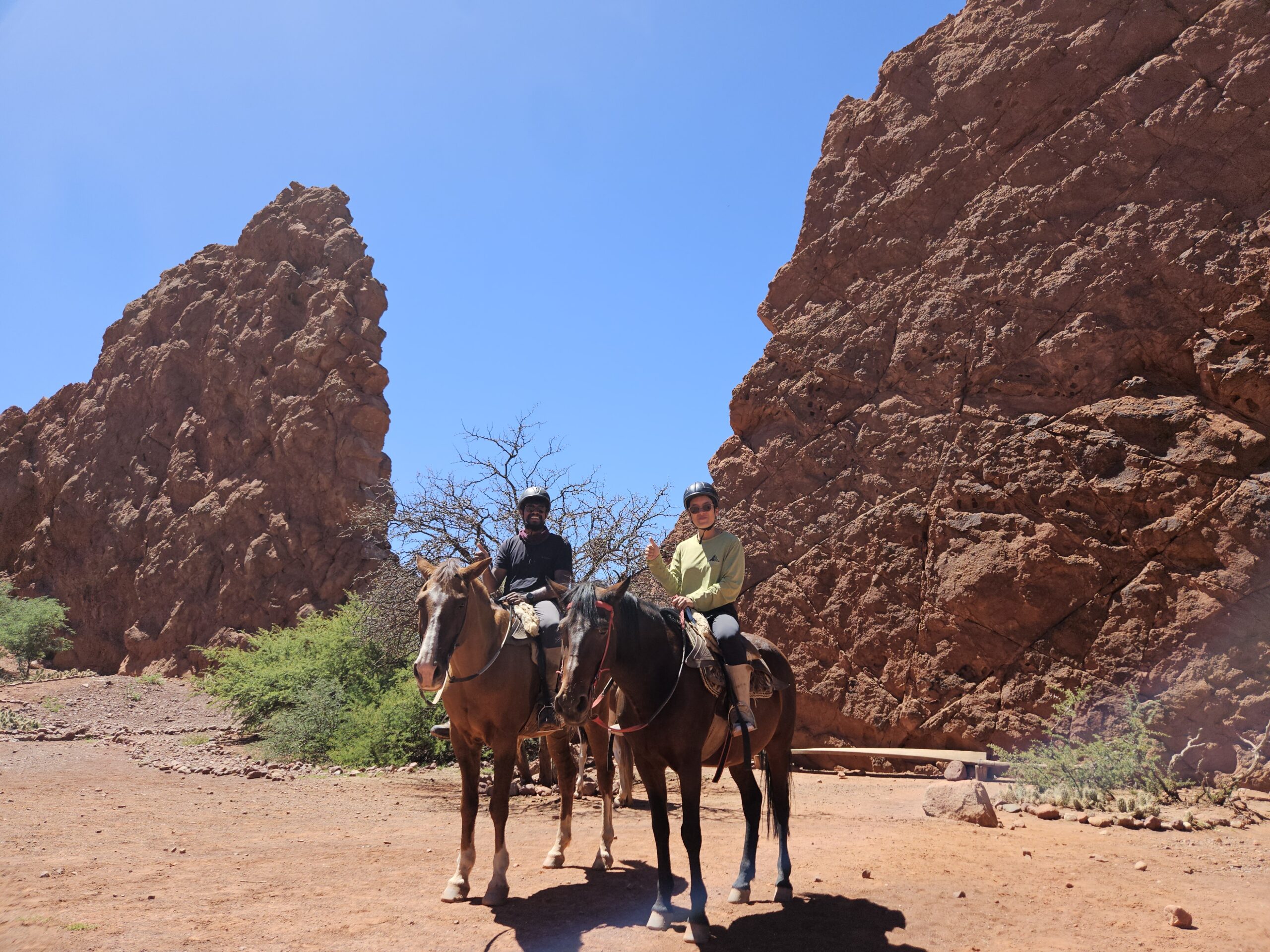
    We chose to explore Tupiza in the most fitting way possible – on horseback! There were options for 3, 5 and 7 hour tours, depending on what features you wanted to visit – we went with 5, and could hardly walk the next day… but it was so worth it! Although we both have next to no experience on horseback, we felt super comfortable with our guide, the horses looked happy, and the whole stable group were so friendly. And we kind of felt like cowboys – we even got to ride the horses at a trot, which is HILARIOUS for uncoordinated first timers. We went with Club Ecuestre Amazonas – highly recommended.  Get in touch with them on whatsapp to make a booking.

    The main features to visit in the desert are:

    • Canon del Duende – a narrow pass which opens up into a canyon with some spectacular rock formations. Best done on horseback as it is further away from town.
    • Puerta del Diablo & Canon del Inca – easily combined on a walk. The first is a cool looking piece of rock, and you’ll have to pass it to visit the canyon. The canyon goes on quite a way, although it starts off with a small ‘climb’ up a little rock face – and it was our last visit on our horse tour and we were feeling a little heat-strokey, so we didn’t continue on.

    This is a good thing to note though – we weren’t walking or exerting ourselves much on horseback, but by the end of the 5 hours and in the midday heat we were both feeling a little poorly – bring plenty, plenty plenty of water if you decide to go out into the desert!

    We stayed in Hostal Butch Cassidy – there are not that many hostels in Tupiza, so we mention this one because the rooms were comfortable, the breakfast was good, and it had a tidy little kitchen. We spent two nights in Tupiza, which was perfect for us. After horse riding in the morning of our full day, we lunched and rested before checking out the sunset from the Mirador Corazón de Jesus. It was an early night and an early start for the Salt Flats tour the next day!

    Keep it Short & Sweet:

    • Crossing the border from Argentina (La Quiaca) into Bolivia (Villazon) is best done early in the morning, but can be so quick and easy – depending on your passport and the requirements for a visa.
    • From Villazon, we’d suggest catching a direct bus to Tarija to explore Bolivia’s wine region and some beautiful-seeming swimming holes.
    • We caught a direct bus to Tupiza – a great place for seeing some Bolivian life off the beaten track, wild-west horse riding and launching a tour of the Salar de Uyuni.
    • Alternatively, there are direct buses to Uyuni, if you’re in a rush or aren’t interested (but we’d definitely recommend being interested!

  • Exploring Northern Argentina: Salta and Jujuy Provinces

    Exploring Northern Argentina: Salta and Jujuy Provinces

    It’s difficult to change the way one travels, as much as one may want to – old habits die hard, and our are formed from a deep-rooted need for organization and order, along with a strong sense of competition (it’s us vs. the daily budget). We are self-aware enough to realise that while on some days we can embrace ‘just going with it’, most of the time we do not. But as we reflect on our time and travels in Northern Argentina, we realise what really helped was keeping an open mind – to be more comfortable connecting through a stuttered conversation in Spanish, and a moment to take it all in.

    Tell me everything:

    As noted – the main attraction of the Salta and Jujuy provinces was the allure of revisiting Argentina at a more economical price, as our previous visits were in southern Argentina- much more on the $$$ side. We arrived in Salta on a Friday night from San Pedro de Atacama via a long bus ride through beautiful and winding mountains. In Salta, we were greeted by a lively, cheerful atmosphere. We walked from the bus terminal, down a main road into the centro historico, which also met alongside an evening craft market and a huge number of food stalls selling giant hot dogs, burgers and milanesas at thrifty wee prices. Families were out, friends were out – having been the first ‘city’ we’d visited in months (bar Santiago, which we literally breezed through), we were ready to enjoy some local comforts!

    Salta is nicknamed ‘La Linda’, the beautiful – the centro historico is well preserved, with white facades and lovely architecture perfect for photography. There are also plenty of churches to marvel at (we didn’t take a walking tour, so we don’t know why so many), so there’s a great calling for just wandering around, looking at knick knacks and shops during the day. We also love a good market – both for a good deal and to look at all the quality produce (even if we’re just going to cook a plain pasta dish – again). The mercado municipal in Salta is a great place to pick up anything you need – one thing I love about the South American markets is picking up dried herbs and spices, because you can just buy a massive bag all at once instead of the silly, tiny plastic bags they sell at the supermarkets. So much more efficient!

    Salta was also a major change in climate for us – we’d been from the wind and cold of Patagonia (even in the summer!) to having our noses dry out in Atacama, to Salta – hot late-summer days, a humid, jungle like feel and – god forbid – mosquitos in the backyard! Despite the heat, our favourite thing in the city was a sweaty hike up Cerro San Bernado. A well worn staircase will bring you from some fancy suburbs up to the summit with magnificent views across the city. You can take a cable car up to the summit if you aren’t able to walk it, and from the summit you can also catch a gondola to a neighboring peak – for even more views! Bring plenty of water in the summer – it’s a hot one.

    Now for something we haven’t covered in a while – food! After many moons of cooking and eating dinner in our hostel, we were able to get something more than just a coffee. In Salta, we had the best lunch of empanadas we’d ever thought we could find. There are lots of little spots selling empanadas, and lots of Google Maps reviews stating ‘they’re the best we had in Argentina!’. Certainly, the quality across the board is higher, but our favourite spot was called La Ollita. It’s not in the centro historico but so absolutely worth it. Not only were the empanadas fabulous value for money – so kind was the lady who took our order – patient with our poor Spanish, full of recommendations, big on smiles. We bought a dozen empanadas to share – 6 chicken, in the oven, 6 cheese, fried – all of them, to die for! We ate them in a nearby park, freshly cooked, and burnt our mouths enjoying them so much.

    Another key element in the food scene of Salta, and north Argentina in general, is the Pena. Penas are an experience, not just a restaurant, made so by the musicians who occupy the rooms every night. A talented group will be employed or contracted by the restaurant to play traditional folklore music late into the evening. Classically Argentina, penas only open late, and run late into the night. We must have left around 11 and there were still people just arriving for dinner – on a Sunday, too! We visited ‘La Casona del Molino’ for our experience – it seems to be a bit of an institution, for tourists and locals alike. We booked in advance via Whatsapp, because while you can turn up at any time, there was a line waiting for the doors to open. Once we were in, we were guided through a series of rooms to sit out the back – my impression was that you could sit anywhere, or at least that moving around was acceptable, as each of the different areas had different performers – pick your style of music, pick your seating, and have the perfect night! The food was plentiful, and good quality, and the two fullahs who performed in our section had the most stunning voices – many of the locals were singing and clapping along, but there were a few other clueless gringoes peppered about too. We ordered the parrilla for two (great value!) plus tried the Locro, a (delicious) regional stew. If you can’t make it to La Casona, or don’t want to head so far out of town (it’s very safe to walk around at night in Salta, so if you need to walk off a big meal, it’s doable!), you can try Balcarce Street for alternative penas.

    Feed at the Pena

    One night, we cooked at home, but felt like a little something extra… wandering down Avenue San Martin towards the bus terminal from the centre will offer plenty of street fast food – think fries, sandwiches, burgers, and hot dogs – in a super cheerful setting. We grabbed a (very salty) milanesa to eat for second dinner, and enjoyed watching the people go by. Just a note for where the cheap little snacks are!

    Now, getting out of Salta and around the province is a very popular trip; plenty of agencies offer day excursions, to the North, West and South. If you want to explore more of this area of Argentina, renting your own car is the best way to do it – however, we were sold on the prospect of travelling north towards Bolivia. It seemed to be a fairly blanket cost of 35000ARS pp for a full day tour – not including lunch, but including quite a lot of driving, in some cases! 

    In Salta Province, many of the pueblitos (small towns) are so popular because they are so cute – think colourful buildings, or well maintained colonial architecture, handicraft markets and real local vibes. A lovely combination of good photography ops and a real snapshot into Argentinian life. We didn’t visit any specifically, but we got some details from a local tour agency and did a little research to figure out what we thought was worth it. We think overall, a road trip through the following would serve you better – more time to pick some day hikes, and more freedom to skip the spots you find boresome! 

    To the south, the key stop is Cafayate, a wine-making town set amongst red rocks. Tours definitely include a stop at the Quebrada de Las Conchas, the Shell Canyon, to check out some fossils and rocks, but I think the itinerary has a few other spots en route – this area has a number of vistas.

    Immediately to the west of Salta is the town of Cachi – although it’s not so straightforward to get to, as there is a mountain range in between! However, day trips do still go here to see this picturesque little town and we did some reading that there is also some hiking to be found in the mountains of this area.

    Heading to the North West will take you past the Salinas Grandes – Argentina’s own salt flats. We didn’t need to take this tour, as our bus from San Pedro took us along highway 52 and straight through the middle of them! While we didn’t stop, it was a stunning sight out the window, so we think worth a visit. 

    Usually tours will loop back through the town of Purmamarca, a town known for its ‘Mountain of Seven Colours’. The valley that it’s set in is certainly beautiful (again, our bus passed through on the way to Salta), but we didn’t see it in the flesh.

    Now – we can give a little bit of personal advice on heading to the north! By this time in mid-March, we’d had nearly three weeks since our last multi-day hike – and we were itching for another way to explore the countryside. Using Wikiloc, we found a few random multiday trails, but nothing seemed particularly popular in this area – moreso because summer is the rainy season in the jungle areas. We decided to try out a trek from Tilcara, which had a handful of good reviews – a homestay-to-homestay hike, from the alpine pampas to the humid jungle. We’ll do another post on the details but – this was definitely one to remember! We had some incredible uplifting interactions with people, and a real taste of Argentinian hospitality and kindness that you may hear so much about.

    Other than a multi-day, Tilcara is popular for a short day-hike to the Gargantua del Diablo (if you read the last post, you’ll find this is a recurring theme – though this one refers to a waterfall rather than a narrow gorge!), which is a nice way to spend a morning. The entrance was 3000ARS pp. The market in Tilcara is tidy, and a great place to pick up fresh produce and see what’s up. We also found a really lovely cafe that served the most insane cakes – La Casa de Champa. We both got a full portion slice, which it turned out to be a mental amount of sugary deliciousness – we had to take the leftovers away. Their outdoor area was lovely to sit in, and we spent some time journaling here. Otherwise, Tilcara has quite a few international restaurants for such a wee town. If you’re looking for a cheap meal, Killa O Wasi serves a decent menu del dia for dinner, with basic but yummy kai. There’s a couple of other spots to check out if you want to spend more than a day here, a historical site and a cactus filled botanical garden, but we didn’t go for them.

    Tea and coffee at La Casa De Champa

    Our next stop on the trail up to Bolivia was Humahuaca, which bests Purmamarca with its Mountain of 14 Colours! We took a ‘tour’ for 15000ARS each, though the tour guide didn’t have much to say (and all of it was in Spanish – and ours was still not very good at this point!), we met our Brazilian friend Guillerme and a wonderful Argentinian couple by taking a shared van up to the site. We saw a few Vicunas on the way up (how are their eyes so large?), and the mountain itself is gorgeous and lovely to just gaze upon. It does run up to quite a high altitude, so if you decide to take the short walk to the lower viewpoint, be prepared to puff on the way up! And in another unexpected moment of kindness, on the drive back down Florian & Esteban helped us indulge in our first mate experience – kindly, not judging when we didn’t know to slurp on the straw as we finished. And while we have no frame of reference, their organic yerba was incredible and delicious and we are so grateful that on our last day in Argentina, we were able to experience such a key part of this culture!

    Photo with Florian, Esteben and Guillerme after our first mate experience

    Other than this tour, there’s not a lot to do in Humahuaca – but there’s some good cheap street food near the river, and we tried Llama Cazuela in one of the restaurants here – a traditional plate of the area. One thing that we might’ve tried if we had a little more time (or the freedom of our own car) is a tour to Inca Cueva, which is a historical site to the north of Humahuaca that involves a small amount of hiking.

    And thus ended our excursions in Argentina’s north – a part of our trip that surprised us, surprised us, and surprised us again. Everything in travel is great for different reasons, and while ‘no expectations!’ can give you a good experience, it’s the unexpected human interactions and snapshots of a whole different culture that leads to satisfaction.

    Keep it Short & Sweet:

    • Salta: Not the home of the Saltena, but certainly an excellent place to pick up a delicious Empanada, or experience local food and traditional music at a Pena. 
    • Spend a morning walking up Cerro San Bernado for some sweet views. 
    • Wander through the old town for shopping, chaos and churches galore! 
    • Pick up cheap street food along Av. San Martin. 
    • And it’s a great place to start a road trip, or take some full day tours: explore South for canyons, wine tastings and gentle hikes, West for the Salinas Grandes, or North for charming towns tucked in alongside dramatic Andean valleys. In March 2025, all of the day tours were about 35000 pp.
    • Explore the north: 
    • Tilcara offers a sweet day hike to the Gargantua del Diablo (if you read the last post, you’ll find this is a recurring theme – though this one refers to a waterfall rather than a narrow gorge!), or an extraordinary hike across the mountains, from the pampas through to the selva. Check out our next blog post for more details.
    • At Humahuaca you can jump in a 4×4 to explore Serrania de Hornocal, the mountain of 14 colours, or if you feel like a dash of history, a day tour to Inca Cueva, an old Incan site.

  • Exploring Northern Chile: San Pedro de Atacama

    Exploring Northern Chile: San Pedro de Atacama

    San Pedro de Atacama is one of those places on the Gringo trail – and while I think it’s deserving of the popularity, don’t forget that it is a highly popular, heavily touristic little town. The town sits around an oasis in the high-altitude Atacama desert, and its popularity stems from its proximity to many different natural vistas – colourful high alpine lakes and birds, Mars-like rock formations, geysers, star-gazing, salt-rich lagunas, canyons and pre-Colombian ruins. Many of these activities are day-long activities, either requiring a tour or a rental car – it’s a hive for excursions, and you could spend days making your way in and out of town.

    But a concentration of tourists and activities makes one thing certain – nothing is free! Every new area that you enter, lagoon that you set eyes on, path to cycle down has a little price tag set against it – and while the communities need to (and should) make their margins off us Gringos that come through, it can be tough on budget travellers who might like to hike on their ‘saving-days’, but even that is costly.

    Excuse the whining – read it instead as fair warning – because San Pedro does pack a punch in “things to do”. Although, our other observation is that many of them will require several hours driving and not a lot of walking – and our personal vibe is that there are only so many times you can pull over to take photos before it gets a bit hoha (tiresome), but many other reviews seem to have the opposite opinion.

    Click here to take yourself to the short and sweet section for the main informative points from this post.

    Tell me everything:

    Car Hire

    We found the most efficient manner to explore San Pedro de Atacama was with our own rental car. Note: we did this with only two of us, and it was still substantially cheaper! The tour companies are sneaky and don’t include park entry in their ticket prices, so check on that. The crux of the matter lies in hiring the cheapest car possible, and I can imagine the mathematics may not apply in the peak-peak times. We hired a sweet little Suzuki Swift, which sounded like it would be a right nightmare, but just take it slow to avoid the potholes and let everyone overtake you. You should be enjoying the views while driving anyway, so just chill! There are certain tracks you can only take with a 4×4, which will nearly double the cost for car hire, but read on for more details & make a decision based on your vibes.

    The descriptions below are itineraries we nicked from the tour agencies. Get them to give you a run down of the tour in person if anything is confusing below. I can’t comment properly, but because these are all sightseeing tours, we felt no need for a guide initially, nor did we feel as though we missed out on anything substantial without one.

    Note: always have at least a half tank of gas (in our experience) and offline maps downloaded. You’ll go into quite remote places. We used nearly a whole tank of gas over two days – which was pretty efficient. We paid 100000CLP for the Swift for two days’ hire, and 37000CLP for fuel. There is only one gas station in town that is notorious for scamming tourists so please make sure you check your receipts and you bank app that the amount charged is correct!

    Road Trip 1: Piedras Rojas (South) + Lagunas Piedra y Cejar + Ojos y Salar

    This one is a long day of driving! Leave early towards the town of Socaire, where you can grab a feed if needed and you’ll have to pay for your ‘park’ entry – 15k CLP pp. Continue on to where the views begin. We drove all the way out to Laguna Tayajto before stopping for our first photo ops, then turned around to come back, but really you could go all the way to the Argentinian border if you love to drive.

    Most of the viewpoints on the way back are clear & on the main road, and all involve a small amount of walking only. Don’t miss the turn off to Lagunas Miscanti and Miñiques – up a sandy road, a lil’ suss in the Swift but doable. There was heaps of birdlife at Miñiques, and we saw our first Flamingo!! So cool.

    If you haven’t mucked around too much on the way out and want to squeeze everything in, turn off to Lagunas Piedras and Cedar on the way back (swimming), and the Salar & Ojos del Salar (photography). I do think you’d be pushed for time to get all of this in, so it’s probably easier to do another, shorter road trip to these spots – we missed them because of time, and because all three had additional charges that we didn’t want to budget in.

    All in all, this road trip was cool, but driving to see sights is not something we rate highly. In saying this, the sights were worth the drive so we would recommend it.

    Road Trip 2: Highest Geysers in the World (North East)

    Another long day, but not as long. The best time to arrive at the geysers is while it’s still dark – which means a really early wakeup, and driving down a road full of potholes in the pitch black – not ideal. Nevertheless, it makes for an adventure, and one that is pretty sweet.

    The coldness of the predawn makes the geysers the most impressive, both because they blow higher and because of the amount of steam they then generate. Let’s be real – you won’t be seeing 10m blasts – the average height is something like 133cm. While there are a range of different type of geysers to admire, check with the person who takes your ticket where the most active geysers are (they were the furthest ones when we were there) and listen into the tour groups to figure out which ones are likely to be popping off soon – we caught some cool movement luckily by doing so! It’s bloody freezing as you’re up nearly at 5000m, so definitely don’t forget to layer up. Your ticket (15k CLP pp) has no end time, so enjoy the different Geysers until the sun rises and you can warm up. 

    We had our breakfast (brought our camping stove for hot coffee, honestly amazing) on the small hill just outside the park – most of the tour groups eat there too, so going a bit later also assures some peace. One of the tour groups were finishing up their breakfast and offered us their fresh fruits and biscuits, which we kindly accepted!

    Afterward, start back towards San Pedro with a few wonderful stops. This road is stunning, and you won’t have seen it yet! Appreciate the mountain views and straight roads. Spot Vicunas and Alpacas and birdlife (MORE FLAMINGOS) in the wetlands as you descend – there are a few miradores & clear places to stop. You can pause at Puri Libre (or Termas de Puritama & pay) for a thermal bath. If you feel like walking, take a wander through the Cañon de Guatin to spy some cool cactus.

    This was definitely my preferred trip – the views were more impressive and the geysers were really interesting. We saw far more wildlife, though that’s mostly luck! It’s also less driving (or maybe we just started much earlier?), so we were back in town late afternoon as opposed to night time.

    Road Trip 3: 4×4 Cerro Toco (East)

    This one got away from us, as the tours were even pricier and the 4×4 hire was out of budget. The trailhead for this 5604m peak is only accessible on a rough road that a poor wee Swift can’t handle. Although it’s high-altitude, the climb is supposedly non-technical and easy to do without a guide – though double check this with a local before you set out as things are always changing, and triple check that you’re acclimatised, as this hike hits some real heights! We also don’t believe there is an entrance fee for this hike.

    Night Road Trip: Stargazing

    If you’ve got a car hired and you’re a star lover, why not find a spot out of town and away from street lights to enjoy the clarity of looking at the night sky in a high altitude desert. In winter, there is less rain and cloud, so the likelihood of getting a truly clear night is much higher. The higher altitudes generally have clearer skies and less pollution than at sea level, so you should be able to enjoy some sweet views! Of course, you can also take a tour if you’re so inclined, there are plenty of offers within town. There is a huge observatory close to San Pedro de Atacama – we were hyped to do a tour, learning about the kind of astronomy that they perform (and to look through some huge telescopes!). Unfortunately, most of the time the observatory doesn’t actually run tours, but also do an extra check.

    Bicycle Hire

    Another great way to explore San Pedro de Atacama is on two wheels. There are plenty of options for bike hire around the town, for either half or full day. You could probably do the two valleys below in a single day, though you’d be hooning around for a long while and the sun does get blistering in the middle of the day – so take plenty of water. We paid 7000CLP each for a half day of bike hire – a full day was 16000CLP.

    Valley de La Luna 

    We hired bikes for half a day and cycled this route – you can easily get to the ticket office from the town, and while you have to cycle for a small while on the main highway, there are big shoulders that mean you will feel pretty safe even with the cars zooming past. At the ticket office they give you a map with all the different points of interest, which are all on an out-and-back road that runs into the desert. The suggested activities totals up to 2-3 of walking plus a couple of hours of cycling. Each of the stops is pretty cool, and it’s nice to switch between taking the landscape in on a bike and more slowly by foot. Entrance was 10800CLP.

    The entrance ticket also includes a viewpoint on the top of the hill, which is a great spot to watch the sunset – however, it’s not very accessible by foot, as it’s quite far from the town. If you want to enjoy the evening sun from this spot, make sure you hire the bikes for the whole day, or have a car to travel there in the evening. You can also just purchase a ticket for the sunset view, if you want to return, though we’ve advised an alternative (free) sunset location below.

    We both had incredibly sore butts by the end of the day, as the road is fairly bumpy! Fair warning if you’re not used to biking (like us) and plan to do more hours on the road.

    Gargantua del Diablo 

    As we only hired bikes for half a day, we didn’t get to this location. There is also an entrance fee here, paid at the entrance to Valle de Catarpe (currently it appears to be 5000CLP pp). It’s supposedly a great ride with a completely different type of scenery to Valle de la Luna, and a little mirador at the end that you must walk to. It may also be comparatively quiet to other locations you visit in San Pedro, as it’s further down the main tour list at agencies.

    Pukará de Quitor

    If you’re feeling like delving into a little bit of history, visit Pukara de Quitor, a remnant of the indigenous Atacama people. You can arrive at this site by bike, as it’s close enough to the town, but you’ll need to explore the grounds on foot. There is an entrance fee, and we can’t comment on the worthiness of the site itself, as we didn’t visit.

    Free Sunset spot at San Pedro De Atacama:

    Watch the sunset at Mirador Likan-Antay

    Keep it Short and Sweet

    There is so much to do in San Pedro de Atacama, but all of it will be dry, hot, high-altitude (make sure you take time to acclimatize) and cost you a buck or ten.

    Travel by: Hire car (instead of taking the same as a tour) and rental bike. We recommend hiring the car through West Rent a Car

    Road Trips: Piedras Rojas (15000CLP pp), Geysers (15000CLP pp), Lagunas Piedra y Cejar + Ojos y Salar (unsure on cost)

    Hiking Road Trip: Cerro Toco

    Bike tours: Valle de la Luna, Gargantua del Diablo, Pukara de Quitor.

    Tip: This list is not all inclusive! Check at the local tour agencies for all the activities that are available in San Pedro de Atacama, and don’t be afraid to use their itineraries as inspiration for your own self-guided journey. 

  • Exploring Bariloche: The four Refugio Hike and More!

    Exploring Bariloche: The four Refugio Hike and More!

    There’s no rest for those who love to hike – we had one night in a hostel in El Calafate before jumping on a plane to our final Patagonian destination: Bariloche, where warmer weather finally awaited us. In fairness, the weather was too warm – a series of wildfires had started a few hundred kilometers south of Bariloche, and for the previous few weeks the wind blowing from the south had been bringing ash and smoke into the skies. We got super lucky, and arrived as the prevailing wind turned. We had wonderful weather without a trace of the disasters further south. 

    Bariloche was the first reasonably sized town we’d been to since we left Puerto Montt. It was a bit of a shock to see so many bustling people, both locals and tourists, but overall the vibe was pretty cool – fancy chocolate shops line the main street, with stores full of Argentinian knick-knacks and anime filling the gaps. A small plaza overlooks the lake, and we arrived on a Sunday so there were plenty of locals out enjoying the sunshine, purchasing snacks and generally contributing to a sweet summer vibe.

    Bariloche was to be our last stop in Patagonia before we took a break from hiking and began to travel north towards Bolivia. We had eight days to explore the surrounding parks –  but after already spending 10 nights in the tent, we were keen to combine the hiking with some R&R. Thankfully, we spied a little B&B for a reasonable price, so the b

    Tell me everything:

    The Four Refugios Hike (well, two)

    Two days in Bariloche and we were off again, onto the popular Four Refugios hike. Of course, we weren’t staying in the refugios ($$) , but our tent (-$), although some of the refugios do have a large enough common area to accommodate campers – at least until dinner is served.

    This one didn’t go quite the way we had planned – it wasn’t just that the budget allowed us to spend less time in our tent, but that the rain forced us to cut this hike short. We spent two nights at Refugio Frey, taking a day in the sun to relax a bit, followed by one night at Refugio Jakob before the rain packed it in. The staff at Refugio Jakob strongly discouraged us from taking the route the next day to Refugio Negra (which also happened to be the most difficult section), and told us the National Park had actually closed the track for the weekend, the weather was forecast to be so bad. One of the staff described an ‘alternative’ route – that was, hiking down to the road, along it for 5km, and then back up the track to the next Refugio – totalling about 30km in the rain, with about 1000m of elevation in both directions. Once we got to the road, wet and cold, we decided it was a no-go plan. We ended up booking a last minute AirBnB within an hour’s walk of the trailhead, in the small village of Villa Nahuel Malal. Call us softies, but it ended up being the perfect little cottage – with a wee kitchen and a comfortable outdoor area – it made us feel as though we were still in the outdoors, but with the creature comforts a roof and hot water bring. Awal’s knees had started to play up with the elevation changes, so the extra days of recovery were well worth it. It does turn out that some of that ended up being beach time, because the forecasted ‘weekend storms’ never arrived! We had days of blue skies by the lake.

    The standard Four Refugios loop takes only four days. The order is Frey JakobNegraLopez. You can book at the huts online, either camping or in the refugio itself. They all have a limited number of booking slots (which is why we stayed at Frey two nights), although in the end as far as we could tell, they aren’t too worried on the number of campers who actually turn up. Please note that it snows during winter here so sometimes it is not possible to access certain huts and they are closed. Each respective website will be the best place to find the most recent information. Each refugio has a different amount you’re meant to pay to camp, though Frey was free when we were there. There are flushing toilets at all the refugios too – fancy! The refugios provide dinner & breakfast (for extra $$$), and you can buy lunch, so if you’re not inclined to bring food up the hills, you can purchase meals (and extra snacks) as needed.

    Each refugio is accessible from the road, but the track goes over mountain passes to join up to each of them. This does mean that on weekends & in general throughout the summer, they fill up, as locals can do overnighters easily. Frey is also a popular spot for climbers – which makes it extra busy!

    Getting There:

    There’s a public bus that leaves every hour from Bariloche, #55, that you can catch to “Cathedral” (ski area), which drops you at the trailhead. A Sube card is necessary, but you only need one for a group. The fee is relatively higher than others (we recall 5k ARS each), as it’s about an hour on the bus and it’s a popular tourist route both in summer and winter.

    Day 1 (~4 hours)

    Once at Cathedral, you’ll be dropped at a big parking lot. Check your GPS for the track start (or follow the line of people). It is well marked, once you find it. The track climbs steadily for about 30 minutes until you reach a highpoint over Lago Gutierrez. The track is exposed and provides gorgeous views as you walk alongside the lake. Eventually, you reach a pass, where you will turn northeast and begin to ascend again through forest – we spotted a woodpecker in this section, so keep an eye out for birdlife! Eventually, the forest clears and it becomes rocky scree and low bush again, and there’s a final ascent to Refugio Frey, which sits next to another Laguna for picturesque views.

    Note: Some people do this as a day hike, or you could do it as an overnighter loop, looping this section in with the start of day 2. The circuit goes up the first pass, and then back down to the west around Cerro Cathedral. We didn’t check out the route, but we read a few other blogs that said this path can be pretty steep and sketchy in sections – so have some good boots to keep you steady.

    Day 2: (~5 hours)

    As above, the track continues on around the laguna and up the first pass. The first uphill section is just a tough slog upward, and you eventually will arrive at a second, smaller laguna. The next section is a bit more challenging and fun – there’s a bit of boulder scrambling to get up, using your hands and a little rock climbing. Once through the pass, there are some gorgeous views of the surroundings, so take it in for a moment before beginning your descent! The descent is pretty steep, with some sections of thick scree (fun) and some of light scree (slippery as hell). You’ll descend into the forest and skirt the edge of the valley, walking east. There’s a campground marked on the map here, if you’d prefer to wild camp off the tops, and it seemed like a really nice spot. Continue on from there to eventually start rising again – one more pass! This climb is much less technical and a lot gentler, although the descent on the otherside is again, rough, the shots of the refugio nestled in against another the laguna are very very cool.

    Day 3: (supposedly, 10 hours)

    From here on, we have no personal experience. This section of the track is supposed to be the most difficult and the most poorly marked. As noted, it does seem like the National Park is a bit overkill on what is difficult and what is probably totally doable, but it is still above the bushline so always take care with the weather and ask if there is snow or ice on the trek. We do have some friends who couldn’t attempt this trek because all the passes we snowed out!

    Day 4: Trek to Refugio Lopez

    This day takes you over another pass to Refugio Lopez, but it’s meant to be quite a short day. Enjoy a long rest at the refugio!

    Day 5: Trek out of National Park

    You have a couple of options for this day – the short option, straight down the hill to the road for a couple of hours, or take the scenic route around to the lakefront and end in Bahia Lopez.

    Once you’ve finished your hike, you can take the bus from along RP77 (so if you take the short route, youll need to walk along the road a bit) back into Bariloche, but we’d recommend finding some accomodation along the waterfront and out of Bariloche so you can enjoy some of the day hikes at the end of the peninsula!

    Cerro Llao Llao

    This regional park is the main section of daywalking. There are several tracks that sort of join up, which offer hiking in between some huge & gorgeous pine trees, plus beach access. Visiting Mirador Llao Llao is a must, as the views to the lake are stunning. If you stay back in town, or somewhere along the coast, buses go from Bariloche, along the coastline to near the trailheads. The stops are by a handful of fancy restaurants and hotels, if that’s your post-hike vibe ($$$$).

    Biking Circuito Chico

    An alternative way to reach Cerro Llao Llao, and explore a bit more of this area, is to explore by bike – known at Circuit Chico. This (quite) hilly circuit should take at least a whole day, as it’s not just the riding that you’ll want to do but also the day walks around Cerro Llao Llao and stops to some of the pueblitos on the route, such as the quaint Colonia Suiza. We didn’t end up completing this circuit – although we wanted to – as the bike hire was actually quite expensive, and Awal’s knees were still on the ginger side!

    Nahuel Huapi National Park

    We’ve described one hike in Nahuel Huapi, but this national park encompasses more than just the four refugios trek. Check on the National Park website for all of the refugios, campsites and tracks that you can link up. You could spend days in the park, drifting between refugios and enjoying the outdoors, but as mentioned before, check on conditions in the mountains before you head out, as some of the passes can get gnarly. 

    Check out the official website for a list of hikes, both multi-day and single-day. Note that the park has an entrance fee, though the only place this seems to apply is in the Cerro Tronador area (which does look like a wonderful overnighter!). https://nahuelhuapi.gov.ar/

    Seven Lagunas

    If you’ve got time and, more importantly, a hired car on your hands, there’s more to do around the Argentinian lakes district. We had neither, but we would love to return one day to complete the seven lakes road trip. This driving route runs from Villa La Angostura to San Martin de Los Andes. You can stay in gorgeous little Argentinian villages and drive through spectacular scenery of glossy lakes and mountain peaks. A quick look can be taken in one day, or you could spend a few checking out the route and exploring the little towns and some small hikes.

    Hiking to the South

    With a car, you can also turn to the south of Bariloche – and to more national parks. Alerces is another very Popular park with plenty of hiking options, although with the lack of accessibility it should take you away from the crowds somewhat. Alternatively, you can visit Lago Puelo NP, which is closer.

    Overall, Bariloche itself offers plenty of cool things to do, gorgeous scenery, and yummy snacks (we went to this chocolate shop (https://maps.app.goo.gl/X211zoyUukaqMeLL8), which was a lot cheaper than the ones on the main strip, but the chef was genuine and enthusiastic and the choccy was delicious!!), we would love to return one day and continue exploring the area.

    Keep it Short and Sweet

    • We only did 2 days of this hike as the park closed due to bad weather
    • the bad weather never arrived!!!
    • You need to book spots at the refugios and campsites
    • You can purchase breakfast, lunch and dinner at the refugios
    • Catch bus #55 from Bariloche to the “Cathedral” (ski area) for the start of the hike
    • You will need a Sube card to catch the bus. You only need one per group. You can buy them from a kiosko but get one early as they seemed to be nearly all sold out when we were there!
    • Day 1 and 2 were moderate in difficulty. Day 2 specifically has alot of desending so take care of your knees!
    • Cerro Llao Llao is a beautiful regional park for day hikes
    • You can also do a bike ride along Circuito Chico. We found bike hire to be 35000ARS
    • You can do the seven lagunas- if you have hired a car we strongly recommend this!
    • Delicious chocolate at a reasonable price: https://maps.app.goo.gl/X211zoyUukaqMeLL8
  • Los Glaciares in El Chalten: Patagonia’s Most Famous Hikes & A Moral Conundrum 

    Los Glaciares in El Chalten: Patagonia’s Most Famous Hikes & A Moral Conundrum 

    It’s curious to consider how a region gets famous, and the fine difference between popular and overrated. Is it the difference between online-generated expectations and reality? Is it the crowds of people? Is it the burgeoning prices? Or some perfect, unfortunate combination of the above.

    Parque Nacional Los Glaciares is probably the most heavily visited area of Patagonia, iconic for Petito Moreno Glacier in the south, near El Calafate, and for the Cerro Fitz Roy mastiff in the north, by El Chalten. The accessibility of natural beauty from these two towns is a key reason for their popularity. Petito Moreno is an hour bus ride each way, but only a 30 minute walk to see an advancing glacier. And while trekking to Fitz Roy is a fairly long day (25km return), the trailhead is right in town. These two small Argentine towns have a mountain-village charm that – for us – was somewhat worn down by exorbitant prices. 

    Prior to summer 2024 – 2025, there were no fees to enter Los Glaciares. Prior to January 2025, there were no camping fees in the park, and wild camping was permitted – but all of this changed, quickly, without warning, and without the infrastructure to support the changes. 

    Entry to Los Glaciares now costs 45k ARS per day – although Guardparque Stations only exist on some trailheads, and the Guardparques are only serviced from 7am-5pm, so avoiding the fees is very much doable. A night’s stay at any of the campsites in the park costs 15K ARS per person – with long-drops available, but no campers’ shelter.

    As in our previous budget posts, the high cost of goods is some unlucky combination of Argentina’s changing economy and Patagonia’s isolation, but all prices are also driven by demand, of which there is plenty. Of course, we are complaining as reasonably well-off tourists – so if we found the prices in supermarkets rough, it only stands that the locals have it even harder.

    But while consuming food and booking accommodation supports the local community, it sounds like the changes to the park and park fees themselves are having little impact on the local people or the park maintenance itself. Although, whether that is the truth or a tale designed to make us all feel better, we have no proof.

    We’d say that in general, we’re pretty rules-driven people. We like lines. We think sign-in books are cool. We’re comfortable paying for an honesty campsite. And we both instantly feel guilty when we do something that we know isn’t right – so camping in Los Glaciares was a mixed bag for us. 

    We planned the trip to El Chalten based on information collected from the previous year – which turned out to be wildly wrong. It wasn’t until we had booked flights in and out that we checked again – on reddit – only to find out about all the changes to prices. We were already massively over-budget in Patagonia (a good start to a year travelling!), and couldn’t even remotely afford an extra 60USD each per day. Our only option was to hide out in the park, free camp in secluded places, and enjoy the solitude as much as possible.

    Tell me everything:

    Overall, we spent 11 days in Los Glaciares, with one restock. Five days were on the Huemul, which we’ve detailed in another post, then another 6 in the ‘main’ section of the park.

    Skipping Petito Moreno

    We flew from Ushuaia to El Calafate, as we’d already travelled through Punta Arenas and Puerto Natales, and didn’t need to return (and it ended up cheaper). We decided to only spend a single night in El Calafate, skipping a visit to the Petito Moreno Glacier. If you’ve the cash to burn – don’t do what we did! It does sound spectacular. The walkways are close to the glacier front, so you get stunning views all around. In the afternoon, it’s supposedly common to see the glacier calving, where it sheds chunks of ice. But it’s 45k ARS entry (as part of Los Glaciares), plus 50k ARS for the return bus. That’s about 100USD ea…

    Bus Prices: Calafate to Chalten

    Talking about extortionate – buses in Argentina are far more expensive than those in Chile. The three hour ride between the two mountain towns will set you back 38K ARS per person, each way. Apparently, there is one bus that’s cheaper, but we don’t think it runs often (or at all) anymore.

    Camping at Laguna Sucia

    After the Huemul Circuit, we restocked and reentered the park late, snagging an uninspired camping spot in some trees a couple of hours in. The next day, we continued on with the intention of enjoying Fitz Roy from the neighbouring Laguna Sucia, rather than the main track, and camping there the night – we’d read and heard that there were lots of good campsites on this track. As mentioned, we had snapped a picture of an old park map, which had multiple tracks that are no longer displayed or ‘recommended’. So when we went to turn off onto the Laguna Sucia track, there were a couple of signs telling us to turn back! We ploughed on, crossed the river and did some fun boulder hopping to get to the laguna – which is absolutely worth it. It was super quiet, and the weather was stunning – no wind, no clouds, and only one other person, who wasn’t camping there. We picked a spot with a big rocky barrier someone had kindly built, and settled in for a calm evening.

    Little did we know – although perhaps it should’ve been obvious by the absence of other campers at the laguna – a storm was coming over the mountain. And that’s the problem with camping near such dramatic peaks; the sudden changes they can cause. From 9pm, the wind and rain picked up more, and more, and more, until we were pulling on rainproofs, crawling out of our shaking tent, restaking pegs and tightening guys – and eventually, changing clothes completely, packing up everything non-sleep related, and considering packing down and leaving. But at 3am, the storm eased off a bit (to the point where we didn’t have to hold up the tent’s buckling pole system), and we slept uneasily until sunrise. We snapped a cute photo and enjoyed the morning light on the mountains, slept a few more hours, then made our way down the mountain and away from the horrors of the previous night.

    Camping by Lago Electrico

    We’d wanted to spend two nights at Laguna Sucia recovering from the Huemul, but there was no way we were taking another chance there. Our next goal was Lago Electrico – at the far end of the park, and far away from the big crowds. It also turns out, Lago Electrico is actually private land and isn’t technically part of the park. There’s a shitty little barbed wire fence that has been maneuvered to fit a hiker, but otherwise we were easily able to move between the two without any guard stations.

    From the base of the Fitz Roy trail, we traversed down the true left of the Río Blanco, which enables you to take a side trip to some cool views of Glaciar Piedras Blancas. There’s a bit of rock hopping around this section too, which is fun, but will slow you down a bit. With the pack weight and the tiredness, this actually ended up being a much longer day than we anticipated.

    Río Electrico and the valley run perpendicular to the Cerro Fitz Roy mastiff – that is, it runs in the direction that the storm came the night before. This didn’t become obvious until we exited the cover of the forest, right after the Piedra Del Fraile refugio. Camping at the refugio was available for 20k ARS a night, so we continued on to brave the winds…

    … which did not work out in our favour. It took over an hour to reach the shores of Lago Electrico, where again, we’d read there were good camping spots – all of which were super exposed! There were a few ‘sheltered’ areas amongst the rocks on the way, but the wind simply said no – it must’ve been gusting at well over 100kph, and always found a way to rush around or over the surrounding escarpment. As we retreated back from the beach, we tried to set up in three different spots, quite unsuccessfully, and eventually were forced to run back to the trees, racing a rain front and the dying sunlight, and setting up camp alongside the cliff-face ascending to Piedra Negra. It was cookies and nutella for dinner.

    We spent three nights in the same spot – the next day, the sun shone and the trees gave us shelter, so we spent the whole day lazing around, eating our spare food and enjoying the break. The following day, the rain packed it in again, so we had a slow morning before taking a day-walk back to the shores of Lago Electrico. Emma really wanted to see the marked ‘Playita’ campsite on the map, but the river was impossible to cross without getting boots wet – so in the spirit of taking it easy, we enjoyed the view of the back of Fitz Roy and headed back for an early night.

    Cerro Fitz Roy

    Day 10 in the park – a few hours walking took us from Lago Electrico and back to the big crowds, and it was time to join in – for the most famous peaks in Patagonia. Actually, only Emma ascended to admire Fitz Roy from the traditional spot, and Awal stayed with the packs (a kind gesture, but also driven by being a wee bit hoha). It was a gorgeous day; although the wind was howling the whole time, the clouds would part to expose the peaks. What I found most hilarious was the line of people waiting patiently to stand on ‘the’ rock in the laguna, which provides the best shot of you, the clear blue waters, and the dramatic peaks. Do take care heading up – there is a steady line of people in both directions, and some places are well worn and quite slippery. It’s great fun to race up and down (especially being pack-less after walking 10 days with a pack!), but watch out for the wind in the exposed sections, it will blow you over if you’re moving too fast…

    After snapping a few shitty (hilarious) selfies with ol’ Fitz, we carried on to find a new campsite, again running away from a rainfront, and trying to find a spot nice and close to a trailhead for an early morning exit. We eventually set up near Laguna Capri, and had an early night hiding from the rain.

    Over and Out

    We exited super early the next morning down the main Fitz Roy track, and en route were greeted by dozens and dozens of other early risers! So many people complete this trail, from keenos who want to see the sunrise to trail runners getting their ks up to the majority – who just want to get through before the guard gets onto their shift. Since we’d been off the main tracks in the popular hours, this final part of our hike was the real ‘holy shit’ moment of the density of people walking in Los Glaciares.

    And it was a good thing we left early – we rocked up to the bus stop to check our tickets at about 7:50am, and found out that our midday bus was cancelled and we could only get on the 8am bus! There was a rush to grab some snacks, and then it was a prompt return to El Calafate and the biggest pot of post-hike maccy cheese you’ve ever seen. Delicious!

    Keep it Short and Sweet

    Normal Routes

    So we did a few odd things, and spent a few extra days just chilling out, but in the end didn’t backtrack on ourselves that much. We’ve put a little annotated map below, with a similar circuit and some options for wild camping that we thought might be good. Aside from our recommendation, there are apparently two massive circuits that you can complete – one that links up the Huemul to the main attractions instead of re-entering in the town, although you’ll need to do an extra Tyrolean and hire the harness for your whole trip. There’s also a super hardcore route, which you should only do guided or with expertise, that takes you over the ice sheet itself from Lago Electrico down to midway on the Huemul – it sounds so amazing!

    Our route in Los Glaciares
    Our recommended route in Los Glaciares

    So… Our Recommendation

    In conclusion, we had a superb time enjoying the hiking in Los Glaciares – there are plenty of trails to fit a journey to your liking, and plenty of spots that are less crowded to explore. What we did absolutely not enjoy was the continuous stress. Will someone find us without a ticket? Are we allowed to camp here? Is someone going to fine us? Is any of it worth it? On this trip, we realized the extent to which we are not rulebreakers, and while we loved the walking we were able to do, we aren’t sure that we could stomach doing it again.

    So, a lesson for us and maybe some insight for anyone reading, always stay true to your values, because doing the opposite doesn’t feel good!

  • Essential Guide to Huemul Circuit in El Chalten- 4 day trek

    Essential Guide to Huemul Circuit in El Chalten- 4 day trek

    El Chalten and Parque Nacional Los Glaciares is one of the most popular parts of Patagonia, primarily due to Cerro Fitz Roy and the two neighboring peaks, which create a dramatic backdrop to stunning mountain lagoons. However, it’s not all that the park has to offer, and in our opinion, the centre of the park is Absolutely NOT the highlight. The Huemul Circuit is a 4 day, 65km loop that runs around the southern of Los Glaciares (but still starting from El Chalten, so not that south – it’s a big national park!). It’s technically a very normal hike, with two exceptions – two Tyrolean Traverses, which require you to hire a harness in El Chalten and carry it for the hike. The Tyroleans are so cool, and an awesome experience if you haven’t done it before (like us!). But the true highlight of this track is the Southern Ice Fields. If you’re lucky enough to complete this track with good weather, you’ll come across the first pass with an unbelievable view of the world’s second largest non-polar ice field. If the mouthy title doesn’t impress you, the views absolutely will!

    If you are only here for planning purposes and only want key info about the trek, then please CLICK HERE to take yourself to ‘Keep it Short and Sweet’

    Tell me everything:

    Hiring a Harness:

    A harness, safety rope, a steel carabiner and a aluminum carabiner are all musts. Optionally, you can hire a loop of retrieval rope. We didn’t know much about the traverses before we did them, so we hired this, but it’s absolutely not necessary if you’re completing this loop in the direction we describe. The only reason it can be helpful is if you have a big group and want to pull all the bags over at once (instead of each person clipping on their bag), or if you complete the track clockwise (and you’re in a multiple), because there is only one retrieval rope on the second Tyrolean, and it’s on the wrong bank.

    The cheapest place (Feb 2025) we found was Viento Oeste, at 8k ARS per day for the essentials, and 2k ARS per day for the retrieval rope. The other four shops in town were 10k per day. Viento Oeste was also the only shop that checked we could put the harness on correctly before hiring it out – which made us feel more comfortable!

    Starting Off:

    El Chalten is your start point. From the bus stop, head back south across the bridge to the visitor centre for the trailhead. At the centre, the staff can give you any up to date information on the track, and there’s a form to fill out with your intentions. I don’t think they check it, to be fair, so have your own safety system set up (as always!). 

    At this office, we were lucky enough to snap a photo of an old park map, which marks a number of tracks that new park maps don’t show. It was very helpful once we moved back into the main section of the park!

    More details on the above photo will follow in our Los Glaciores post.

    The track starts behind the office. This is one of the trailheads that was marked by a guardparque toll booth in 2025. Enter after 6pm as required. The track is marked well in places, and can be unclear in others. Make sure you have a GPS or offline maps. The campsites are all free, but there are also no facilities. Always be a good hiker and bury your shit well and away from water sources, and piss somewhere it will get washed away. Be aware there are lots of stinky spots!

    We’re describing the ‘normal’ way to do the track, anti-clockwise, though it is doable clockwise too, we can imagine the ascent up on the 2nd day (3rd in our blog) would be quite rough.

    Day 1: El Chalten to Laguna Toro; 16km; 4 hours

    Day 1 is fine, but our memories are limited as is not hellishly interesting compared to all the other days. We completed it quite late, as we arrived late in El Chalten, and were hustling down the track. The trail starts quite rocky and uphill, but eventually changes to a mix of boggy fields and drier forest. There is a lot of cattle on this section, weirdly enough, but also great views to the north of the iconic tip of Fitz Roy. Eventually, the track descends back down towards Río Túnel, and then alongside it for another hour or so until you reach the (very basic) campsite, sheltering In some trees. We actually started so late we didn’t make it to the campsite, just found a flat spot near the Río Túnel.

    Day 2: Laguna Toro to Paso del Viento Camp; 16km; 5 – 7 hours

    From the campsite, start weaving your way around the rocky formations on the true left of the river. The track can be a little unclear at times, so check for cairns, but you’ll know you’re in the right place in about 30 minutes, when you reach your first Tyrolean Traverse! This Tyrolean runs over a ravine that the water has carved – there isn’t an alternative crossing place. The traverse is short and a bit steep, so definitely keep your bag off your back, and clipped in by your feet. ALWAYS remember: steel-on-steel. Make sure your harness isnt twisted. Take your time! Safety is more important than someone else’s impatience. There are plenty of videos out there, either keep one downloaded or screen-record if this is your first time to make sure you’re comfortable with the process.

    Awal did the traverse with his backpack on his back and he would not recommend this! Your back pulls you down and you cannot stay upright as you’re attempting to pull yourself uphill. DONT MAKE THE SAME MISTAKE I DID! Take your backpack off and clip it too the steel carabiner aswell.

    We were lucky to reach this Tyrolean first, so we could get comfortable with the gear and set up. As we said, it’s short but quite steep, so it can be a bit rough on the forearms. The dismount is also a bit hectic, because the rock face is fairly steep, so again take your time here! 

    Once over the ravine, and the adrenaline rush wears off, continue along the true right of the river along the rocks. This wends around a bit until you come to your next challenge – walking on or next to a glacier!

    It’s important to be careful here, as the moraines are unstable and the glacier, well, is icy. We found there was a well travelled path on the moraine, that wasn’t too slippery, so we followed that along the edge of the glacier, and just jumped on for a walk on it at the end. Poles definitely help with the slipperiness. There were lots of crevasses on the glacier that we could see, even right next to the moraine, so we kept off it until right at the end.

    Once youve had your fun on the ice, the track begins to ascend steeply, providing awesome views of the glacier below. Continue climbing for views over the glacier, which is broken up into two pieces now (or maybe it splits into two? Either way, it looks amazing!). The climb continues for an hour or so until you come to the top of the saddle.

    Now, if you’re lucky with the weather, this is the real extraordinary part, with the Southern Ice Field opening up below you. The views descending the pass into the valley below are the best you’ll get – we advise stopping and taking your fill of the view here and now.

    When we completed the O Trek, one of the rangers told us that as we ascended the John Gardener pass, if we were lucky we’d be able to see up the glacier to the Southern Ice Fields – and we were not lucky, so seeing it this time was so spectacular. 

    The main campsite descends to the left of the pass, and is only another hour’s walk. It sits next to a little lagoon and at this one, there is a tiny little campers’ shelter – which smelled like piss. There are several camping boundaries set up with rocks, and there’s not a lot of privacy. Being people who don’t love that vibe, we managed to find a little flat spot up in the rocks above the campsite (beyond the ‘toilet’ section – watch your step).

    Before that though – if you have terrific weather and time to spare, we recommend heading down to the right and camping at Laguna Ferrari for an extra night, which is a brilliant blue and is close to a series of moraines that overlook the ice sheet and give brilliant views. Obviously, being close to so much ice means it is quite cold, so wrap up tight overnight! It’s only an hour between the two campsites.

    Day 3: Paso Del Viento Camp to Bahia de los Tempanos; 14km; 5-7 hours

    As above, this was our day 4, but we’ll keep the numbers as is. The day starts with some easy, flat walking parallel to the ice sheet, between rocky moraines and stream ridden grassy fields. Eventually, the trail starts turning to the east, and you’ll start catching views of the Glaciar Viedma, which splits off the ice sheet. There’s a particularly nice view, and a good spot to take a break, just before the track begins to narrow and follow a sheer wall on the left, and a solid drop on the right. This is also where, for us, the famous Patagonian winds began to really pick up. The ascent up the pass is very steep, but not too technically difficult, and we did it with the wind blowing into our backs, making us trip up into the hill, but there were times where standing was nigh impossible!

    There’s a slight reprieve of a bowl at the top of this section, though the real ‘peak’ of the pass is up to the left a bit further. We took a right turn here before checking the GPS, and had to backtrack (big regrets in the wind). The track descends through scrubby legua forest – we assume the roots keep erosion to a minimum, but they make for some leg raises as you’re walking! The real rough bit comes on a very steep, eroded section a little way down. There are some ropes to help (it’s basically on sand covered rocks, but at about 45° – hell), but we both spent most of it sliding down and not really walking. The descent overall is quite long, so take care on your knees.

    Eventually the track flattens out though. Take care, as you’re again in a section with lots of cattle, and misleading tracks. The campsite is only about 30 minutes walking more, where the final stretch descends to Bahía Tempanos of Lago Viedma, sheltered by the trees. There a lotsssss of rats at this campsite, so keep your food triple bagged and out of your tent. We think there’s an alternative campsite another 30-60 minutes along the trail, but we didn’t check it out. The beach is rocky and slippery, and with the wind can be quite rough, so take care if you swim (but it’s so worth it).

    Day 4: Bahia de los Tempanos to El Chalten; 16km; 5-7 hours

    As mentioned, take care with the cattle trails compared to the track. GPS can be helpful in this section to keep you confident. Also note that when we completed this section, we had to do a small stream crossing about an hour in. It’s a couple of hours trekking through grassy countryside until you reach the second Tyrolean. 

    As mentioned, this Tyrolean only has one retrieval rope, but you should be on the correct side. Just make sure you don’t forget anything on the pulley (or let go of the pulley too early… maybe before you’ve attached your harness for your trekking partner… just a thought). This one is also quite long! So be prepared for a workout, and possibly wear gloves to help with the rope chafing.

    From here, it’s pretty flat walking out of the park. If youre lucky, or organised, you can plan a ride to picn you up another 30 minutes along the track. If youre not so organised, or cant afford the taxi, its another hour and a bit to the road, which at this point, is really just a slog. But you’ll get there eventually, joining up to the road, and a beer and a bed.

    Keep it Short and Sweet

    Track Type: Circuit

    Distance: 65km

    Elevation: 2500 meters gained

    Days: 4

    Park Entry Cost: 45k ARS (the guards leave after 6pm)

    Camping Cost: Free. No facilities at campsites.

    GPS needed in sections, in general the track is easy to find.

    Cattle tracks can be misleading. 

    The cheapest place to hire a harness is from Viento Oeste, at 8k ARS per day for the essentials, and 2k ARS per day for the retrieval rope.

    Day 1: El Chalten to Laguna Toro; 16km; 4 hours

    Cruisy day

    Day 2: Laguna Toro to Paso del Viento Camp; 16km; 5 – 7 hours

    First tyrolean traverse, glacier walking

    Day 3: Paso Del Viento Camp to Bahia de los Tempanos; 14km; 5-7 hours

    Walk up a pass with a sketchy downhill

    Day 4: Bahia de los Tempanos to El Chalten; 16km; 5-7 hours

    Bit of a slog and final Tyrolean traverse