
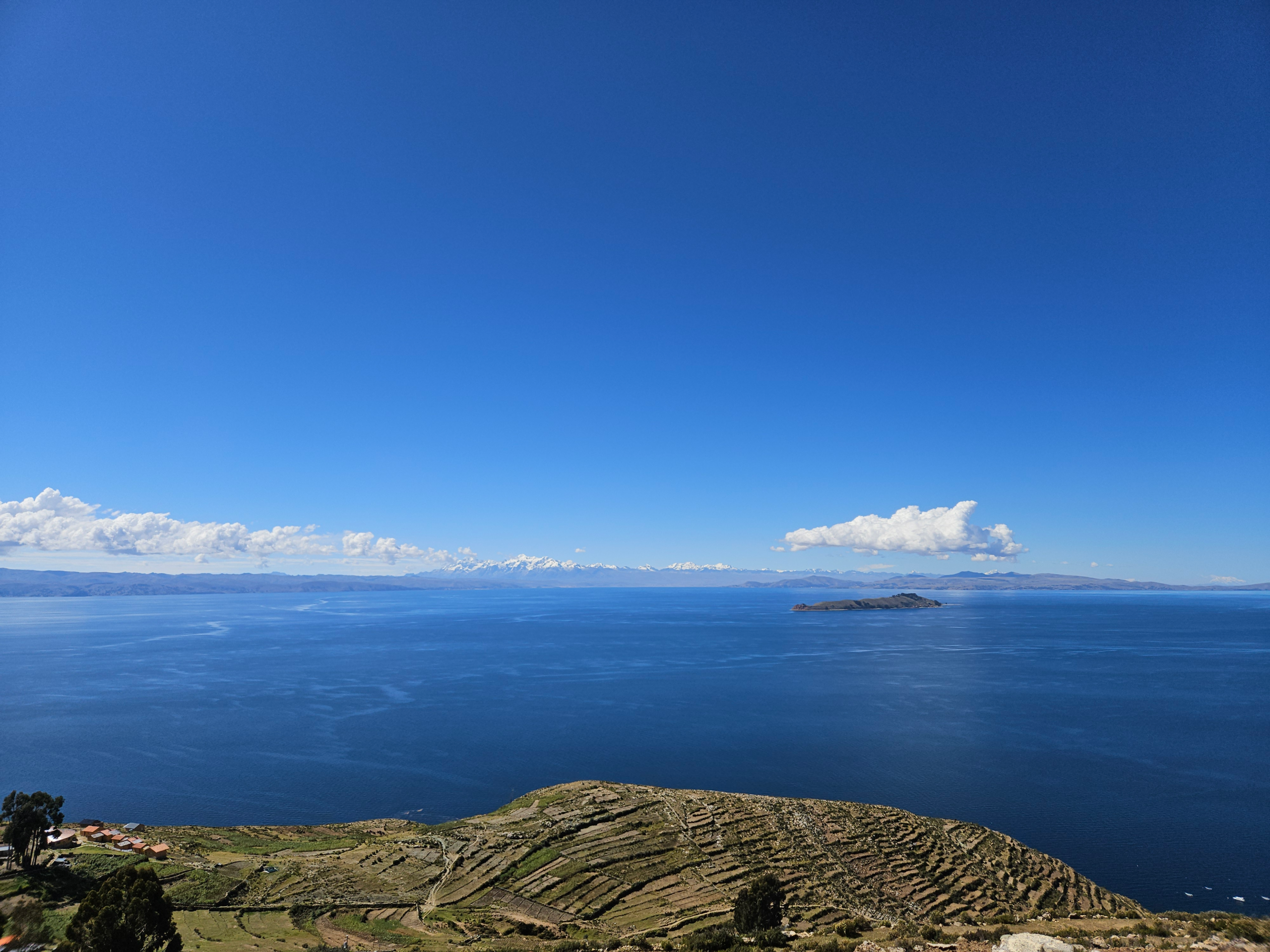
The final stop in our 67-day tour of Bolivia – the birthplace of the sun, and the highest navigable body of water in the world. Bolivia’s navy do their duty out on this lake (can’t get out of it even if you’re landlocked), which seems to be a prime job in a pristine location. We spent 4 days around Lago Titicaca with hardly a single cloud, and just the barest breath of wind. Isla del Sol is a place of cultural importance for both the original indigenous population (for whom this and other islands on the lake are sacred), and following on from them, the Incas, who believed that the sun god was born on the island and built temples accordingly.
Getting to Isla del Sol’s history and views generally requires a stop at Copacabana. While there isn’t a heap to do here, it’s worth staying a night before or after visitng the isla to store your bags. Lago Titicaca is at 3800m, so clambering around Isla del Sol takes a lot of effort even without a big pack – especially when arriving at the south port, where all of the homestays are directly up the ridgeline!
There’s also not a lot to do on the island apart from admiring the views and visiting a handful of historical markers. For us, that added to the allure; having had a number of full-on stops in Bolivia, we were looking forward to relaxing with some sweet views. Just keep in mind that the relaxing probably won’t include swimming – the water is bitterly cold, along with the air, even though the sun is strong!
Keeping it
short and sweet
Getting there
Copacabana to La Paz only takes four hours, and the cheap buses run most of the morning (from next to the Cemetario General). Once in Copacabana, is a ferry in the morning to Isla del Sol, and again around lunch. If you need to get over there in a day it can be a bit tight, you’ll probably need to stay one night.
getting back
Copacabana connects to Puno (in Peru) for onward travel.
Where to stay
We stayed at a random cheap hotel in Copacabana, which was nice enough, and on Isla del Sol there are plenty of local families with homestays to choose from. We stayed at Inti Wasi, which is a huge yes as our room had an incredible view of the sunrise over the Andes, and the family were shy but quite lovely.
where to go
From Copacabana, ferry over to Isla del Sol or Isla de la Luna to see historical places are great views.
Fees
Copacabana and Isla del Sol are both quite expensive for Bolivian standards as they’re popular tourist locations. On the isla, you will need to pay tourist fees as you walk through the different villages on the island. There are 3-4 different payments, and there’s no signposting or information – someone will just run up to you with a ticket book and name a price. Keep the ticket with you always
walkies?
The daywalk around Isla del Sol (it’s quite small) is super lovely and can be done in a day; we would recommend it. You can make it into an ‘overnighter’ (albeit a short one) by staying at Challapampa (north) one night and Yumani (south) the other.
Recovery
Drink or dine on the ridge at Yumani for overpriced food but a wonderful view, or grab a few snacks and enjoy the sunset from the top of the hill. And go for a cold, cold swim if that’s your idea of relaxing…
tell me everything
It was finally time to leave Bolivia, having explored and eaten our fill of the areas around La Paz. Our last stop on the way to Peru would be the sacred Lago Titicaca. For our final morning in the capital, we set a new record for the number of salteñas eaten for breakfast and nearly missed the bus to Copacabana in the process. We’d already travelled along the bus route on the way to Sorata, but had missed the most entertaining (and confusing) part of the bus ride, where the main road is blocked by an arm of Lago Titicaca. We all disembarked onto a crowded passenger boat while the bus floated alongside on a rather dodgy-looking single vehicle ferry. Nevertheless, everyone and everything made it across without incident, and another hour later we arrived at the main body of Titicaca and the town of Copacabana.
Copacabana doesn’t boast a wealth of activities – there’s lots of tourist shops on the road heading down to the waterfront if you want knick-knacks, and there are plenty of coffee shops aimed at gringos. On the waterfront, to the left are a row of shops in shacks which all sell basically the same variety of freshly-caught lake trout. It’s a great place to sample the local cuisine, but it’s definitely a tourist setup, with prices to match. The beach itself isn’t very nice, with a fair bit of rubbish on the beach, inflatable obstacle courses in the shallows and tonnes of speed boats and jet skis making a racket further out in the water. A few streets back from the water is the main plaza and cathedral, which is quite pretty, and off from that stems the local market, with some restaurants that are more reasonably priced, but in general we found the quality of the food here to be below the normal Bolivian standard.
That evening, we did enjoy the walk up Cerro Calvario for the sunset – Lago Titicaca and its surrounds are so spectacular. There are no really large cities nearby so there’s no pollution; the air is clear and the water is a pristine blue and the snow covered Andes make an unreal backdrop. Unfortunately, apparently the lake mineral balance is worsening, and the water levels have dropped nearly a metre over the last few years due to glacial melting… but uhhh, it still looks good… Anywhooooo, the walk up to the summit is worth the effort for the sunrise and for the peaceful feel!

The main thing to do from Copacabana is get out to the lake. Staying a night means you can watch a sunset and sunrise, and leave the majority of your luggage at your hotel. The ferry leaves in the morning and the afternoon, but we’d say get on that morning one. El Isla del Sol is the largest island and main attraction, with two different villages with ports at the north and south ends, several homestays to choose from, and a day’s worth of archaeological sites and viewpoints to visit. El Isla de la Luna is much smaller, but also offers homestays and a historical site if you are really interested in Incan history and a more remote visit.
We only visited the island of the sun, spending two nights in the same homestay in Yumani. Yumani is more populous than Challapampa, and has better views and worse beaches. From Yumani, the homestays are all directly up the ridgeline, which makes for great views from most of the accommodation options but a rough start to your stay. Leave most of your luggage in Copacabana.
Challapampa is much flatter and easier to access, with some really nice beaches. However, to reiterate, we aren’t sure if you’d really like to swim, as the air temperature is always low here, and the water’s maximum average is around 15°C. Even with the strong afternoon sun, it sounds like too much! The ferry can drop you in either village, so if you only have a day to spare it’s possible to get dropped in Challapampa and walk through the central part of the island to Yumani, then take the afternoon ferry back to Copacabana. We’d definitely recommend staying at least a night though – if you’re dropped at Yumani, you can walk to Challapampa and stay the night, or complete the whole loop in a day and sleep back in Yumani (gives you an option to leave your sleeping clothes at your homestay, too). Staying two nights will actually give you an opportunity to relax and enjoy a moment of slow island life.
When you land at either port, you’ll pay a tourist fee (~10bol) for that part of the island – there are at least three, maybe four different ‘areas’ of the island, where the local community charges you to visit their land (even if you are literally only passing through), so keep it in mind if you take the trail around the island. We got charged at Challa, and again in the centre of the island on the main track (when we were walking to the south). Each was 10-20 bol per person.
The day we arrived, we just enjoyed the views from our homestay which looked to the east over the Andes, and took a short stroll up to the mirador to the north of the Yumani ridgeline. South of Yumani is el Templo del Sol, which is one of the main attractions on the island, but we’d read that the entrance fee is not really worth it without a guide, or at least to find some relevant information online, as there’s not any information at the site itself.
We followed the trail around the island the second day. There is a track around the island which forms a loop; we walked anticlockwise, starting from Yumani and following the tracks on the eastern side of the island; they’re a bit random at times, heading alongside farmland and through other villages, but in general it’s easy walking and really picturesque. There’s a few homestays along a beach in a community called Challa, which is just over half way to Challapampa. Grab lunch when you read Challapampa, as there are a handful of basic restaurants on the beachfront opposite the mini-port. The track then continues on to the north towards a series of archeological sites. The first is a rock formation, but as with el Templo del Sol, there’s not a lot of information about the archaeological sites. Unless you’re aware of the significance beforehand, they just look like curious rocks. The final part is an out-and-back to the end of the island, but we were both uh… needing the loo… so we didn’t complete the full length, instead taking the direct way back to the south, towards Yumani.


The central part of the track is well defined and doesn’t pass through any villages, just a few small stores. We think this part of the track is more popular with the people who are only staying a single day. It is also much hillier – expect a lot of ascent and descent, but great views to match. It took until the evening to reach Yumani again, where we got a few snacks from a store, and then a pizza for dinner. A great day!
The ferries leave in the morning back to Copacabana, and you can only get your ticket on the day, so arrive a little early to pick one up. Once you’re back in Copacabana, there are options; the buses onward to Peru leave a few times a day if you just want to go to Puno, but the overnight bus to Arequipa (where we went) or Cusco doesn’t leave until 6pm, so you’ll have some time to kill. Also note that the bus price increases a lot here – you’ll still pay in Bolivianos, but the price will be adjusted to match the Peruvian currency.