Two essential pieces of information for this post: first, that the currency in Bolivia is going through some crazy times, so visiting with foreign currency in hand means that everything is half the price*. Second, that we absolutely adore eating. Here we have cheap cafes, markets and restaurants, and two hungry kiwis who’ve spent the last 2 months cooking for themselves almost exclusively in Argentina and Chile.
Across our next three stops, PotosI, Sucre and Cochabamba, we didn’t do a lot. Although there is a lot to be done across all of the cities, we mostly enjoyed just being present. Visiting markets, wandering streets, appreciating the performances of marching bands that seem to be a constant in Bolivian life, and nibbling on food in plazas or cafes.
Bolivia is full of complex and sometimes uncomfortable history. Potosi and Sucre are two places where the Spanish were particularly present, which has impacted the development of these cities and its people. If you want to understand more about Bolivia, taking walking tours and visiting museums in both of these cities is a must.
* See our general post about Bolivia for a full description on how the currency discrepancy works.
Keep it Short & Sweet:
Potosi: Now a small town with a decreasing population, Potosi once fueled the Spanish presence in Bolivia through the richness of the Cerro Rico silver mine. The town exists with incredible, if disturbing, history. Take a walking tour (Mariam from Koala Tours was excellent) for a detailed, local view. Many tourists take a tour through the mines of Potosi – now bereft of silver, local workers still try to exploit it for less valuable metals. Conditions are still pretty dire and while companies claim to give back to the community and the families of miners, many are questionable. We were not convinced that this is a good way to support, and if you’re interested in doing this kind of exploration we urge you to complete research thoroughly.
Sucre: Bolivia’s capital, nicknamed the White City for the preservation of its historical centre in traditional colonial white, is a beautiful place to park up and take a break from constant travel. There’s not a lot to do here, but the vibes are great, there are plenty of lovely hostels to pick from, and if you have the time, it is an excellent place to take a week or four of Spanish classes. The quality of classes in Sucre are really high, there are plenty of schools to pick from, and the prices are much better than other places in the country. There’s a sizable rich immigrant population, and the large number of gringos has led to considerable gentrification of the centre – take your pick of cafes to complete your homework.
Cochabamba: ‘Cocha’ has a little bit of everything, but is prized as Bolivia’s gastronomic centre. The country’s third-largest city has a large, fun historical centre, with multiple markets to explore, and a beautiful plaza to hang out in. The city sits in a valley of towering peaks, so there are a few high altitude day hikes that you can tackle. Easier to achieve but also enjoyable is the walk up to Cristo de la Concordia, a massive monument to Jesus with incredible views over the city. Cochabamba is a good base to visit Torotoro and the national park there, or the Canyon Tuta Wallpas (though we didn’t make it to the latter, it seems to be growing in tourism but is still off the beaten path!)
Tell me everything:
Potosi
We travelled to PotosI immediately from Uyuni – as we mentioned, Uyuni is very much a tourist town, with people visiting almost exclusively to see the Salar. We read it’s pretty seedy and there isn’t a lot to do other than the Salt Flats – so we were straight on the next bus, along winding roads up to 4000m and PotosI.
PotosI is centred around an old, Spanish centre. The plaza is lovely, with an ancient cathedral and old government buildings surrounding the corners. Because of the historical concentration of wealth in the town, there are plenty of fancy facades to admire, and historical names have resided in many unassuming buildings. The streets are narrow and winding in this mountainous town, which makes exploring a breathless exercise – again, the altitude here can mess you up, so take it easy!
The best SalteNas in Potosi can be found at la SalteNeriael Hornito. Get in early as they are super popular, and do sell out. They are spectacular. Also try the K’alaphurca, a local delicacy of beef & corn soup – what’s special about it is they throw in a fire-hot rock in before serving, which initially keeps the soup splattering all over you, but does ensure that it doesn’t cool down too fast in the freezing air. We ate at Restaurante Tambo SeNorial, which was a lovely traditional restaurant with a cute vibe.
We stayed at Hostal Los Faroles – a really lovely homestay with a delicious breakfast and large, comfortable rooms. It’s really well placed (right next to the market). We took our walking tour from Koala tours, with Mariam – she was so awesome, even though it was just the two of us and her, she was really detailed and when we started asking questions about food she got us a few treats to fuel us on the way. We really recommend asking for her if you are in Potosi!
It’s popular to take a tour of the mines in PotosI – we didn’t think this was a super ethical thing to do, so preferred the Walking Tour only, although Koala Tours has great reviews for the mine tours, you can never be 100% sure where your money is going. If you’re going to take one of these tours, make sure you do your research before, understand the history of the mines and the current working conditions, and make sure you are comfortable with the impact you’re having.
We also visited the National Mint of Bolivia, where the silver collected in the mines was minted into coins during the Spanish rule. The tour was really interesting but in Spanish, so we missed quite a lot of content – there was meant to be an English tour, but it never happened and we just got lumped into a Spanish one. Still – worth it for the history!
Because PotosI is in the mountains, you can imagine that there should be some nice hikes to gorgeous viewpoints. There are, although the ‘niceness’ of the hikes seem debatable, as PotosI is an industrial/mining town outside of the city centre, so the walking is mostly along rough roads. However, on these hikes you have to be super, super careful of dogs, which can be really aggressive in this area. We met one guy who actually got bitten on the way to Laguna Kari Kari, and Emma was exploring PotosI a few blocks to the east of the city centre, and got barked at (almost to the point of snapping) by a dog. It was totally out of nowhere – I was stopped on the roadside, there were other people out, I was checking my phone – and this dog wandered out of the corner of my eye and turned on me – at least it was a busy road, so I could run behind a moving car, but it was so bizarre and pretty scary!.
We spent a couple of days in PotosI – eating treats and exploring, before moving on to Sucre. This trail also takes you down more of the historical trail of the Spanish. The altitude of PotosI makes it a pretty undesirable place to live; it’s cold all year round, and bitterly so in winter. Sucre, sitting at about 2800m, is much more mild, with cool nights but warm days, and consistently pleasant weather. It’s also still close to PotosI (today, only a 4 hour bus ride), so the Spanish had much of their government working here.
Sucre
In Sucre we were planning to finally take a bit of a break – we could stay in affordable hostels, do a mix of home cooking and eating out cheaply at the market – and most importantly, we could finally, officially learn some Spanish. We’d both been learning haphazardly on the road, using reels, podcasts, conversations and Google Translate to pick up words and grammatical structures, but really nothing beats some structured classes. There are plenty of Spanish schools in Sucre – pick based on your preferred style of learning and the Google reviews, although almost all are favourable. We decided to go with Spanish Friends School – they had a good deal including a private room and the private classes for a week, and they were one of the few schools which offered a focus on speaking rather than technicalities and grammar – which is exactly what we were looking for. While initially, Awal wasn’t super interested in the classes (as he’d been leaving the learning and talking mostly to Emma), the price was so reasonable that we decided ‘why not’, and doing a class together (and having shared homework) is always a fun way to bond.
Unfortunately, we also both got food poisoning during this week. Emma was first, and was up all Monday night, and was totally wrecked on Tuesday, so we had to postpone the day’s classes until Saturday. Awal’s reaction was more mild, but lasted longer – he felt ill, though never actually threw up, throughout Wednesday, Thursday and Friday. What’s more – we were cooking for ourselves at the time, so it was our own fault that we got so sick!
Classes were in the morning until 1pm, so we had the afternoons to ourselves – more practice, or feeling unwell, eating, and a little bit of exploring. In total, we spent two weeks in Sucre – a few days before the classes, and a few days after. The Freedom House National Museum is a great place to visit for some history. There aren’t a lot of plaques, so make sure you take a guided tour – they have them in English in the afternoon, though it’s best to check in person when exactly they run. The Mirador de la Recoleta is a great place to visit for stunning views over Sucre. Adjacent to it is the Museo de Arte Indigena – also a really cool museum which focuses on detailing, preserving and revitalising indigenous art forms. There’s a store out the front with beautiful works of art from the artists participating in the revitalisation, particularly of weaving, and you can have a complimentary tea in the garden afterwards. It’s a great spot.
While we stayed at Spanish Friends School for the classes, we preferred staying at Hostel Pachamama – we got a room on the top level of a three storey complex, with a lovely view over some of the city, in a beautiful courtyard filled with blooming flowers. The family living there was incredibly lovely and welcoming, and we were always stoked to hang out with Mango the dog!
Special food mentions in Sucre:
- Wawa Pizza for affordable, delicious pizzas
- Bienmesabe for really flavoursome, healthy Venezuelan-style arepas. Really great for post-food-poisoning stomach.
- The Mercado Central for all the different typical local foods – they aren’t as cheap as if you find a small specialty shop, but the convenience is worth it.
- SalteNeria el Patio – delicious SalteNas and an amazing setting to eat them in! Don’t spill the juice!
- Cafe Mirador San Miguel – have a drink at the top of the bell tower at sunset for a stunning view. The cakes are pretty tasty.
- And of course, SOMOS, our favourite cafe and consistent haunt in Sucre. Get a cinnamon roll! We’re still dreaming about it.
Our favourite experience in Sucre was a totally random one. Our friend Guilherme was also in Sucre learning Spanish. He was immersing himself properly, going to community events wherever he could find them, and kindly invited us along to a painting workshop at the cafe at the Mirador de la Recoleta. We learned to paint with instant coffee, practiced our Spanish and met some other locals – one of whom, Elida, invited us over for coffee the next afternoon. We were a little hesitant – without Guilherme, whose Spanish was already skyrocketing, we were both a little shy and uncertain in casual conversation. But politeness and a desire to connect pushed us through the nerves. We turned up with some treats to share, and ended up having an incredibly lovely afternoon. Elida’s two dogs were hilarious – a silly boxer and a big german shepherd – her son was hanging around as well, and he had a little english, so when our Spanish fell short we could use some Spanglish. We had Colombian coffee and cake and chatted about our trip and life in Bolivia. Eventually, Elida’s granddaughter woke up from a nap, so her daughter brought her down to say hello – and then another of her friends came over, just to visit. It ended up being eclectic, wholesome and such a lovely time – one of those unexpected interactions that makes you love a place so much.
Our two weeks in Sucre came to an end – our Spanish was better, we’d met lots of new people, made some amazing connections, eaten incredible food, and in general had time to recharge and relax from constant movement. Our next stop – Cochabamba, Bolivia’s gastronomic city.
Cochabamba
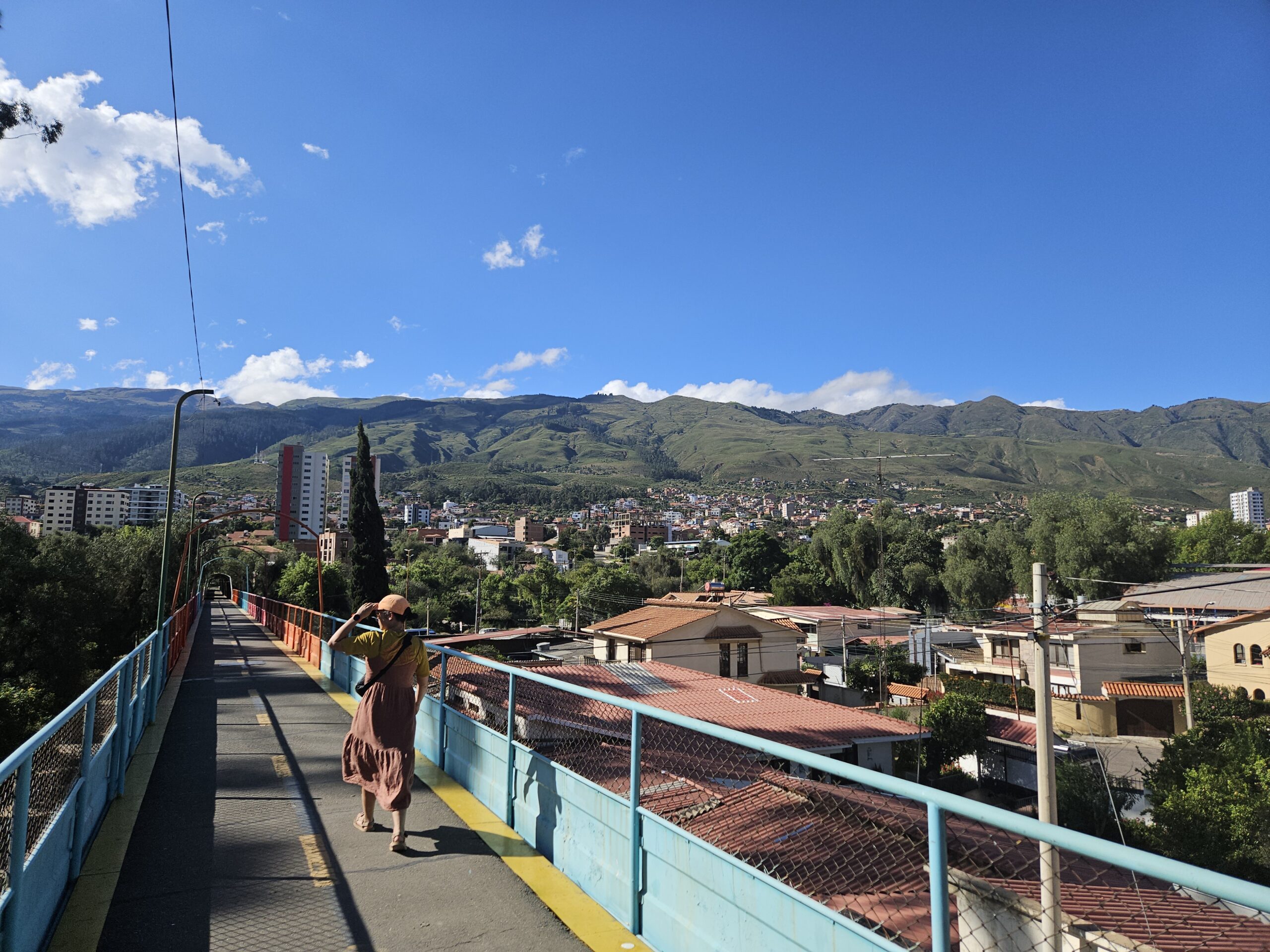
Cochabamba was a bit of an unknown to us, but we luckily picked an awesome hostel called El Pueblito – owned by Sergio. Sergio was a real king – he let us check in at 6am, and gave us sooo many tips on how best to enjoy Cochabamba. Cocha is a newer city – think upmarket restaurants, big boulevards, malls. There’s still a real sense of Bolivia as you know it in the historical centre – tight streets and a chaotic market spread over several blocks. But modernity is prevalent. One of the benefits of this is the bike path, which extends over much of the city, including past the iconic monument of Christ and around Laguna Alalay. Renting a bike or spending a few hours walking (or running!) along the bike lanes is a great way to see some of the city safely and without worrying about traffic.
If you’re looking to do something more active, there are a few day hikes in the hills surrounding Cochabamba. The city sits in a valley at about 2500m, but the surrounding hills rise up to over 5000m. One peak that you can climb is Tunari, to the north west of the city. It can be reached via public transport by taking a trufi to Quillacollo, and then another minibus to the trailhead, going towards Piusilla. We didn’t end up completing the hike, but it sounds like an awesome adventure for a day – even if you don’t make it to the top (with that altitude, watch out!), the adventure of getting there and back is definitely worth it.
There are some other treks in the area too. We’d read about the Circuito de 20 Lagunas, an overnighter to the north of Cochabamba, but getting there required a taxi and was a bit pricey. We’d also read that some of the trails are now mostly mountain roads, rather than tracks in the hills. Instead of exploring this area, we decided to move on to Torotoro – a small town with an increasing popular national park, a couple of hours (and a very windy road) away from Cocha.
When we stayed in Cochabamba, there was actually a real lack of hostel options – there only seemed to be El Pueblito and another in the middle of town. This should give you an indication of the number of backpackers this town sees. However, despite not being a popular tourist centre, as above there is still a bit to do – and it’s a great launching pad to get to Torotoro if you want to explore canyons and caves.
Torotoro exists as a tourist location to service its National Park. In the way that these things go, this means it’s a little bit of a tourist trap, but we do think that the excursions are pretty cool and it’s worth a visit (especially in the current Bolivian economy). The National Park access system is a little strange. It’s impossible to enter without a guide – which makes sense, as the two main tours are canyoning and caving. You must get a group together before booking a tour – splitting the tour cost across your whole group. If someone wants to join after you’ve signed the paper and paid, it’s strictly not allowed. Staying at a popular hostel is your best bet for meeting a group – or finding some people in Cochabamba before you arrive. Of course, people will always be on the lookout, so you can loiter outside once the offices open to try find some random friends.
On top of the tour/guide payment, you must pay entry to the national park – which is 100Bs pp, although the ticket lasts four days, so if you are planning to take multiple tours you won’t have to pay again. The tour guide office and the ticket office are adjacent to each other, and you can get all the information you need there.
As mentioned, the two most popular tours into the National Park are a hike into the El Vergel CaNon, or a caving experience in Umajalanta. We only did the former, as we are both a little claustrophobic, and we’d read a few things mentioning that the quality of the guides is quite varied – not what two first-time, nervy people are keen on. The hike to El Vergel was a half-day activity, but we really enjoyed the wander round the park, and then the descent into the canyon, jumping across rocks, and finally the view across the canyon – it was a really enjoyable morning. The tour cost 250Bs for the group. The caving tour cost 700Bs, but it is more of a full day excursion. For people who are hoping to cram both into a trip – catch an early collectivo from Cochabamba to Torotoro, drop your bags off at your chosen hostel, and head to the offices. Head out on a tour of the canyon that afternoon. That night, meet some people at your hostel who are keen to jump on the caving tour the next day. Book the tour the next morning – spend the day squeezing through little holes and having a real adventure – then return to Torotoro. Either stay another night, if you’ve got time and prefer to relax, or jump on the next collectivo back to Cochabamba, as they run pretty constantly.
From the collectivo stop at Cocha, we walked straight to the bus terminal and booked our bus onwards – our next stop would be La Paz, the highest capital in the world!