
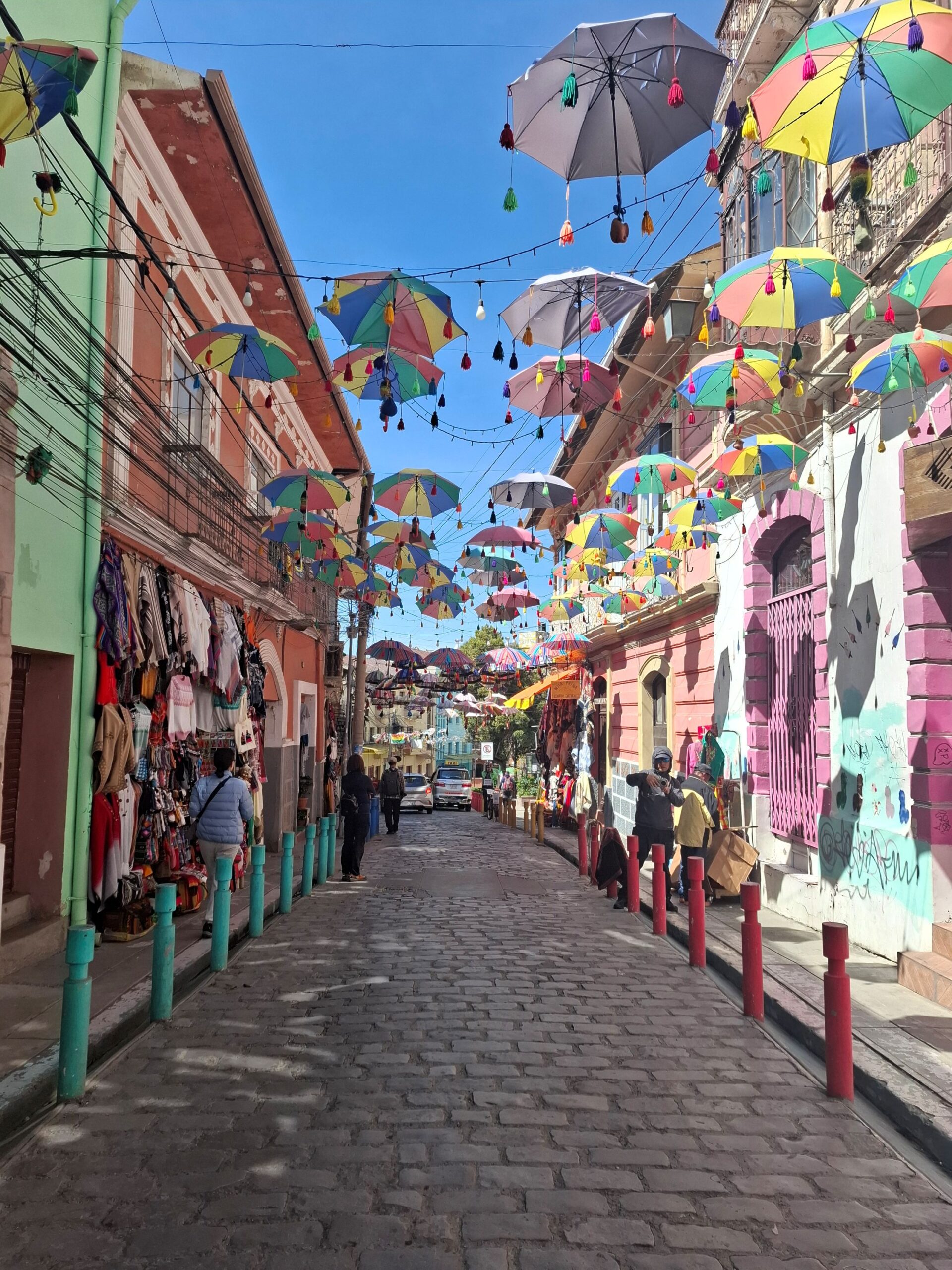
Have you ever wanted to explore a city – yet still wake up amongst great snow capped mountains? Felt the urge to wheeze your way up (and down) every street? Thought to commute by the absolute best method in the world – telēferico? La Paz holds potential for all that and more. Bolivia’s capital – the highest in the world – has something for everyone, from mountain summits to wrestling extravaganzas, street market chaos to fancy cafes and restaurants. We spent over a month jumping to and from La Paz, always revisiting between sights to recover for a day – recovery meaning grabbing coffee, boba and as many saltenas as it’s possible to consume at breakfast.
La Paz is a ridiculous logistical nightmare. It sits in a narrow, rocky valley, hemmed in on one side by the heights of the Andes. La Paz extends massively eastwards and upwards and to the plains where sub-city El Alto lies, and downwards to the south into lower, milder elevations – and more posh suburbs. The demographic changes massively with altitude, which is a curious and somewhat controversial facet of the city’s layout. Whatever biases it represents, the vistas are spectacular – the best way to get an idea of the craziness of the geography is to catch the telēferico (gondola) around the city. As its purpose is to more effectively navigate the steepness of the city, the lines take you to all the good viewpoints. The carriages (what else do you call them?!) are clean, the lines are efficient, it’s smooth and quiet, and for foreign currencies, it’s incredibly affordable.
Being the nation’s de facto capital, La Paz can also be tumultuous – fireworks on the weekend = party, but fireworks in the week = protest. Although we were always safe, there were protests where tear gas was used while we were in the region, and it’s quite common to have the road blockaded between La Paz and Cochabamba.
Bear in mind that we visited Bolivia while the Blue Dollar was particularly strong – so our experiences of eating in more upscale restaurants and cafes was very affordable, and we were more flexible than usual with taking tours.
Keep it Short & Sweet:
- Getting there: if you’re starting your South America journey in Bolivia, this is where you’ll probably land (though, El Alto is technically not La Paz). By bus, La Paz is very well connected – as the financial capital and largest city, it only makes sense!
- Where to stay: Central suburbs, Rosario or Centro Historico, when first arriving. Universo Hostal for a quiet vibe, Wild Rover (not that we stayed there) for an iconic La Paz hostel experience. Stay in Sopocachi if you’re staying longer or looking for a more authentic time, we wholeheartedly recommend Raven Hostal.
- Where to go: Take a walking tour – exploring Mercado Rodriguez, the Witches Market and the Centro Historico is best with a guide. Visit the El Alto market at 16 de Julio, then go experience a Cholita Wreslting match. Bike down Death Road for an adrenaline rush, or use La Paz as a base to explore many other areas of Bolivia.
- Fees: Despite being a bigger city, La Paz has prices at both ends of the range and we found it very comparable to the normal Bolivian prices – upmarket tourist areas and gringo-centric cafes charge a premium, but local restaurants with excellent menu del dias and cheap produce at markets will exist just a few blocks over. If you’re on a budget, just keep hunting.
- Walkies? Yes! Huayna sort-of fits the walkie category – and check out the Condoriri Trek nearby, or the Illampu Circuit & Sajama National Park further afield. Nearer to La Paz but dependent on the wet season is also the El Choro Trek (we didn’t complete this). Closer day walks in the valley of the moon & the dead are accessible by pupblic transport.
- Recovery: Eat salteñas from Los Castores or Salteña Mania. Relax with views on the teleferico (not at rush hour though!)
Tell me everything:
Our arrival into La Paz was ungracious – travelling by overnight bus from Cochabamba only takes 7 hours, so it’s a leave-late-arrive-early situation no matter what departure time you select. We walked 10 minutes in the wee hours of a Sunday morning and arrived at our hostel doors unhassled and sleep-deprived. Thank god for South America’s chill hostels for relaxed check-in times – by 6am we were in a proper bed (and a proper bed – it was at least a super king!) and ready for a decent sleep in. We stayed at Universo Hostel, which isn’t on any websites, but the rooms are so incredible, the staff are ridiculously helpful, the location is central but not hectic, and the beds – well our bed – we still remember as the best bed we’ve slept in (at time of writing – in 9 months). It’s a pretty quiet vibe, there aren’t great common areas, but if you’re looking for something cheap and quiet, it is perfect. We stayed there two separate times before moving suburbs.
We also stayed in the Greenhouse Hostel (good social vibe, but 0% recommend unless you’re looking for a bargain – the rooms were a bit dirty and small, and the guys owning the place were unfriendly, and we’re pretty sure they tried to scam us), and Raven Hostel in Sopocachi. Raven was incredible – really good vibes, super friendly staff, and also really amazing rooms. It’s a bit pricier, but the facilities are extraordinary and it’s in a great location.
Now – why to move? The area around Universo Hostal is central as it gets – Sagarnaga is the key road for tourism, lined with tour operators and international food options. A visit is essential to organise tours in and out of town. One of La Paz’s main tourist attractions, the Witches Market runs parallel – shops filled with stillborn llama fetuses, items for offerings, and charms and potions for whatever you can imagine, next to stores packed with knick-knacks and ponchos. Sagarnaga ends at the Basilica of San Francisco, which marks the start of the Centro Historico – a great place to check out some old churches, refreshed museums, parliamentary locations, and a plaza that’s seen some serious history – we definitely recommend getting an overview with a walking tour. Sagarnaga and the Centro Historico sit on either side of the valley, and La Paz’s main road sits in between them. Combine steep hills, a single key thoroughfare of the city, old architecture and therefore street layout… and we have some serious crowding and traffic issues! There are plenty of cool hostels on both the western (Rosario) and eastern (Centro Historico) sides of the highway, but the chaos and clustering of tourists and locals in the area can be a bit overwhelming at all times of day. Sopocachi is about an hour’s walk to the south, it’s a little lower in altitude, a little warmer, and a lot more relaxed. If you’re planning to stay in La Paz for a while, we think you’ll end up here naturally.
Activities in La Paz
We’ve already alluded to a few key spots to visit – Sagarnaga, el mercado de las brujas, centro historico. We also loved the sprawling Mercado Rodriguez on a weekend – there is so much produce to sample, and it’s a wonderful way to interact with locals. Most of these sites you would explore if you took a walking tour – and the history of La Paz is quite interesting, so we absolutely recommend it. We went with Red Cap Tours, which we found pretty great.
We visited the Museum of Ethnography and Folklore, which was quite cool – although most of the plaques were only in spanish. We never made it to the Coca Museum, but this shouldn’t be something you also miss – as such an essential and unique part of Bolivian culture.
Going further abroad, it really is easiest to use the teleferico. Traffic is heinous, and while taxis are cheap and respond to bargaining, getting stuck for an hour is not great fun. Looping around the teleferico is a chill activity – just don’t go at peak hours as the carts can get really full. If you started the loop at Prado (midway between Sopocachi and central), you’d travel via:
(prado) celeste > (del poeta) blanca > (villarroel) naranja > (central) rojo > (16 de julio) plateada > (faro murillo) morada. There are other lines – the two majors are the verde line taking you down into the gentrified lower suburbs, or the azul line which traverses El Alto.
The teleferico is by far the best way to get to El Alto if you want to explore. Thursdays and Sundays are the best days – for the El Alto market, South America’s largest outdoor market, which sprawls over streets and streets, selling all kinds of goods (and snacks). In the evening on both days, you should also be able to catch Cholita Wrestling – Lucha Libre, but with women in traditional dress. It’s a pretty amusing spectacle, and while it now caters in its majority to tourists, it began as a form of protest for the rights of indigenous women – so its roots are in a pretty special place.
Going wider afield, but still in the city – a half day trip to the Valle de la Luna or a full day to Valle de las Animas can get you off your arse and on your feet for some more crazy rock formations. Buses or collectivos can take you to both locations – just check in with your hostel for the exact location.
Activities Around La Paz
There are two main excursions out of La Paz. A one day adventure cycling down Death Road (though we’ve also heard that staying a night in Coroico and exploring some of the lower elevation is a good way to tack on some more exploring) is one of the most popular activities in La Paz. Named Death Road for the ridiculous number of accidents which occurred along its length, this was previously the main road towards the Amazon, but since a new (safer) highway has opened, it has been closed to general traffic and opened up as an adventurous downhill biking experience. We didn’t actually spend the money on this – but it’s done by basically all travellers, so take from that what you will!
The other is Huayna Potosi – one of the ‘easiest’ and most accessible 6000m+ summits you can do. It’s super popular; there’s a trail of lights heading up the mountain every night to hit the sunrise summit. It’s also very affordable, and a really incredible first-time mountaineering experience. Experienced (or time-poor, though we wouldn’t recommend it) climbers can do this in two days, but the three day option gives you an extra day for acclimatisation, which really makes summiting a lot more likely! We’ll make a separate post dedicated to Huayna – while it’s not quite a Walkie in our traditional sense, it was a pretty special experience!
Other Destinations
In the end, we visited La Paz six separate times – staying between two and four nights depending on how much recovery we needed. We returned after the Condoriri Trek, Huayna Potosi, Sorata & the Illampu Circuit, Sajama and Rurrenabaque. Because a lot of that was recovering from hiking, we didn’t do a lot in La Paz in the days that we were there. But we could always find a good spot to eat a Saltena, or drink a coffee, or somewhere to wander about and watch the people of the city go about their days. It’s a place that holds a special place in our memories, for the people we met and the experiences we had.