
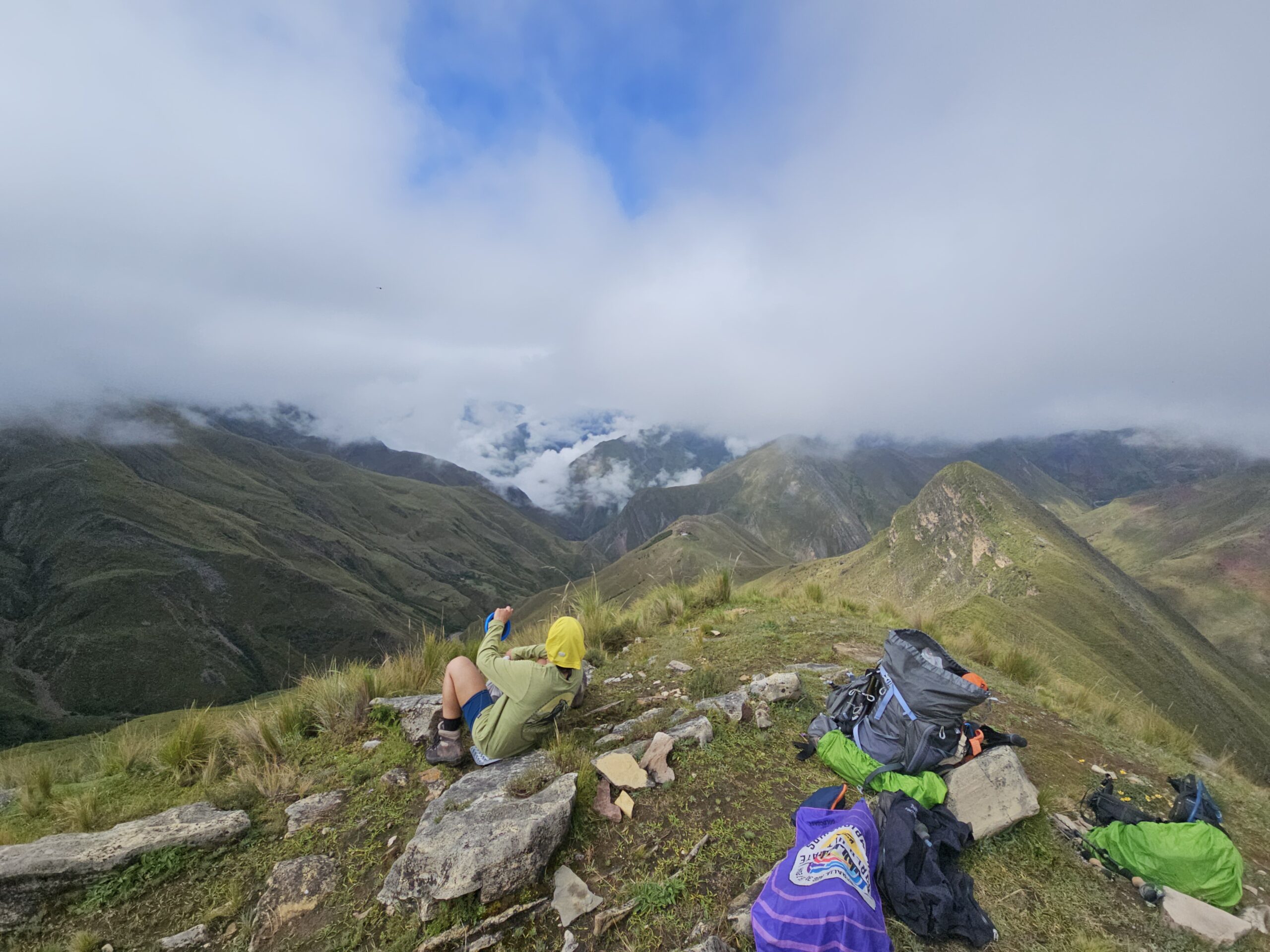
This walk was a lesson in “if you’re willing to wing it a bit, it may just surprise you”. The Tilcara Traverse was a trail we picked based on a hasty search of Wikiloc, after a hot minute of deprivation from trekking (okay it was maybe three weeks… but it felt like months since Patagonia!). We weren’t certain what the hiking would look like in Bolivia, so we were willing to try something out before crossing the border.
We knew that we were going to be walking on paths less trodden by tourists, as all of the recommendations were by locals with local guides (and there were no blog posts at all!), but the kind contributors to Wikiloc had left great detail. The paths would still be well trodden, as the route we were going to take is one used by the people who live in the mountains – the range is dotted with pueblitos, so they need ways to connect to their neighbours, and to the roads for supplies. While the crossing from Tilcara to Calilegua is one of the most direct ways across the range, there are plenty of small trails that veer off to other villages and individual homes along the way. It’s an insight into a totally unique way of life in a really special part of the world; being able to see it first hand is a true privilege.
It was also technically the ‘low’ season for this part of Argentina – being so far north, the summer/winter seasons are more like wet/dry, and of course hiking in the wet season is never ideal!
Click here to take yourself to short and sweet where we summarize this blog post.
Tell me Everything
Because the trail runs between villages, and actually amongst a lot of private land, the trek is a homestay to homestay number. We camped nights 1 & 3, and stayed in beds on night 2 (the weather was rubbish and the price was great… who were we to say no?), but even on the nights we camped, we were on someone’s property and were able to use a flushing (!) toilet and a makeshift shower. The relevant people can be contacted on WhatsApp before; this is most important for night one as the Yuto Pampa is not a village, but is a loose collection of houses – other homestays may be in the area but it’s not clear.
Our original plan was to hike from Tilcara to Molulo, then return by the same route to Tilcara – because the trip back to Tilcara via road is so convoluted, and there are so many buses to catch, we were a little hesitant to waste a day or two travelling back around when we wanted to get to Bolivia (read: had meant to be in Bolivia two weeks prior…). However, the first two days were so spectacular (and we had descended SO much), that we decided to continue in the spirit of ‘just wing it’, and figure out the buses as we went along. And well… read on to see how that went!
Day 1: Tilcara to Yuto Pampa (7-9hrs)
It was not a good start. Our hostel host had organised a taxi pickup at 8am to the trailhead, which is at Casa Colorada, with an agreed price of 35000ARS – which was on the limit of what we were willing to pay for a 50 minute taxi. Halfway through breakfast our host burst in to inform us that the taxi was actually only going to take us to La Garganta del Diablo for 35K (a 30 minute drive, but the day before we’d walked it in one hour!) – and if we wanted to go to Casa Colorada, it was dependent on the ‘condition of the road’ (the weather had been perfect) and was going to cost us 50K! Clocking out at nearly 75NZD just to start our hike was an absolute no-go for us, and we were pretty upset as we felt like our host had been untruthful and it was feeling really, really scammy. We told him we couldn’t catch a taxi for that much and he got pretty mad – in Spanish, so unintelligible to us – and pretty much stormed out of the dining area while saying we had to follow up our end and take the taxi regardless of the cost.
That was a pretty bad vibe – we had been planning to leave our spare kit at the hostel, but we really couldn’t afford to take this taxi, and we didn’t want to leave our stuff in the lap of someone who was potentially going to be looking for revenge. When the taxi arrived, we had a conversation about the mishap – the driver was very amicable, and relaxed about letting the job go. Nevertheless, with a few angry WhatsApp messages waiting on the phone, we shot out the door with all our things and spent the next 30 minutes finding a new hostel to book a room post-hike to secure our bag storage.
In hindsight – we do think it was a genuine mistake by the host, and not that he was in kahoots with the taxi driver – partially because we walked past the taxi stand on the way out and checked their (always inflated) prices. The language barrier is always tough with this kind of thing. We spent the rest of the day to-ing and fro-ing – we were in the right, we were in the wrong. But at the end of the day it was done, and we had an extra 600m elevation and 6.5km to tackle!
From Tilcara village, follow the track to La Garganta del Diablo. Without packs, this takes an hour – with packs and a burning sense of injustice, it also takes an hour! Continue along the road for another hour, climbing steadily, until you reach Casa Colorada. When we passed by, it seemed deserted; we had contacted them on WhatsApp for room prices out of curiosity, but there was no response at all, so we aren’t sure what the deal is there. Either way, it’s the last place you’ll find real shade the rest of the climb – so take a break!
The road then continues on vaguely, but eventually peters out and becomes a normal track. The trail really just is switchbacks, cactus, and views over the valley until you hit the saddle. We were incredibly lucky with a cloudless stunner of a day but with a decent breeze, so we never got too hot. At beginning of the saddle, there’s a small river crossing via rock bridge, and then you enter a flatter valley filled with flowers and lush grass that rises to the maximum point of the hike, before descending somewhat to Yuko Pampa and El Cokena Refugio for the night.
We would love to tell you that the views are gorgeous, that the descent into the pampa is magnificent – and while we’re sure it is, we have no clue personally, as the weather completely clouded over for us before we even reached the high point! We reached the refugio damp from cloud, rushing from impending rain, and feeling a little off from the altitude. It’s an important point to consider – even if you start from Casa Colorada, it’s a massive gain, and you’ll be sleeping quite high. We’d messaged El Cokena’s owner in advance, so they knew that we had our own gear – we guess that was why there was nobody there to greet us, and why the dorm rooms were firmly closed & locked. They don’t seem to live in or near the refugio (again, visibility was terrible, so we could have missed something), but there was a flushing toilet (that is, a toilet designed to flush, with big buckets of water to flush it yourself! No plumbing needed) and shower under a concrete shelter which were open to use. We had a bathroom, running water, and a flat space to pitch up – what else could you want!
With the altitude playing tricks on our appetite, it was cookies with nutella and peanut butter for dinner, and an early night.
Day 2: Yuto Pampa to Molulo (5-7 hrs)
Day 2 also started a little miserable – the cloud hadn’t cleared, so we woke up fairly damp and still without a view. The altitude sickness was still playing on us, and who wants to cook breakfast in misty rain, so it was a quick pack down and off we went. The track continues to descend into a valley – and with this descent, we finally got some clearing clouds and some very cool sights of red clay against green hills, with horses and cattle peppering the hills. Down it goes (and down slips the hiker!) until the river that carves out the valley, and then it’s back up the other side. The track is not entirely clear in this section due to the livestock, so check your GPS regularly. The trail then winds around the tops of this part of the range for some time, which we think would give incredible views on a clear day – maybe even all the way to the yungas forest from certain points. We were lucky enough to see sporadic vistas of our close surroundings – little hamlets would appear randomly at the base of the ridge we were walking; peaks would suddenly loom out from across the valley; sunlight would peek through to warm and dry us off for a few minutes. Not quite knowing what we were walking through really added a layer of mystery to the journey.

The track eventually leads you into the village of Molulo. Here, there is a school and a little hospital, and a collection of houses and two or three homestays to pick from. The popular refugio in the pueblo is Refugio Lo de Lili (according to Wikiloc), but we found an alternative called ‘Mi Esperanza’ – and we couldn’t have been happier with our choice! The area is generally quite muddy, there’s not a lot of grass, plus we’d been walking in rain all day, so we elected to splurge for the night on a dorm bed each – 15K ARS each, about 21NZD. The family we stayed with were so kind and welcoming – plenty of chooks, a couple of friendly dogs and a tiny wee puppy wandered the yard, and along with Soledad, our host, there were four relatives of varying ages. They were all a little shy (except for the youngest – she was so curious, of course!), but we felt very welcome. The accommodation was basic, a mixture of traditional adobe and concrete, but so comfortable. Another ‘flushing’ toilet, too! They gave us some space once we were settled in by heading out (to a market, or a friend’s place – we weren’t sure), so we cleaned up and relaxed in the common area, had a hot drink and finally got set on cooking a hot meal!
By the time our host Sole and her family returned, we were feeling pretty chuffed with our decisions and comfortable and warm inside. We knew a good night’s rest was just around the corner. We also knew that if we followed our original plan of an out-and-back, we were going to spend tomorrow hiking up all the downhill we’d just trekked down… so we decided to continue down the trail to Calilegua. We toyed with the idea of walking all the way out the next day – but Sole laughed at the idea, telling us that while she could walk all the way out in one day if she needed to, there was no way that us gringos would match her mountain pace! Our plan the next day would be to head to the next pueblo of San Lucas, and stay the night at Sole’s recommendation of Refugio Montana Ramona.
Day 3 :Mololu to San Lucas (6-8 hrs)
We woke up early, (just in case we made good time and could make it all the way to the road) to clear skies on day 3. With a quick breakfast we began the trek down to San Lucas. The first part of the day was unbelievable – Molulo sits tight up against the hills facing east, but the refugio itself was tucked in behind some trees, so we couldn’t see the sun rising. However, once we were out of the village and onto the trail – the vistas were insane. We finally got the full picture of where we were walking. The track is reasonably flat to begin with, cut into the side of a hill. An alternative track runs along the ridgeline above you, if you want to start the day with an ascent to see a different view, but there are plenty coming. Our initial views were just across hills of alpine grass, but as we continued we got an idea of where we’d come from – even higher hills – and where we were going. The yungas were covered in cloud, as rainforest is so commonly, but the sights of the yellow-green of the pampas graduating into verdant forest, which quickly disappears into a blanket of cloud as far as the eye can see – well, it’s a pretty humbling perspective.
The track follows the sights – the rough alpine plants were replaced by bushes, then eventually trees began to surround us, and suddenly we were back amongst humid clouds. The altitude is still reasonable at this point, so it’s not hot – yet. The trail is pretty well worn and clear for this section, and the whole section is mostly downhill – but it still requires concentration, as it can get very, very slippery, especially on sections where the red clay is the prominent. There are a few small uphill sections, and throughout the trail enjoy the variety and beauty of the jungle growths.

Coming into San Lucas, the track widened out into a grassy area, with horses popping in and out of the bushes. Refugio Montana Ramona is well signposted and is the first dwelling in the village proper. The Refugio is run by two kindly old sisters; we arrived as they were doing some building work in one of their rooms – the language barrier meant we didn’t quite know what, or why, but we were eventually able to communicate that we just wanted a spot to pitch our tent, and we didn’t need food – it seemed like they weren’t keen to take dorm visitors and didn’t have the time to ‘host’ properly. Once they realised we weren’t going to be a hassle, they were happy for us to hang out. This refugio was so lovely. As it’s the first property in the village, it sits at the top of the hill with a great view of the valley. There’s an outdoor undercover space to hang out in, with a big table to sit and cook and eat. There’s only enough lawn to pitch one or two tents, but as we were the only ones there, it wasn’t a problem. And there was a proper flushing toilet, and a hot shower if you were feeling fancy! There are lots of other homestays in San Lucas, as it’s a reasonably big mountain village, but if you can get a spot at Ramona we would highly recommend it.
We had arrived quite early, so we spent most of the afternoon lounging, drying off our gear, playing with the kittens and the dog (or watching them get uncomfortably close to our tent), and generally enjoying life. Eventually the views turned to rain for the evening, so we were very happy with some shelter from the rain.
Day 4: San Lucas to Pena Alta (2.5-4hrs)
We woke up before sunrise to get on our way. We’d done some research before we left (and hence decided to only go halfway-and-back…), and our hosts confirmed that there was only one bus from the trailhead to Libertador General San Martin, and it came at 4pm. From Libertador General San Martin, we’d have to catch another bus to San Pedro de Jujuy. Then another to San Salvador de Jujuy. Then another to Tilcara. A logistical nightmare! But we were filled with hope – for hitchhiking is common enough in Argentina; all we needed was someone to be driving along the road.
So we were off early, slipping and sliding through the clay tracks of San Lucas, in the morning mist. The track is a little convoluted through the town as there are lots of houses and connecting trails, but once you’re out it’s very straightforward to the road. The track descends quite a lot to start, down into a ravine. The track then follows the wall of the ravine, which is pretty spectacular, occasionally passing over or through connecting waterfalls. The descent is slow along the ravine, until it’s not! But this is the final section – a drop down to the water, across a bridge, and then back up 100m or so until the trailhead. By this time you will be sweaty – the altitude isn’t enough to stop the heat and humidity, and it’s really mosquito central. Have your bug spray ready if you want to stop.
We really hustled through this section, and took a short break at the road before beginning to walk towards San Francisco – the closest town about 7km away – as we thought that getting a hitch might be a bit more likely from there. Luckily, we weren’t walking for 20 minutes before a ute stopped for us – a friendly young Argentinian guy who was happy to take us to San Francisco, although his plan was to head to Termas del Rio Jordan, a famous thermal spot on the river, to pick up his friends who were kayaking down towards there. We thought that sounded ideal – a touristic area was way more likely to have people coming and going, and our chances of snagging a ride would be way better. Our new friend was munching on coca the whole way, and was happy to practice his English with us, so we had a good yarn before he dropped us off at Cañon de los Loros – a little further than he’d meant to go, as he needed to find a local guide to take him down to the termas. There were plenty of people at the Canyon, so we were hopeful, but all of them were tour groups who were just starting their canyoning tours, and then continuing onto San Francisco – so, the wrong way!
We hung around for 20 minutes or so, before Awal suggested continuing walking away from the groups of people. We looked a little out of place, there was a bit of traffic around, and there was a little bit of a mind game behind it, too. Do you think you’re more likely to give someone a hitch if you see them struggling? Looking miserable? Or just hanging out at a touristy area, looking hopeful and bright… Awal thinks the former is a better play, so we got our packs on and started walking (again) along the road. Now, it was really just luck, not strategy, because the first car drove past us while we were walking without a second glance, but the next car – well, it was our saviour! We were picked up by a super kind Argentinian couple from BA, who were on a birthday holiday in the north. We spent the whole drive out of Calilegua yarning – in broken Spanish, with a bit of Google Translate thrown in, but they were so interested, kind, and welcoming to their country. AND in a stroke of complete luck, they were staying in San Salvador – so they offered to drive us all the way there, directly to the bus station. We were totally overwhelmed with kindness – and the pure luck of being able to get back to Tilcara in a single day.

This was one of those hikes that totally, unexpectedly worked in our favour. The views were sporadic but it meant they were so much more memorable. The locals were kind, helpful and welcoming – not just our hosts, but the people that we met on the trails who were going about their day to day. And of course, without the kindness of friends who offered us a ride all the way to San Salvador (4 hour drive), our experience would have been completely different. We finished up in Tilcara with warm hearts and full of gratitude.
Keep it Short and Sweet:
Climate: Wet in summer – December to March ; dry in winter – June to August
Total Distance: 65km
Elevation: 4500m up and 5780m down
Description: A one way; homestay-to-homestay (book in advance via WhatsApp) track that traverses a mountain range. Walk between small mountain villages in alpine grasses into a humid jungle. If it’s not overcast, there should be fantastic views from the alpine hills across the jungle plains.
Track: Non-technical, mostly well trodden, not always well marked.
Facilities: Homestays with dorms or a space to camp; flushing toilets; makeshift shower; running water (filter needed); food available if you book in advance
Getting there: The track can start from the town of Tilcara. The ‘road’ ends at Casa Colorada, so it’s possible to take a taxi if the conditions are good enough (50000ARS) or walk there from the town (extra 2-3 hours).
Day 1: Tilcara -> Yuto Pampa. Steep uphill most of the way, with views of Tilcara and the surroundings in the valley. At the ridge, take in the views then continue to descend into the pampas. The homestay we contacted didn’t have the bunkroom open, I believe because we had our own tent. The toilet and a makeshift shower were accessible. You will have passed through some substantial altitude, so increase your water intake and be sure to eat well. Homestay: El Cokena – Marcela (+54 9 388 477 9368)
Day 2: Yuto Pampa – Molulo. Descend into the valley, cross the river, then ascend the other side. The track can get a little unclear in patches after this, so check your GPS to eventually descend into… and stay at the home of Sole Martines (+54 9 388 462 4023), Refugio Mi Esperanza
Day 3: Molulo -> San Lucas. Continue around the alpine ridges for a few hours before descending into the jungle. It should still be cool enough that there aren’t any mosquitos. Stay at one of the homestays in San Lucas – we camped at Refugio MontaNa Ramona, which is the first refugio in the village, without a booking.
Day 4: San Lucas -> PeNa Alta (trailhead). Descend for about 4 hours, mostly alongside the river, in a ravine, until reaching the road at a point called PeNa Alta. You’ll be watching out for mosquitos by the end of this track – keep your repellent handy.
Getting out: Is complicated! The range you’ve just walked over is not passable, so you have to drive all the way back round (or double your distance – hardcore). The bus only runs once a day from the trailhead to Libertador General San Martin at 4pm – 5pm. From there, take separate buses to San Pedro de Jujuy, onwards to San Salvador de Jujuy, then finally to Tilcara. Factor in an extra night to travel back. Agencies may offer private transport if you’re willing to pay. We were able to get a hitch hike straight back to San Salvador – which was incredibly lucky, as we only had to catch one bus.