
A place of passion, a country of colour. Colombia is terrific. It has incredible biodiversity, an eclectic mix of culture influences, wonderful people, and a tumultuous history – some of which is very, very recent. While it is very stable compared to some years back, and is pretty safe for travellers, Colombia was the place we felt the most guarded over all of South America. Yet it is also the place we felt the most wowed – the two go hand-in-hand, and you can see how the strength and motivation and pride of the people of Colombia has helped them build a gorgeous place to live, plus a substantial tourism industry.
Our travels in Colombia took us in a big loop – from Medellín, to the coffee regions, over to Bogotá, up to do some exploring in San Gil, up to the Caribbean coast to see the coastal jungle,
We missed a few major hotspots, unfortunately, because they fell outside our budget (and, a little bit, our capacity for heat). We didn’t complete La Ciudad Perdida, a very famous hike in the Sierra Nevada coastal mountain range which takes you to an ancient pre-colombian ruin in the middle of the jungle. It must be walked with a guide, and the fees are pretty high as it’s in demand and on indigenous land – absolutely fair, not in our budget. Tayrona National Park was another one we missed. Supposedly, the most beautiful caribbean beaches, including Cabo San Juan, are only accessible by a hike in the jungle (or a pricey trip by boat), but the entry fee is pretty high, which means it’s only really worth it if you camp a few nights in the jungle, which was something we weren’t super keen on. To be honest, we regret it a little, we could’ve prioritised it more monetarily and got over our perpetual fear of heat and mosquitos to enjoy a little Colombian paradise.
However, we will return! Also, because we never went further south than the coffee region – we were told point-blank by a Colombian friend that by not visiting Cali, we had not seen the real Colombia. Cali has a reputation, so we were a little to chicken to see it this time, but after the wonderful experiences we’ve had in other places, we would definitely prioritise it next time – just staying sensible at the same time.
Keeping it
short and sweet
Geography
Colombia isn’t huge, and a large portion of its area is in the Amazon basin, but the geography is super varied. The mountains carve up the mountains into three sections, so you get plenty of regions in the hot tropical zone, but you can quickly climb into cold alpine sections. It makes for a really varied land to explore!
Climate
Colombia has two monsoon seasons!: wet (Apr – Jun & Sep – Nov) & dry (Dec – March & July – August). However, it’s always hot on the coast, and always cool in Bogota & other high altitude places.
cultural quirks
Tipping! We hate tipping! But in Colombia it has become a common occurrence in a certain type of restaurant.
costs
It’s economical, but less so than other places in South America – being close to America and loved by ‘digital nomads’ and rich immigrants, tipping culture is big and the safe areas are often gentrified.
safety
Colombia has a reputation (or, lack-thereof) for safety and you can definitely feel it. Check with your hostel, stay inside at night, and stay in recommended areas in cities.
transport
Colombia’s bus system is not on the same level as other places in South America! We took some really uncomfortable buses (narrow, poor recline, no footrests!), and the scheduling is pretty whack – on short journeys we’d arrive a few hours early (e.g. overnight = no sleep), and a couple of times we got stuck in mad traffic and spent extra hours on already long journeys.
food
Food in Colombia is awesome, and there is SO MUCH CHEESE. It’s got insane fruit variety and plenty of creativity in frying items, so always get on the look out for snacks.
walkies?
Yes, although unfortunately not unguided 🙁 Most of the national parks can be hiked, to some extent, though some are more accessible than others.
hotspots
We started in Medellín, but had done some poor planning and had to return to see the flower festival, so we visited Colombia in a loop! However, we did hit most of the ‘popular’ places on a Colombia itinerary.
medellín
Other than the flower festival in Medellín (highly recommend if you’re there in early August), Medellín has some popular suburbs around town for exploring, and a few walkies in the valley, great nightlife and beautiful streets. The metro is great for getting around.
Guatapé
A day trip from Medellín but worth an overnight stay. A beautiful lakeside town, with a big-ass rock that you can climb – it’s a cool staircase up, and the views from the top are pretty swell.
coffee region
South of Medellín is the coffee region with plenty of cute little towns – we visited Filanda and Salento, where you’ll also be able to see the tallest palm trees in the world in Cocora Valley.
cali
South of the coffee region and Medellín, head to Cali, for the dancing and the nightlife and a different type of Colombian culture.
Bogota
Instead we travelled to Bogotá to experience a little more altitude in the capital, and to visit some museums, including Botero’s wonderful collection, and learn more about the history of Colombia
san gil
Adventure capital San Gil sits at the centre of a few old colonial poblados, offering some gentle hiking, swimming holes, and some high-adrenaline activities over the canyons if you’re looking for it.
Santa Marta
Santa Marta is a display of Carribean influence. We were there during the city’s 500th year anniversary, so there was a mini carnival and lots of partying going on!
minca
Minca was one of our favourite stops in Colombia. This small jungle town has been gringo-fied in the central streets, but is still remote and beautifully natural outside the centre. Walk in the jungle, find waterfalls and watering holes, enjoy the peace!
palomino
Then we took a turn for the worse, as Palomino was meant to be a beachfront paradise but turned out to be be less than what we wanted – the beach was rough and windy and a bit dirty, and we don’t like to party, so we didn’t take advantage of what some would think is the saving grace! Other beaches up the coast may be better.
Cartagena
Our final stop was Cartagena – despite low expectations after being warned it was overtourised and expensive, we adored the vibes here! It’s full of colour and we only had lovely interactions with people (probably partially luck).
Tell me everything
Geography
The variation in the geography is outrageous in Colombia – from the temperate hills in the coffee region, to cold days and colder nights in the heights of Bogotá, over to an absolute sweltering tropical Carribean coast, coated in humid jungle. Not only that, but the Andes splits into two sub-ranges, the Occidental and Oriental, which makes traversing the centre of Colombia by road really windy in a lot of places.
Even without recent events, the border with Venezuela is passable but seems a bit dodgy – we had a mate who crossed over in 2025, and he got absolutely scammed by the border police there (eventually, another border control officer got him sorted, but it sounded like a fairly awful experience). Unfortunately, Venezuela is probably not super high on the ‘to visit’ list for a lot of people at the moment.
The crossing through to Ecuador is doable, and is part of the normal backpacking route, but there is a lot more drug and human trafficking along that border. So take more caution than normal and read a few others’ experiences to know confidently where to go and where not to go.
Out of interest, there is no land border crossing to Panama – it is only possible to do so by boat. The region between Colombia and Panama is dense, mountainous jungle, supposedly full of guerillas and traffickers. Sufficiently dodgy!
climate
Colombia was the first place we’d been in South America where we felt hot… and there were a lot of mosquitos everywhere again. In the valleys, it is pretty consistently warm all year around, so it’ll take some adjusting if you’ve come from somewhere cold – we struggled, and even more so on the Carribbean coast, where it’s consistently around 30degrees. Fair warning that some of those jungle treks which are so popular will be through those same conditions – that was enough to make us second guess it.
We were in Colombia in one of the dry seasons, spending most of July and a little of August there. However, it is tropical so there were still storms every now and again. Our interpretation is that the ‘dry’ and ‘wet’ seasons are a guide, not a rule. Expect rain all year around, though it was never for more than a couple of hours.
Costs in 2025
The Colombian peso operates without cents, working in the thousands (mil in Spanish). When we travelled, 1NZD = 2320 pesos.
In Colombia the menu del día is less common in all areas, especially in more tourist-heavy locations where restaurants focus on local specialties. The ‘normal’ local restaurants need to be sought out, and it seemed like the cheapest menu del día would be around 20K peso pp.
For a really cheap lunch or breakfast, we would usually go to a panadería (bakery), and pick up a few fried snacks, around 10K peso pp.
We probably averaged a sit-down meal once a day to try a local dish, and we cooked for other meals. Even so, on average, we spent more on food in Colombia than anywhere else in South America.
Transport cost was quite variable. We took two 12 hour overnight buses, one cost 50NZD pp, the other 80NZD pp. And the 5 hour bus from Medellín to Salento was 35NZD pp (and a really terrible bus).
Private rooms in basic homestays and hostels cost us between 50k – 100k pesos depending on location; our average was 80k per night.


Cultural Quirks
Unfortunately, the American tipping culture has made its way here. In restaurants it’s expected to tip 10%. In traditional establishments, the menu del día type, it seems less common – it’s predominantly the gentrified and touristed areas have picked up the habit. Honestly, we hate this so much, it’s so annoying to have to add on the extra cash when it could just be built into the cost.
There is a lot more English in Colombia than other places in South America, as there is a lot more tourism from the US, but it’s still important and helpful to know basic Spanish.
Safety
As we said, we felt substantially more uncomfortable in Colombia than we did in the rest of South America. Hostel and hotel staff consistently told us not to walk around after dark, and to take a taxi, even in suburbs that we felt should be quite safe at all times. It is just safer to trust the locals, though on a couple of occasions we did walk home – it just feels like such a waste to catch a cab for 5 minutes.
During the day, it is safe to walk around in most tourist places; of course, keep your wits about you, and if someone tries to mug you, just give them your stuff… it’s not worth any injury and certainly not your life, and that’s why you get your insurance sorted (DO NOT TRAVEL WITHOUT INSURANCE, WALKERS).
We felt the most uncomfortable in Santa Marta – it’s a bigger city, and we were there during the 500th anniversary celebrations, so it was constantly busy. However, there were a huge number of buskers, hustlers, beggars, and generally people peddling stuff in a way that sometimes felt too insistent. One guy followed us down the street seemingly friendly, before try out the baby formula scam – it’s just frustrating!
transport
We travelled by bus, which is, as always, the cheapest way to get around. In saying that, flight prices aren’t as outrageous as in other South American countries – Cartagena and Medellin both have well serviced airports, being popular destinations from the USA, and of course Bogota is the capital, and is also well connected. Some routes are better than others – the best company was Berlinas del Fonce
Although buses are the cheapest way to get around, the pricing model was unpredictable. Different routes with similar distances & times can be wildly variable. We got scammed in person once (double charge babyyyyy – we should’ve known we were getting hussled), but aside from that, we saw the differences in the online Redbus prices, which was quite odd. If you’re tight on the budget, it is probably worth doing a bit more research in advance to find the most economical route, as it may not be what you expect.


Food
Ahhh Colombianos know how to eat! Almost all the snacks are fried, meals are big and hearty, and the fruit is gorg.
- Arepas con queso – corn meal and cheese snack. The best version is the one with the cheese melted in the middle, though I’m not sure on the terminology because sometimes a bit of cheese is just slapped on top.
- Buñuelos are super spherical deep fried balls of the most incredible dough. Get them with arequipe (dulce de leche), chocolate or cheese.
- Snack on empanadas or papa rellenas Colombian-style – deep fried.
- Bandeja Paisa is the trophy winner plate. Fried pork belly, mince, sausage, egg, beans, plantain, avocado, one full as puku.
- Search out Patacones in the hot regions – unripe plantain fried with toppings. So YUMMY.
- Try Ajiaco in Bogota or around the mountains – it’s a warming soup classic to the mountainous regions.
- Chocolate con queso – hot chocolate with a slice of cheese on the side. Gotta do it.
- Coffee in Colombia is actually quite terrible, despite it being a coffee growing country – but of course, all of the good stuff gets exported.
- Try mangosteen and rambutan if you haven’t been to Asia, and of course the mangoes are heavenly.

Walkies!
There are options, but the information is not always clear, it changes often, and generally cannot be done unguided. Almost every national park requires you to be guided, which is actually quite expensive, and you cannot stay overnight in a number of them. It seems to be a combination of factors: there’s no search and rescue, it’s not a popular local activity, and safety as there is still guerilla presence in some parks. And, of course, to increase the monetary output of tourism… Nevertheless, here are a few options that we found, but mostly uncompleted due to the guide situation.
- From Medellin, there are day hiking areas to the north – Parque Arvi has lots of tracks, or try Cerro Quitasol.
- Los Nevados National Park connects up to the trails from Cocora Valley. We completed a 3 day hike unguided, staying in homestays in the mountains, although we did leave early to avoid any awkward questions at the entrance. We’ll put details in a different post, but start from Salento for the easy options, and consider a guided hike from Manizales for a traverse of the range.
- In the areas around San Gil you can complete the Camino Real, an old path which connected several colonial towns. We only walked a day hike, but it can be done over three days, staying in homestays.
- El Cocuy National Park – there was once a 3 day hike through this park and it looks beautiful! Since COVID, you cannot camp in the park, and to complete dayhikes you must take a guide. It ended up well out of budget from the reviews we found. El Cocuy town is the place to book your excursion. Unsure if this compulsory-guide-situation may change, so it’s worth checking if you’re keen to walk.
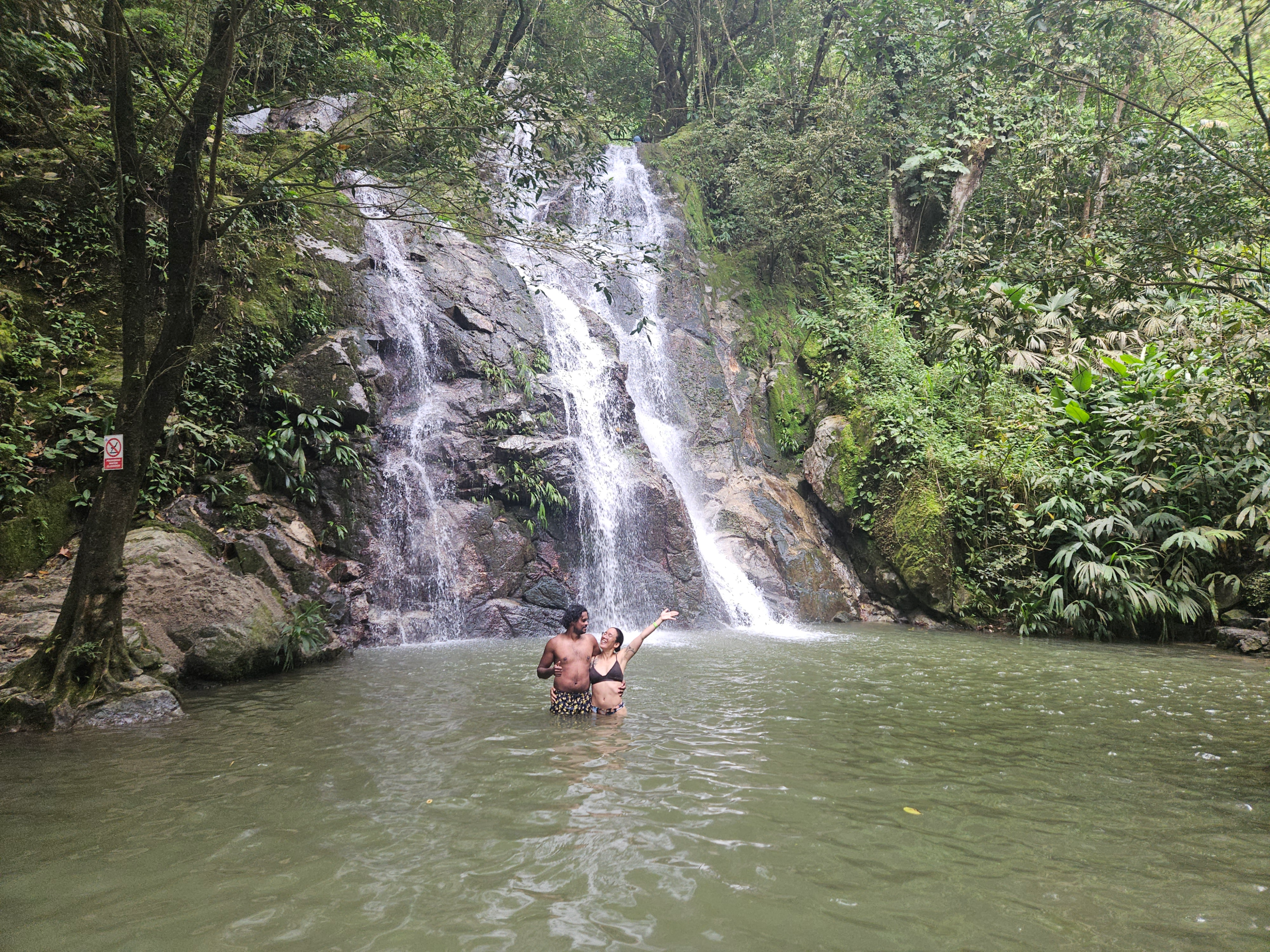
- Minca has plenty of day-walk options. For many of them, you can catch a moto part or all of the way, but the roads are very walkable and you’ll still see wildlife (saw howler monkeys one day, and there’s lots of birdlife, especially in the mornings). Marinka waterfall was one of our faves; there’s lots of spots along the river you can bathe in; or you can overnight at Moncho Hostal to see the sunrise at Cerro Kennedy
- As mentioned, there is hiking in Tayrona, though the fee is a bit extortionate. It’s probably worth it if you’re planning on spending a few days in the jungle, but hiking in 30 degrees with a full pack sounds rough.
- And of course, Colombia’s biggest walking drawcard, the 4 day lost city trek, La Ciudad Perdida.