
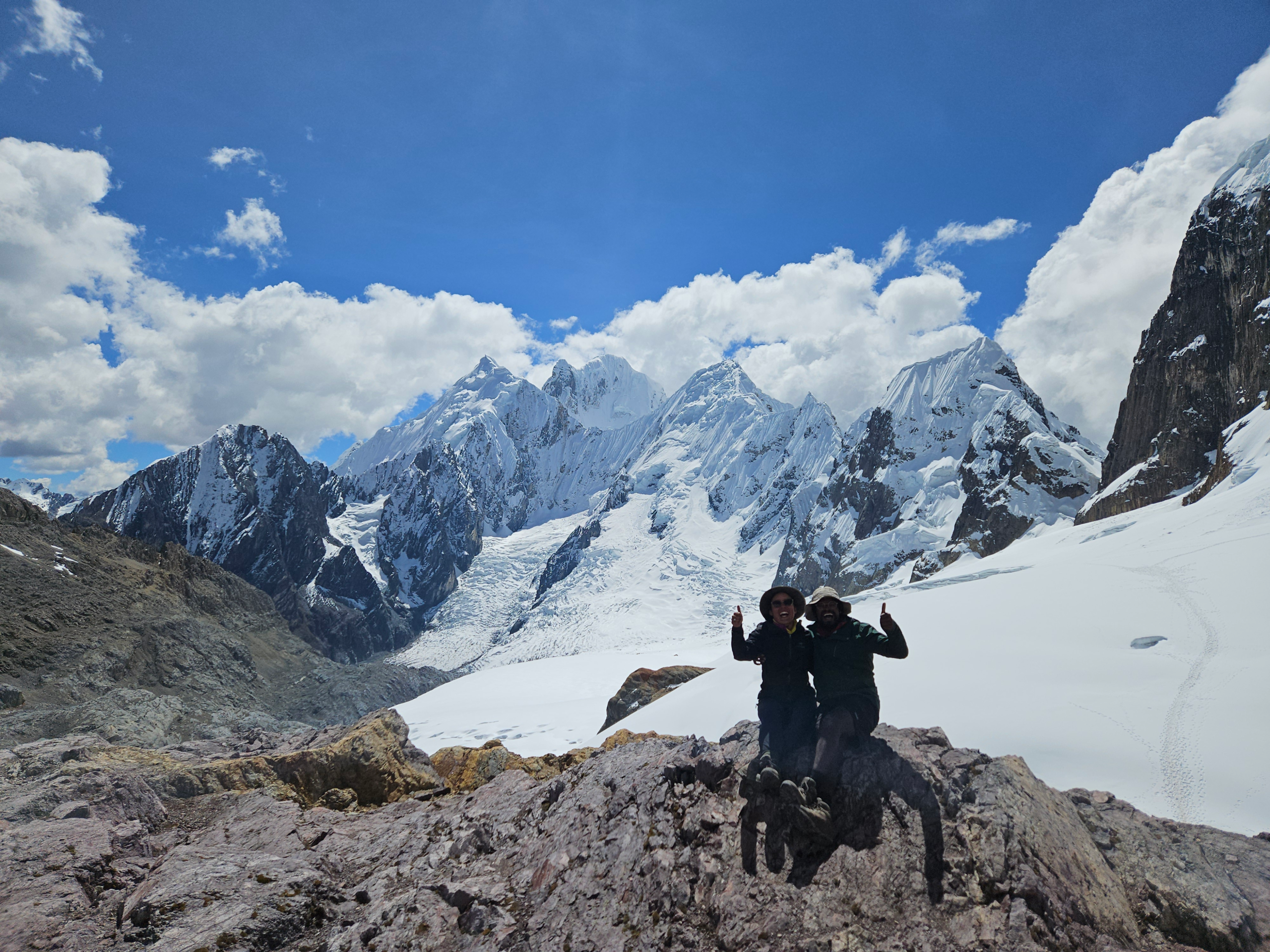
The famous lands of the Incas have captivated travellers of all backgrounds, but it’s a country that’s greater than its history of empire, and that has so much to offer other than Machu Picchu.
Visiting in June 2025 marked our second time in Peru – with Machu Picchu done and dusted in 2022, this time we decided to excuse ourselves from revisiting the ancient ruins (and the massive detour that Cusco presents), instead focusing a neat line up the coast, inland to Huaraz’s mountains, then back to Lima. There were some key things that drew us back to Peru – aside from it being the next obvious step in our journey through South America. The most prominent of those was the Huayhuash, an 8-day trek around a sub-range of the Cordillera Blanca near Huaraz. We’d heard wonderful things about the trek in the Colca Canyon, one of the deepest canyons in the world. And last time, we’d only spent a couple of hours in Lima while transiting buses, so we wanted to experience some of the cuisine that Peru’s capital boasts.
Our first piece of advice to someone visiting Peru is: do not underestimate how long and how mountainous this country is. The first time we visited in 2022, we learned this the hard way. Having entered Peru at its northernmost point from Ecuador by road (the worst border crossing we’ve ever done, to date) and with a mere 2.5 weeks to explore, we picked a few key locations to hit – Huaraz for the mountains, Cusco for Incan history and Arequipa for the canyon and colonial beauty. While that doesn’t feel like an unreasonable amount of time for only three places, starting at the northernmost part of Peru added in two days of bus travel – and choosing to bus from Huaraz to Cusco (via Lima) is also nearly a two day journey. Don’t underestimate Peru!
Even without the allure of trekking to ancient ruins, Peru has some of the most incredible walking in the world. There are uncountable unreal vistas around Huaraz and through the Cordillera Blanca, with an offering of both day walks and multidayers. Although Machu Picchu is the main attraction in Cusco, the walking in the Andes of that region makes a definite mark, too.
Keeping it
short and sweet
Geography
The geography is crazy; don’t underestimate how long this country is and don’t rush. Across the country, Peru has coastal surfing, massive dunes, incredibly high mountains and also dips into the Amazon basin – really a bit of everything, and the activity variety to match.
Climate
Peru only has two seasons: a wet summer (nov – mar) & a dry winter (may – aug)
cultural quirks
You’ll see plenty of trash on the roadside, people throwing it out of bus windows, though it’s not as pervasive. Basic Spanish goes a long way, even though there’s a bit of English spoken.
costs
It’s economical, but not incredibly so – tourism booms in Cusco, but the effect is felt throughout the country and gringo and immigrant prices will catch you all around the country. On a backpacker budget, you won’t be eating out every meal, and you may have to skip some activities. Guided hikes are pricey.
safety
We felt Peru was quite safe where we visited and stayed. However, Lima has a reputation for violence in many suburbs. Keep your street smarts on and always check in with your hostel for their recommendations.
transport
Peru’s bus system is very good, reliable and safe – though the quality of the buses does vary (the 2-1 seat layout is far more comfortable than the 2-2 for overnight rides). Flights between Lima and Cusco are regular, but not cheap.
food
Food in Peru is varied over the regions, and it probably has the most interesting cuisine across all of South America due to more international influence. Fruits are also plentiful and delicious.
walkies?
Hell yes, both around Huaraz and around Cusco. Going without a guide can be tough work with the altitudes involved; get fit, get acclimatised, and be prepared for some serious cold.
hotspots
Machu picchu
While it was easily sorted only a few days in advance in 2022, in 2025 Machu Picchu sounded like a shitshow – be prepared to drop some serious cash and book well in advance.
the amazon
Take a multi-day river adventure to arrive in Iquitos, then explore the Amazon. Or head to Puerto Maldonaldo for a good chance to see Giant Otters.
The capital
Get gastronomical and learn of Peru’s complex history in Lima. Take your pick of museums, ancient sites, or modern parks.
Arequipa
Explore Arequipa to see more of how colonial architecture is preserved in Peru, visit the Colca Canyon, and summit a mountain while you’re at it!
Northern Beaches
Try your hand at surfing or get partying in the northern coast, like Mancora, if you’re visiting in summer.
Huaraz
For some world-class hiking and mountaineering, or just to get some clear air, head to Huaraz
Nazca
If your budget allows, take a plane tour over the Nazca Lines and admire the work of the ancients (aliens?!?!)
Huacachina
Check out Huacachina, near Ica, for an oasis town and some massive sand dunes – a place for a little bit of adventure by sandboarding or hire an ATV.
paracas
While the town-side beaches won’t amaze you, visiting the ‘Poor Man’s Galapagos’, the Ballestas Islands, is a great way to spot some marine wildlife.
Tell me everything
Geography
You could pass months in Peru feeling like you’re moving into different worlds. Hit the beach one day, climb a 6000m peak the next, hop on a slow boat to cruise along to the Amazon basin as the recovery. Hence, prepare for crazy bus rides, both in length and road quality. Pack clothes for all temperatures; it’s cold at altitude but you’ll melt in the rainforest no matter the time of year.
The border from Bolivia was a breeze to cross – Bolivia and Peru have good relations.
We crossed over from Ecuador in 2022, it was unbelievably awful. We can’t offer updated information, but we’re a little traumatised.
We also crossed into Chile in 2022, which was pretty smooth – we got in a collectivo to head there from Tacna, arrived before the gate opened – and there was already a line. So it seemed like it’s best to try to get over there first thing in the morning. Best to check a more recent experience.
It’s also possible to cross into Colombia via boat from Iquitos, at the port of Leticia. It’s a real adventure, and we were considering doing this, but ended up prioritising time elsewhere.
climate
Being coastal and inland, there is definite variety in the ways the ‘dry’ winters (May-Oct) and the ‘wet’ summers (Nov – Apr) present themselves. On the coast, there’s a definite temperature difference across the two seasons, and the dry winters tend to be foggier (hence, ‘Lima the grey’). The temperature is more stable in the mountains, only varying by a few degrees between the two, and in the rainforest, the humidity will knock your socks off.
In addition to all temperatures with the different geographical regions, prepare for all levels of precipitation. Even if you’re travelling in the dry season, there’s always a chance of rain; it’s not a drought season.
Costs in 2025
The Peruvian Sol is one of the most stable currencies in Latin America, despite political instabilities. It is also one of the strongest, making Peru a more expensive country to travel. When we were there, 2 sol = $1 nzd approx
In 2025, a menu del dia cost 8 – 15 sol depending on your region (4NZD – 8NZD); we tended to eat out once or twice a day, and cooked for the other meals. It was economical, but not incredibly so; you might need to shop around for the best price.
Transport is generally good quality and so a little pricey. An 8 hour bus cost about 100 sol per person (50NZD),
Private rooms in basic homestays and hostels cost us between 50 – 100 sol depending on location (e.g. Huaraz vs. Lima)


Cultural Quirks
Rubbish is in a lot of places, and the locals aren’t concerned about it – while it’s not the worst place in the world, you’ll likely see your share of people dumping rubbish in the gutters, out of bus windows, and along highways, especially in the desert, it just blows all about the place. If you’ve been to Bolivia first it won’t be a surprise, but it’s certainly a difference if you’ve come from the West!
Despite being very popular with tourists, there is not a lot of English spoken throughout Peru. It is well worth brushing up on your basic Spanish to get the best experience.
Safety
We felt safe in all of the places we visited in Peru. While there is some instability in the region, tourists are generally not the targets in most cases.
Lima has neighbourhoods that are very unsafe, as do all cities so large, although if you are a tourist there is no reason for you to go out in those directions. The centro historico is more unsafe & scammer heavy than immigrant-dense suburbs like Miraflores and San Isidro.
Cusco has a growing reputation for unsafety, partially due to gang violence and partially due to overtourism creating local dissatisfaction. When we visited in 2022, we felt no insecurity, but check recent updates – protests are regular, and there is increasing discontent which commonly affects holidayers.
transport
The bus network is excellent in Peru. Some people swear by PeruHop as a method to get around, but using an app like busbud or redbus is cheaper and is still easy to use. Booking directly via WhatsApp or in person should be a little cheaper because they avoid commission.
Note that the journey from Lima to Cusco takes around 20 hours by bus; it’s a big journey inland, which is why many people will fly. For the remainder of the main tourist route, there are plenty of stops up and down the coast which should max out your journey at 12 hours.


Food
Food in the south moves more around picanteria culture, which is an experience we love. On the coast, ceviche thrives, and the fusion of Peruvian and Japanese cuisine is super popular. In the mountains, potato, quinoa and maize rule – a carb-heavy diet is what sustains you at altitude. Lima is a place for gastronomical tourism, with two restaurants in the top 10 of the world (mad), but also incredible food in markets and from street vendors.
- Like much of Latin America, the menu del dia is a lunch staple and the easiest way to get an economical meal. Expect a soup and a main, and maybe a dessert or drink.
- Also head to local markets at breakfast and lunch for economical, fresh and local meals. Just be prepared for all the aunties to yell you over to their stores! To be honest, it’s a hilarious and really fun experience.
- Chifa is the Peruvian interpretation of Chinese food – a bit of fusion, and a great way to get a cheap meal or a big fancy one – family style.
- Japanese influence is also seen in Nikkei restaurants, which are particularly popular in Lima. Be prepared to part with a pretty penny, though!
- In the highlands and parts of the south, you will also find picanterias, which we highly recommend; traditional Peruvian food in relaxed, family-friendly locations.
- A few other dishes to try include: chicharron in a sandwich (breakfast), ceviche (as long as you’re by the sea! Don’t eat it if it’s not fresh) and llama or guinea pig (cuy) as part of a meal.

Walkies!
There are two key hiking hotspots in Peru: Huaraz and Lima. Both offer tough, high altitude Walkies bound to leave you awestruck. The following list isn’t exhaustive, but should give you an idea!
Huaraz (full post coming):
- Huayhuash | 5 or 7 nights
- Santa Cruz | 3 nights
- Paso del Zorro | 1 night
- Day hikes | Laguna Churup | Laguna 69 | Laguna Paron |
Cusco:
- Inca Trail | 3 nights | guide compulsory | ending at Machu Picchu
- Salkantay Trek | 4 nights | ending at Machu Picchu
- Lares Trek | 1 night
- Day hikes | Rainbow Mountain
Near Arequipa, try something more relaxing with the Colca Canyon (1-3 nights), or for something less relaxing, summit the nearby Misti mountain (guide required, 1-2 nights)