
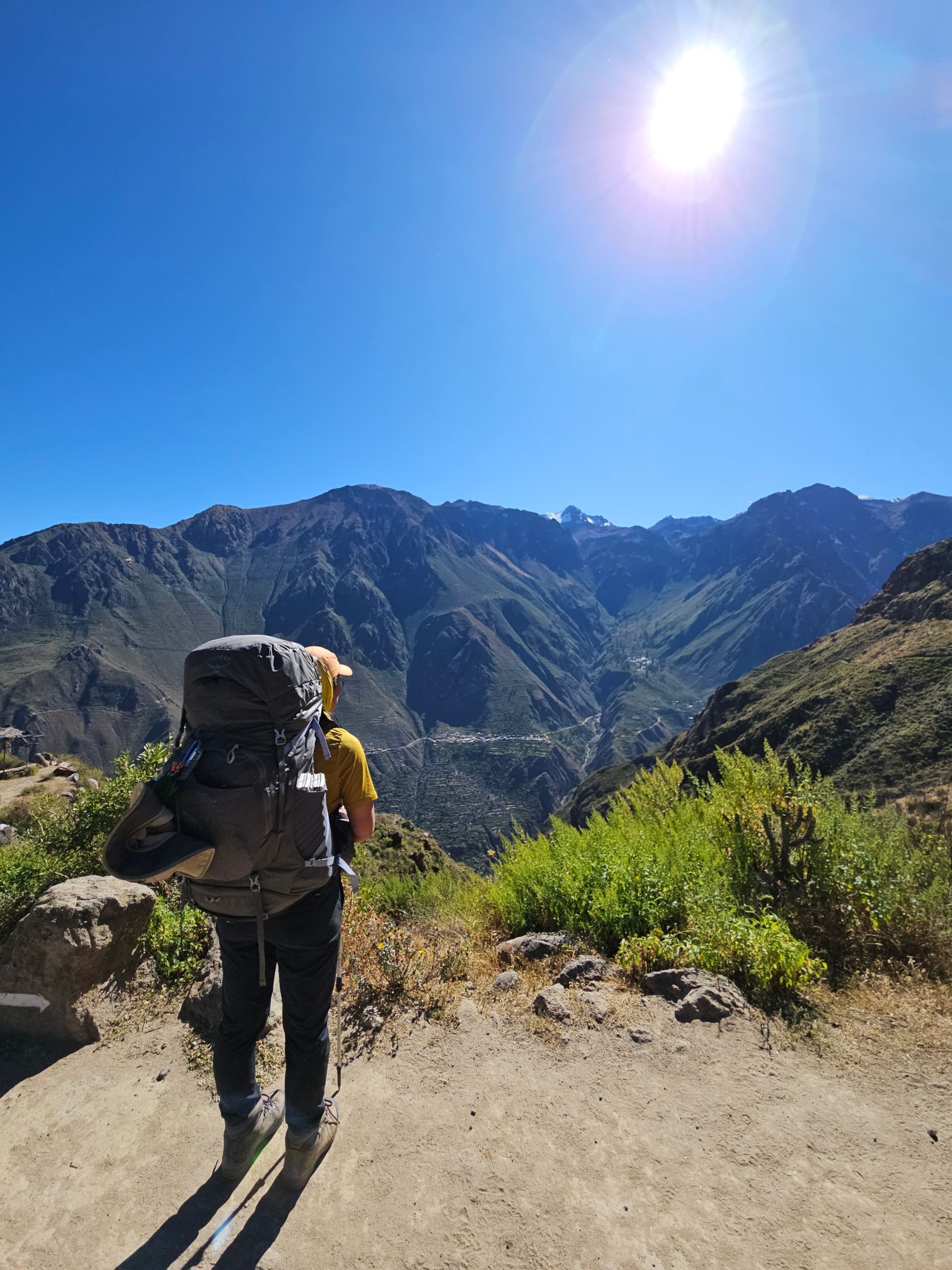
Time to visit South America’s deepest canyon, the second deepest canyon in the world. A trip to the top of the Colca Canyon will lead you to condor viewing, scenes of traditional terraced fields, and gorgeous views down the canyon. If you choose to venture into the canyon, at its base lay small villages which feel like the tropics, and a descent and an ascent which may make you question your life decisions.
The classic Colca Canyon track is a well worn two- or three- day trek – 1000m down on day one to the first village, to get your knees fired up. A stroll on day 2 along the base of the canyon to the main oasis village, with the afternoon spent by the pool. An early start on day 3 to beat the heat, climbing straight up the valley then snagging an early bus back to Arequipa. Combine 1 and 2 to squish the route into two days: while it’s not difficult, you’ll miss an arvo by the pool if you do so.
If you’re looking for more of a challenge, or a route less trodden, extend your route through the valley. There are alternative tracks to other villages which may appeal to someone looking for fewer companions on the walking route.
Many companies in Arequipa offer tours of the Colca Canyon, but if you are taking the classic route there is certainly no need for a guide. Homestays in the villages can be booked online, and they’re all happy to sell lunch, dinner and breakfast if you don’t want to carry your own food. However, with short days and quite touristy prices, we’d recommend bringing your own cooker and kai to save a few bucks.
Keeping it short and sweet
Description
Take a walk through the Colca Canyon over 3 days, enjoying the novelty of walking through a deep canyon and the relaxing air of an oasis. Poles are helpful for the ascent and descent, and it can be done in 2 days if desired. We took the classic route, and would say that while the views are nice, they don’t change a lot and the ‘hike’ is more of a walk. We’d advise taking a more strenuous route if you’re looking for something that resembles hiking, but the classic is worth it if you’re not expecting much and are keen to walk some chilled out days.
Climate
At the valley top it’s cool and breezy, even cold in the mornings as you’re sitting at over 3000m. Once you begin descending, there is very little shade, it tends to be brutally sunny, and it gets uncomfortably humid. Walk early to avoid heatstroke, and take plenty of water.
distance
20km (classic route)
elevation
~1200m from the rim at 3400m to the villages at 2200m on the canyon floor.
costs
Pay to enter the canyon at the rim: it’s 70sol per person, and there are checkpoints throughout the route, so keep your ticket the whole time.
track
GPS is helpful for certainty, but there are plenty of people and signs on the main route through the villages.
facilities
Homestays with complete facilities. No need to bring anything except any extra clothes and toiletries.
notes
It’s easy walking, especially if you’re not carrying a pack, but poles help a lot on the descent.
getting started
Start point is at or a few kilometers away from Cabanaconde. There are public buses to Chivay, where you must switch to a bus to Cabanaconde (they aren’t direct first thing in the morning). Otherwise, it is easy to get a lift with a tour group, who will stop for a little bit of sightseeing before you begin. The tour groups leave at around 4am, and we paid 40sol per person (though some other people only paid 30sol)
Day 1
Get dropped off at el Mirador de San Miguel, where you can take a bathroom break and fill up on (unfiltered) water. Then wander through some property to the trail beginning; there’s a viewpoint and checkpoint where you’ll buy your ticket before beginning the descent. Don’t lose the ticket! The descent begins gently but becomes rough on the knees eventually – it will also get hotter as you descend, due to lowering altitude and the ascent of the sun. At the base of the canyon wall, cross a bridge and walk another flat 30 minutes to the first village of San Juan de Cuccho. Overall, it should be a 3-5 hour day.
Day 2
From San Juan, walk along a mix of pathways and the road. The initial section is quite steep uphill, as the trail works its way across the span of the canyon. We took a path through the small village of Cosñirhua, which wound down eventually into the oasis town of Sangalle. Even going slowly and chatting, this should take 3 hours maximum.
Day 3
Wake up early to avoid the heat! We made it up the canyon wall in just over two hours, and there is a bus back to Arequipa at around 10am – and then not another one until 12pm, so it’s worth trying to back-calculate your pace.
getting out
The buses back to Arequipa are direct, although the bus station is about an hour’s walk away from the town centre, so if you’re cheap (like us) prepare for a bit more ‘hiking’ back to your accommodation.
Tell me everything
The Colca Canyon didn’t blow our socks off, but we suppose if you spend three years waiting to do a hike (having been right there but unable to), your expectations will be high. Don’t get us wrong – it’s a great activity, it’s pretty rewarding walking, and visiting an oasis at the canyon floor is pretty neat. Yet, that’s exactly what it is – walking. Hiking/trekking/tramping, this is not. The path up and down the canyon wall is steep, but it’s well formed, and the days are short, especially the one in the middle. If you’re looking for something a bit more off-trail, we’ll talk a bit more about the alternate route at the end.
Day 1 is equal parts driving and walking. If you’re planning to take the public bus, you’ll need to take the first bus from Arequipa to Chivay, then switch at Chivay to a bus heading to Cabanaconde. We opted to jump in on the transport for one of the guided tours; which was neat, as we got blankets in the van and just passed out the first couple of hours, until the group stopped for breakfast at Chivay. We then took another two stops – one at a viewpoint of the terraces, and another at the mirador de los condors – where we saw plenty of condors from above and below, enjoying their morning flights. While it cost a bit more than catching the bus, we ended up pretty happy with the two stops and the chance to do some sightseeing, and were glad to have our brains completely off for the morning.


We didn’t arrive at el Mirador de San Miguel until about 10am; by which time the sun was making itself known. At the rim of the canyon, this isn’t a problem as the altitude is still considerable – but once you’re descending, the heat becomes apparent. At the mirador there’s a bathroom and a resting place to apply your sunblock. Then get started!
The trail isn’t apparent at first; it winds a bit randomly around the few buildings, then the (actual) Mirador becomes apparent, and someone will sell you a ticket to enter the Colca Canyon. Keep the ticket the whole time you’re in the canyon, and at least until you’re on the bus to Arequipa, as they’ll check it multiple times. Then the descent begins; initially it’s gentle, a dirt path that doesn’t actually take you down much of the supposed 1200m. At some point, however, it changes – it’s never a scramble, the steps are always a reasonable height and the switchbacks are well placed, but you’ll be going down for a couple of hours. There are a few stopping points with a small amount of shade (and a weirdly large number of wasps), so take the breaks when you need them. Eventually, you’ll spy a bridge, and then another ‘eventually’ after that, you’ll arrive at it. Things always look so much closer than they are. However, once at the bridge, there’s a nice spot to cool off, someone selling icy drinks, and another someone will check your ticket.
Once you’ve recovered, head upwards a little, then along a flat track for 10-30 minutes to the village of San Juande Cuccho. We booked in advance, which we would advise. We picked Posada Gloria, which was a little cheaper, and had a lovely garden in the sun which we enjoyed all afternoon and evening.

We had brought our own lunch and dinner, but the homestays sell meals if you don’t have a camp cooking system (or don’t feel like using it). However, our booking at Posada Gloria included breakfast, so that was one less thing to take along.
Day two began by exiting San Juan to the west along a well formed track, then eventually splitting off to the north. The track makes a big U-turn, redirecting up the opposite canyon wall until reaching a road. The trail gets a bit messy here, so we got on the road pretty fast. As you’ll be high up again, you get reasonable views of the valley wall, and it’s all easy walking again now. Enjoy the stroll through the villages of Cosñirhua and Malata, after which you’ll split off back onto a trail, which will descent again into the town of Sangalle and the awaiting oasis. The homestays here are a bit more fancy – most of them are like mini resorts, so we spent the afternoon in and out of the pool. There was a bar too, if you really want to feel on holiday.
Day 3 is an early wake up – as early as you can to avoid the heat. We were walking by about 8, under the assumption that it would take us about 3 hours and we could then catch the 12pm bus. It turned out to be an unlucky choice. It took us just over two hours to get out of the canyon, and a bus left at 10am… so we only just missed it, and were stuck, stinky and waiting for a couple of hours to get back to Arequipa.
Despite the annoying wait time, the buses from Cabanaconde do go directly to Arequipa, with no changeover at Chivay (unsure why it’s different in both directions!), so it was a smooth journey back to town.
Alternative Routes
The ‘classic’ route described above can be done as a two day route if you compress days 1 and 2 together, heading all the way to Sangalle in one day. It’s not hard walking by any means, but if you’re interested in spending time at the oasis, and enjoying the pool, it’s not worth getting there late and rushing away the next morning.
From Sangalle, there is the option to continue on in the canyon. The route from Sangalle continues to Llahuar – back up the hill to the north-east towards Malata, then turn west and follow the road toward the road to Paclla. It seems as though Llahuar is much smaller than the other accommodation options, so most people stay at the lodge. Llahuar is notable for its riverside hot pools – sounds like the perfect way to relax after a day of trekking. From Llahuar, day 3 or 4 out of the canyon will begin by returning to the road, then heading to the south to head back to the canyon wall, then head up to the south east to join back to Cabanaconde.
To add a bit more interest, and to have the novelty of being in a hot pool by a running river, if we were to do it again, we would definitely tack on Llahuar. Because Sangalle was so relaxing, we would still go for the 4 day option to get a good afternoon of relaxing by the pool. If you end up trying it out, let us know how it goes!